Understanding the Basics: What Are Composite Shingles?
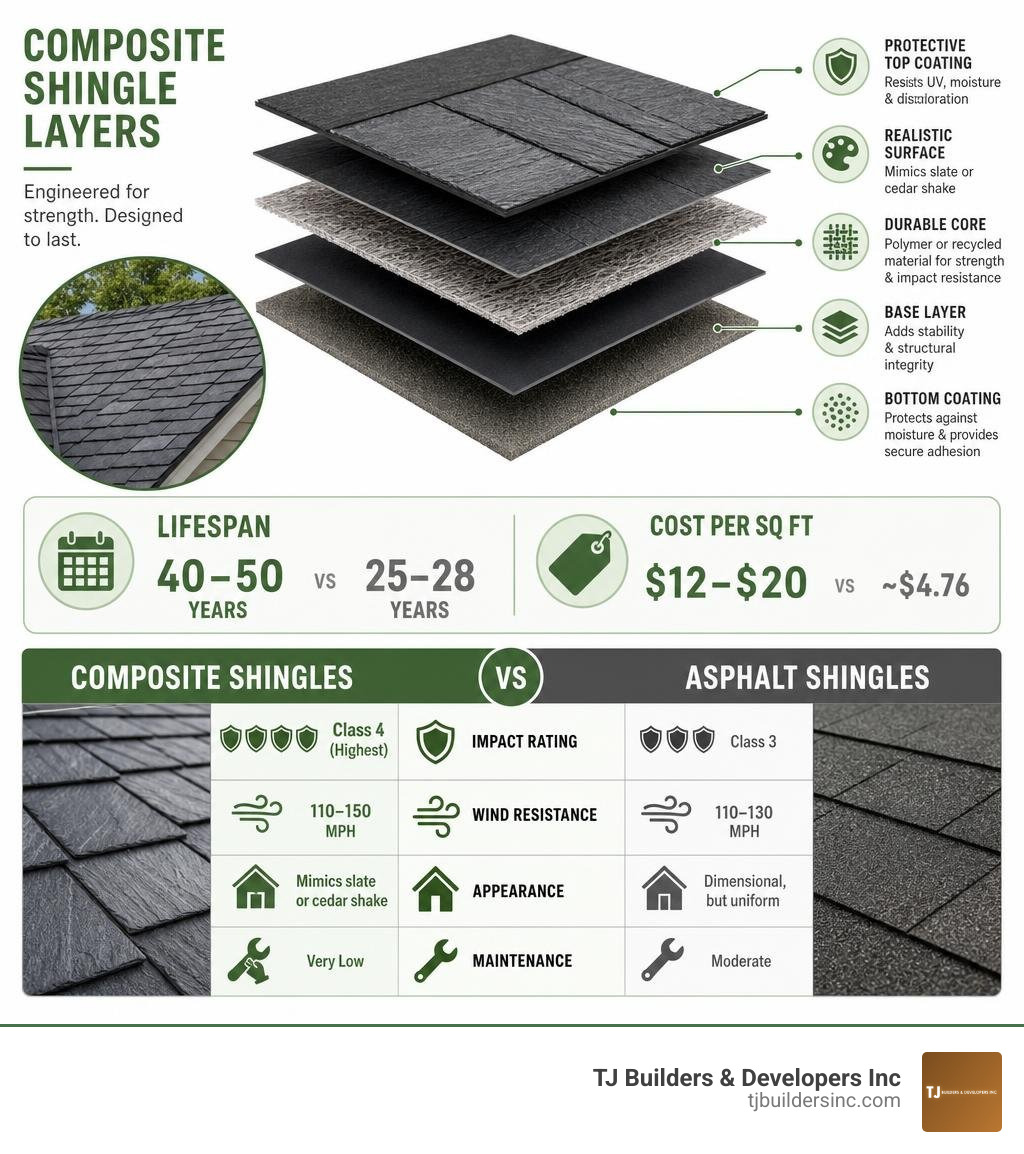
Composite shingle roofs are a premium roofing category made from synthetic polymers or recycled materials, engineered to mimic the look of natural slate or cedar shake — but with far greater durability and far less maintenance.
Here’s a quick comparison to help you decide:
| Feature | Composite Shingles | Architectural Asphalt |
|---|---|---|
| Lifespan | 40–50 years | 25–28 years (realistic) |
| Impact Rating | Class 4 (highest) | Class 3 |
| Wind Resistance | 110–150 mph | 110–130 mph |
| Appearance | Mimics slate or cedar shake | Dimensional, but uniform |
| Maintenance | Very low | Moderate |
Not every aging roof needs replacing right away — but when it does, the material you choose will determine whether you replace it once or twice over the next 50 years. While composite shingles require a higher initial investment, their longer lifespan and lower maintenance make them a highly durable and reliable long-term choice for many homeowners.
I’m Thomas Pruszynski, owner of TJ Builders & Developers Inc, and over the past 20+ years working on exterior home projects across Northern Illinois, I’ve helped many homeowners evaluate whether composite shingle roofs are the right fit for their home, budget, and local climate. In this guide, I’ll walk you through the key differences between composite and traditional roofing options so you can make a confident, informed decision.
Learn more about composite shingle roofs:
- City of Lakewood Roofing Inspections
- Roof Inspection Lakewood Ranch FL
- Roof Inspection Services in Lakewood
In the roofing industry, terminology can sometimes lead to confusion. When people talk about “composition shingles,” they are usually referring to standard asphalt shingles. These are made of a fiberglass mat base, coated with water-resistant asphalt, and topped with ceramic mineral granules. However, when we talk about composite shingles (often called synthetic shingles), we are referring to an entirely different, high-performance class of roofing.
Synthetic composite shingles are advanced, engineered building products molded from actual slate tiles or natural cedar shakes to capture authentic, deep-shadow profiles and natural textures. They are constructed using a proprietary blend of synthetic polymers, fiberglass, and recycled plastics or rubber. This creates a roofing tile that is virtually indistinguishable from the real thing when viewed from the street.
While traditional asphalt options remain highly popular—as discussed in our guide on Don’t Let Your Choices Fall Flat With These Roofing Materials—synthetic composite roofing provides a luxury alternative. It successfully bridges the gap between the premium look of natural materials and the long-lasting performance of modern polymer engineering. To learn more about the makeup of standard asphalt options, you can read GAF’s resource on What Is a Composition Roof.
Evaluating Composite Shingle Roofs vs. Traditional Asphalt
When planning a roof replacement in Northern Illinois, evaluating the differences between standard asphalt and synthetic options is crucial. While traditional asphalt options cover up to 80% of residential roofs in the United States, composite shingles are rapidly gaining ground among homeowners who prioritize longevity and architectural character.
To understand why asphalt continues to be a standard go-to, check out our article on Why Asphalt Shingles Rule the Roost A Comprehensive Guide. However, when comparing the two, several key factors stand out:
- Lifespan: Standard three-tab asphalt shingles typically last 15 to 20 years, and architectural shingles realistically last about 25 to 28 years. In contrast, premium composite shingles are designed to last 40 to 50 years—and in some cases, upwards of 100 years for high-end synthetic slate.
- Curb Appeal: Asphalt shingles provide a clean, uniform look, but they cannot replicate the deep, rustic charm of hand-split wood or the historic elegance of natural stone. Composite shingles are molded from real wood and slate, providing a highly dimensional, high-end aesthetic.
- Durability and Wind Resistance: Standard asphalt shingles typically top out at Class 3 impact resistance and 60 to 70 mph wind ratings. On the other hand, composite shingles carry Class 4 impact ratings (the highest available) and can withstand wind speeds ranging from 110 mph up to 150 mph.
The Long-Term Value of Composite Shingle Roofs
While a synthetic composite roof requires a larger initial investment than a standard architectural asphalt shingle roof, looking at the long-term value paints a very different picture.
If you plan to stay in your home for several decades, a standard roof will likely need to be replaced twice in the time it takes for a single composite roof to reach the end of its lifespan. When you factor in the rising costs of labor, materials, and potential storm repairs over a 50-year cycle, the long-term value of composite roofing becomes highly competitive.
Additionally, because composite shingles carry a Class 4 impact rating, many homeowners in Illinois qualify for lower annual insurance premiums. These savings can help offset the initial investment over time. To better understand standard replacement costs and budget planning, refer to our detailed breakdown on The Cost of a New Crown What to Expect for Your Asphalt Shingle Roof Replacement.
How Composite Shingle Roofs Perform in Northern Illinois Winters
Our local climate in Northern Illinois—including areas like Lakewood, Crystal Lake, Woodstock, and Cary—presents unique challenges for residential roofing. From freezing temperatures and heavy snow loads to severe spring hailstorms, your roof must be built to withstand extreme weather cycles.
Composite shingles perform exceptionally well in cold climates. Because they are engineered from advanced polymers and rubber, they do not absorb moisture. This makes them completely impervious to the freeze-thaw cycles that can cause natural slate to crack or wood shakes to rot, curl, and split.
Furthermore, their impact resistance provides superior protection against hail. If you are concerned about past storm damage on your current roof, you can read The Ultimate Guide to Identifying Hail Damage on Your Shingles.
For homeowners in Lake in the Hills, Algonquin, and Huntley, winter weather can also lead to ice damming. While no shingle material can completely prevent ice dams on its own, pairing a durable composite shingle with proper attic insulation, ventilation, and a high-quality ice and water barrier ensures your home remains dry and protected through the harshest winter months.
Need Help With Your Home?
TJ Builders & Developers handles roofing, siding, gutters, windows, home additions, and fire damage restoration for homes and businesses in Lakewood, Crystal Lake, Schaumburg, and nearby McHenry County towns.
- Free, no-obligation estimates
- Licensed & insured
- 20+ years of local experience
Key Benefits and Engineering of Synthetic Roofing
The secret behind the strength and beauty of synthetic shingles lies in their advanced engineering. Unlike natural wood, which is highly combustible and prone to insect damage, or natural slate, which is heavy and brittle, composite shingles are designed to deliver the best of both worlds.
- Advanced Structural Engineering: Manufacturers design these shingles with a hollow cavity underneath the top surface and a thick butt end. This creates a realistic, high-profile look without adding excessive weight. To prevent the shingles from sagging or deforming under the hot summer sun, the underside features a patented network of longitudinal ribs and lateral rib stiffeners. You can view the engineering details of this design in the patent for the Composite shingle – Tamko Building Products, Inc..
- Class A Fire Resistance: Many synthetic composite shingles carry a Class A fire rating (UL 790), providing critical protection against external fire hazards. This is a massive safety upgrade over natural wood shingles, which can represent a significant fire risk. To compare these features to natural wood options, check out The Natural Choice What to Know About Wood Shingle Roofs.
- Eco-Friendly and Sustainable: Many modern composite shingles incorporate 30% to 60% recycled materials and are 100% recyclable at the end of their lifespan. Additionally, choosing lighter-colored composite shingles can reduce home cooling costs by 10% to 15% in sun-heavy months due to advanced solar-reflective granules.
Professional Installation Standards and Warranties
An investment in a premium composite shingle roof is only as good as the quality of the installation. Because synthetic shingles are a specialized product, they require precise installation techniques to ensure they perform as intended and qualify for maximum warranty protection.
When we install a composite roof, we follow a strict multi-step process:
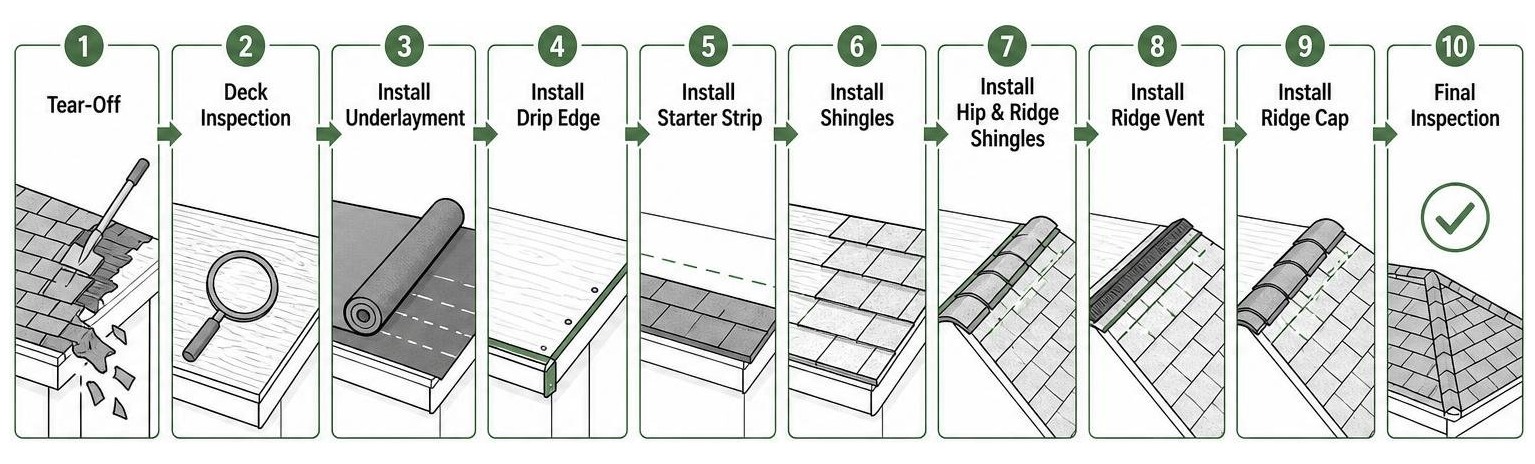
- Complete Tear-Off: We always remove all old roofing layers down to the bare wood deck. Installing new shingles over old ones is a shortcut that can trap moisture and void manufacturer warranties.
- Roof Deck Inspection: We thoroughly inspect the plywood sheathing and supporting rafters for any signs of rot, insect damage, or structural weakness, replacing damaged wood before proceeding.
- High-Performance Underlayment: We lay down a synthetic, water-resistant underlayment. Modern synthetic underlayments resist moisture-related expansion, preventing the “wrinkling” or buckling that can occur with traditional felt paper.
- Precise Fastening: Installers use pneumatic nail guns to secure the shingles, driving fasteners directly into the designated recessed nailing zones to ensure optimal wind resistance.
Working with a certified contractor is also essential for securing strong manufacturer warranties. Premium brands often offer up to 50-year material warranties and non-prorated protection periods when installed by manufacturer-trained teams. For a complete look at our installation standards, read our Roof Installation Replacement Complete Guide.
Need Help With Your Home?
TJ Builders & Developers handles roofing, siding, gutters, windows, home additions, and fire damage restoration for homes and businesses in Lakewood, Crystal Lake, Schaumburg, and nearby McHenry County towns.
- Free, no-obligation estimates
- Licensed & insured
- 20+ years of local experience
Frequently Asked Questions about Synthetic Roofing
Do composite shingles require special roof decking or structural reinforcement?
No. One of the biggest advantages of synthetic composite shingles is that they are relatively lightweight. While natural slate is incredibly heavy and often requires reinforcing the home’s structural framing, composite slate mimics the look of stone without the heavy load. Most standard residential roof decks (typically 1/2-inch or 5/8-inch plywood sheathing) can easily support composite shingles without any extra structural reinforcement.
How do synthetic shingles compare in value to natural slate or cedar?
Synthetic shingles represent an exceptional alternative to natural materials, offering outstanding long-term value. Natural slate is heavy and requires highly specialized, manual hand-nailing (since pneumatic guns can crack the stone), which increases labor demands. Composite options provide the exact same high-end curb appeal and superior durability with a much more straightforward installation process and virtually zero ongoing maintenance.
Can you install composite shingles over an existing asphalt roof?
While some local building codes technically allow for a “layover” (installing a second layer of shingles over an existing roof), we strongly advise against it—especially for premium composite shingles. A layover prevents us from inspecting the underlying wood deck for hidden rot or structural issues. It can also trap heat, warp the new shingles, and void the manufacturer’s lifetime warranty. A complete tear-off is always the professional standard to ensure your investment is protected for decades to come.
Conclusion

Your roof is your home’s first line of defense against the elements. While an aging roof doesn’t always require an immediate replacement, understanding your options prepares you to make the best decision when the time comes.
For homeowners in Lakewood, Crystal Lake, Schaumburg, and the surrounding Northern Illinois suburbs, synthetic composite shingles offer a remarkable combination of historic beauty, Class 4 impact resistance, and a 50-year lifespan. It is a premium investment that delivers long-term property protection and unmatched curb appeal.
At TJ Builders & Developers Inc, we specialize in delivering professional workmanship, durable materials, and reliable exterior home services. Whether you need a detailed roof inspection, a complete replacement, or advice on the best materials for your property, our team is here to help.
For professional assistance with your next project, explore our professional roofing services or reach out to us today to schedule a comprehensive consultation.