Why Identifying Hail Damage on Your Roof Shingles Matters Before It’s Too Late
Hail damage roof shingles is one of the most commonly missed — and most costly — problems a homeowner can overlook. A storm passes in minutes, but the damage it leaves behind can quietly grow into leaks, mold, and structural failure over months.
Here’s a quick look at the key signs of hail damage on roof shingles:
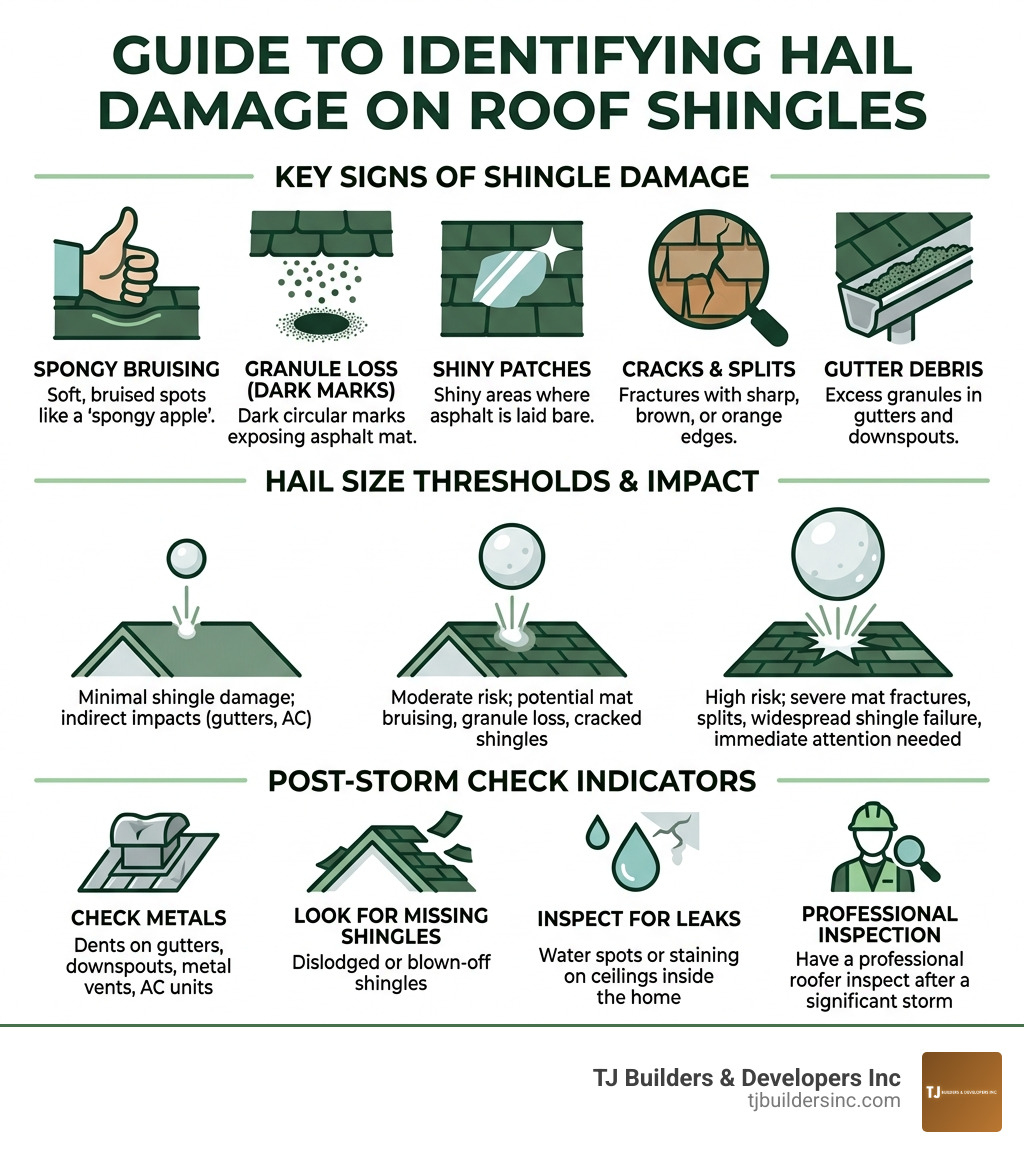
- Soft, bruised spots on asphalt shingles that feel spongy when pressed (like a bruised apple)
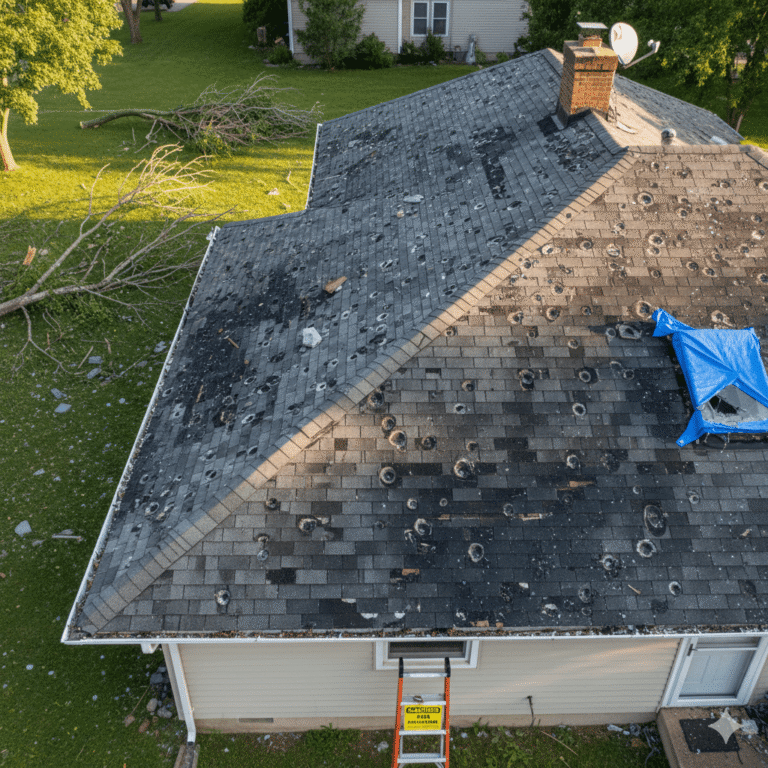
- Dark circular marks where granules have been knocked away, exposing the asphalt mat beneath
- Cracked or split shingles — especially on wood shakes, which show brown or orange splits with sharp edges
- Shiny patches where the asphalt or mat surface has been laid bare
- Granules collecting in gutters and downspouts after a storm
- Dents on gutters, AC units, or metal vents — a strong indirect sign that hail hit hard enough to damage your roof too
These signs aren’t always obvious from the ground. In fact, some of the most serious damage — like mat fractures just beneath the surface — can look completely normal until sun and rain break the shingle down from the inside out.
Hail events are more frequent than most homeowners realize. In 2025 alone, NOAA documented 5,340 hail events across the U.S. — and the annual property damage from hail routinely exceeds $1 billion. In Northern Illinois, where severe spring and summer storms are common, the risk is very real.
I’m Thomas Pruszynski from TJ Builders & Developers Inc, and over more than 20 years of hands-on exterior restoration work, I’ve inspected and repaired hundreds of roofs affected by hail damage roof shingles across the Northern Illinois area. This guide will walk you through exactly what to look for, how serious it might be, and what to do next.
What Does Hail Damage Look Like on Different Roof Shingles?
Identifying hail damage roof shingles requires a keen eye because different materials react to ice impacts in very different ways. While a metal roof might show a clear dent, an asphalt shingle might hide its wounds deep within its fibers. Understanding these nuances is the first step in protecting your home in Lakewood, Crystal Lake, or Schaumburg.
Identifying hail damage roof shingles on Asphalt
Asphalt shingles are the most common roofing material in the Chicago suburbs, covering about 75% of homes. Unfortunately, they are also highly susceptible to hail. When a hailstone strikes an asphalt shingle, it creates a “bruise.”
To find these, we look for:
- Granule Loss: This is the most visible sign. The impact knocks away the protective ceramic granules, exposing the black asphalt or the shiny fiberglass mat beneath.
- Mat Fracture: This is the “hidden” danger. If you press on a dark spot and it feels soft—like a bruised apple—the internal mat has likely fractured. This is considered functional damage because it compromises the shingle’s ability to shed water.
- Circular Patterns: Hail hits are usually random and circular. Unlike manufacturing defects, which often follow a straight line or a repeating pattern, hail strikes wherever the wind carries them.
For more details on your material choices, check out our guide on Asphalt Shingle Options. Proper Roofing starts with knowing how your specific shingles handle the elements. You can also find more visual cues in this How To Identify and Fix Roof Hail Damage resource.
Wood, Tile, and Metal Indicators
If your home features specialty materials, the signs of hail damage roof shingles change significantly:
- Wood Shingles/Shakes: Hail often causes wood to split. Look for brown or orange splits with sharp, clean edges. Older splits from natural weathering will look grey and rounded, whereas new hail damage exposes the “fresh” wood underneath.
- Clay and Concrete Tiles: These materials are tough but brittle. Heavy hail can cause star-shaped cracks, chips, or even shatter the tiles completely. If you see pieces of tile in your yard after a storm, your roof has likely been compromised.
- Metal Roofing: Metal rarely leaks from hail unless the stones are massive, but it is prone to cosmetic dings. We check for “burnish marks”—areas where the hail has scrubbed away the oxidation or “patina” on the metal, leaving a shiny spot.
For a deeper dive into these material-specific signs, you can refer to this guide on Roof Hail Damage: Signs, Repair Costs & Insurance Claims.
Need Help With Your Home?
TJ Builders & Developers handles roofing, siding, gutters, windows, home additions, and fire damage restoration for homes and businesses in Lakewood, Crystal Lake, Schaumburg, and nearby McHenry County towns.
- Free, no-obligation estimates
- Licensed & insured
- 20+ years of local experience
Distinguishing Real Hail Damage from Common Mimics
A challenge homeowners face is telling the difference between a storm-damaged roof and one that is simply showing its age. Insurance adjusters are trained to spot these differences, and we want you to be prepared too.
Manufacturing Defects vs. Storm Impact
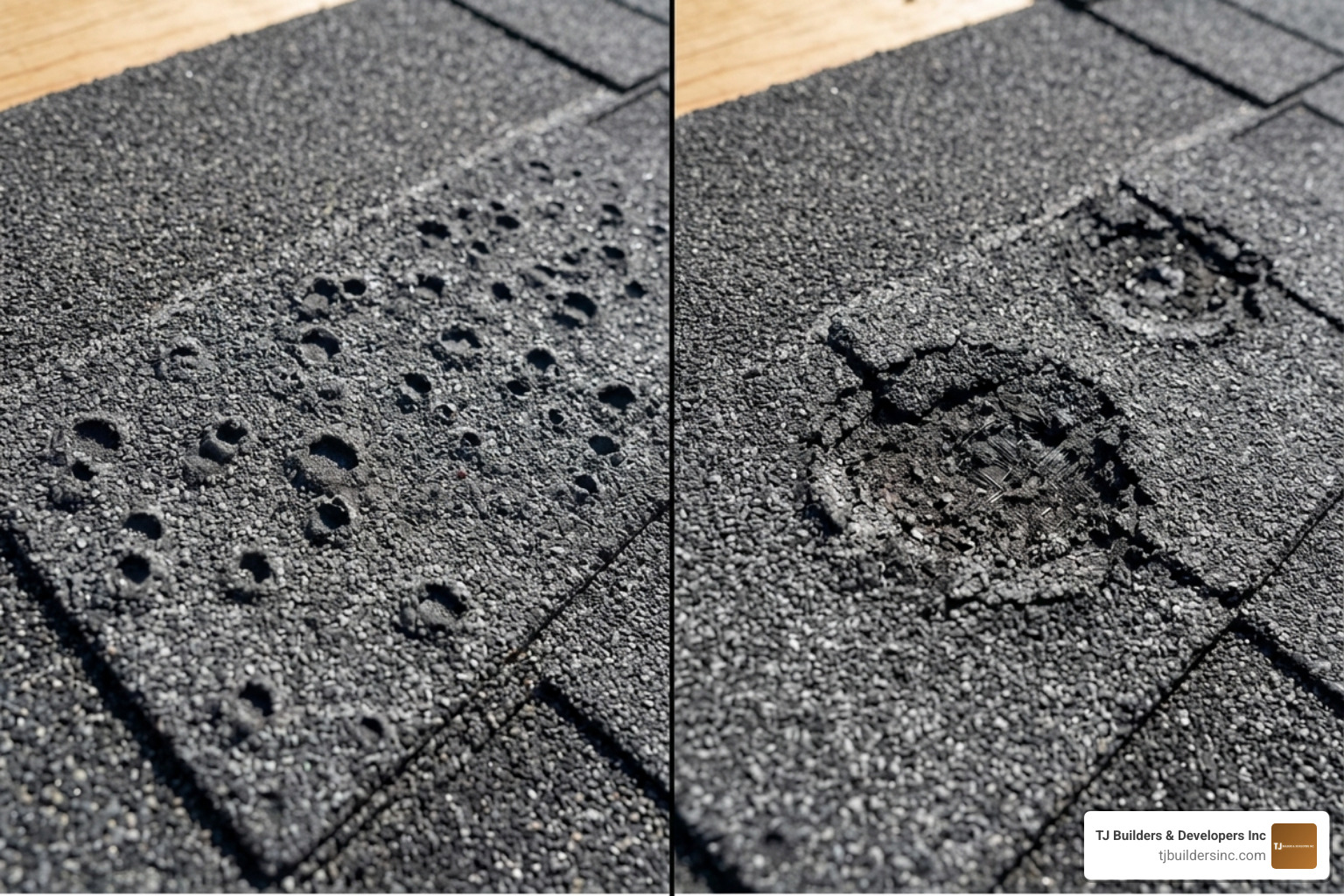
Not every dark spot is a hail hit. Common mimics include:
- Blistering: This happens when moisture is trapped in the shingle during manufacturing. As the sun heats the roof, the moisture expands and “pops,” leaving a small crater. Unlike hail, blisters are usually small (less than 1/4 inch) and don’t have the “bruised” soft feel.
- Installation Scuffing: Sometimes, workers walking on a hot roof can scuff away granules. These marks are usually elongated or shaped like a footprint, rather than the random circular hits caused by hail.
If you suspect your roof has more than just age-related wear, read more about storm hail damage restoration.
Wear, Tear, and Aging Factors
As shingles age, they naturally lose granules and become brittle. This is called UV degradation. You might see:
- Thermal Cracking: Long, horizontal cracks across the shingles caused by the roof expanding and contracting.
- Algae Growth: Dark streaks that look like stains but are actually biological growth.
- Granule Shedding: A uniform loss of granules over the entire roof, rather than localized “hits.”
When a roof reaches this stage, Reroofing or a standard Roof Repair might be necessary regardless of storm activity.
| Feature | Hail Damage | Wear and Tear / Aging |
|---|---|---|
| Pattern | Random, circular hits | Repeating patterns or uniform over the whole roof |
| Feel | Soft and “bruised” | Hard, brittle, or “crunchy” |
| Collateral | Dented gutters, AC units, etc. | No damage to metal surfaces |
| Exposure | Fresh asphalt (black) or mat | Oxidized asphalt (grey/weathered) |
Assessing the Severity of hail damage roof shingles
The severity of hail damage roof shingles depends on three things: the size of the hail, the speed of the wind, and the age of your roof. In 2024, Texas led the nation in hail incidents, but Northern Illinois remains a high-risk zone.
Hail Size and Impact Force
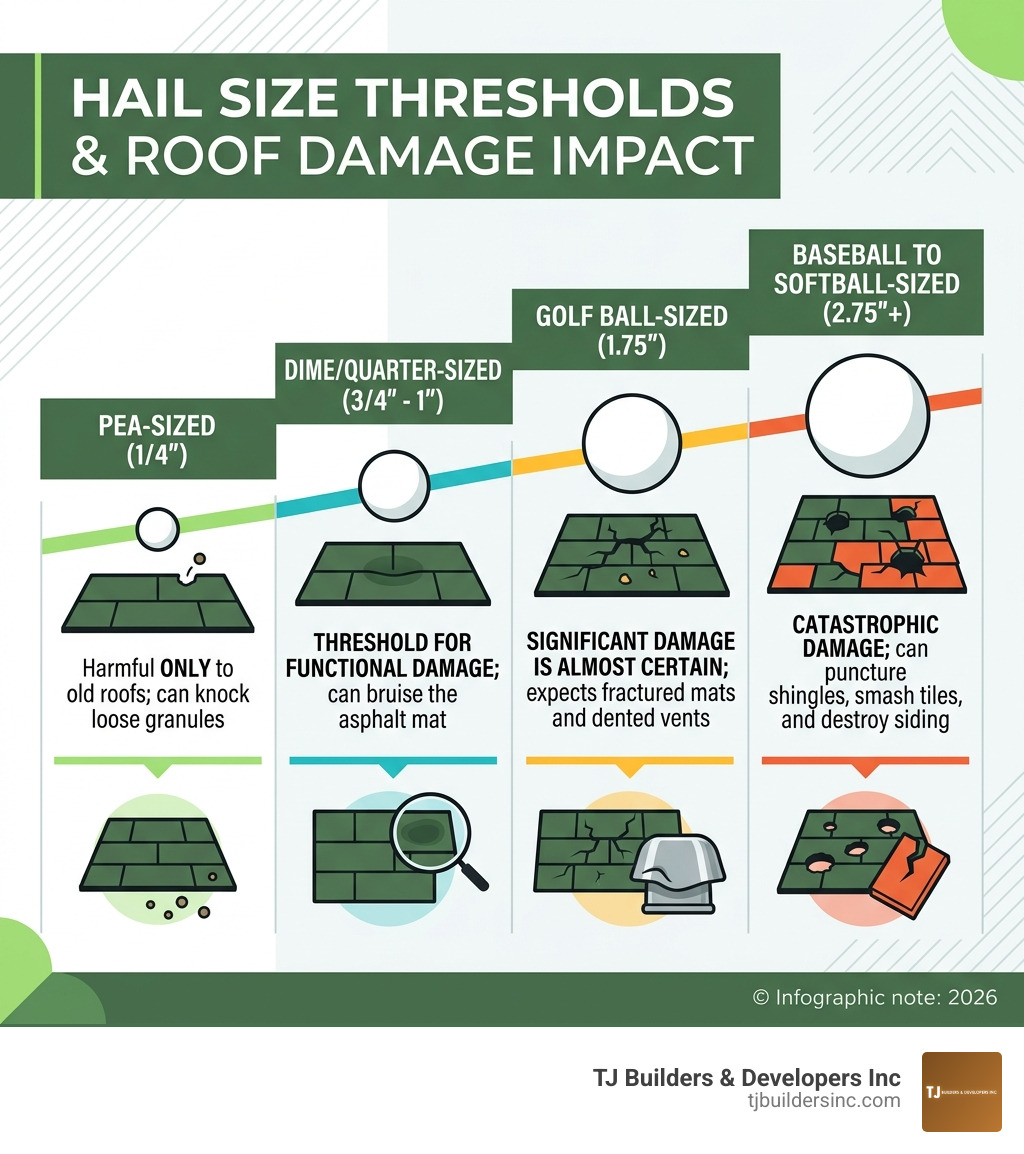
How big does hail need to be to cause damage?
- Pea-sized (1/4″): Usually harmless, though it can knock away loose granules on an old roof.
- Dime/Quarter-sized (3/4″ to 1″): This is the threshold for “functional damage.” At this size, hail can bruise the mat of an asphalt shingle.
- Golf Ball-sized (1.75″): Significant damage is almost certain. Expect fractured mats and dented metal vents.
- Baseball to Softball-sized (2.75″+): Catastrophic damage. This size can puncture shingles, smash tiles, and destroy siding.
For a professional perspective on how size influences claims, see this Hail Damage to Your Roof: Identification, Repair & Insurance Claims post.
Collateral Damage Indicators
You don’t always have to get on a ladder to know your roof is in trouble. We look for “hail witnesses” around the property:
- Gutters and Downspouts: Look for small dings in the metal. If the gutters are dented, the shingles likely took a beating too.
- AC Condenser Units: The thin metal fins on your AC unit are very sensitive. If they are flattened or dented, it’s a sure sign of heavy hail.
- Window Screens and Siding: Check for holes in screens or “half-moon” cracks in vinyl siding.
Documenting these signs is a key part of our process at Hail Damage Roof assessments.
The Professional Inspection and Insurance Claim Process
If you’ve spotted the signs above, the next step is a formal evaluation. Professional inspections are much safer and more thorough than a DIY check.
Documenting hail damage roof shingles for Insurance
When we arrive at a home in Elk Grove Village or Rolling Meadows, we use the “Test Square” method. We mark off a 10×10 foot area on each slope of the roof and count the number of legitimate hail hits.
- Industry Standard: Generally, 8 to 10 hits per square on at least three slopes is the benchmark many insurance companies use to justify a full replacement.
- Photo Evidence: We take high-resolution photos of the hits, the collateral damage, and the overall roof condition.
For more on what a full replacement looks like, see our Roof Installation Replacement Complete Guide. Detailed roofing services documentation is the backbone of a successful claim.
Navigating Homeowners Insurance
Most homeowners insurance policies cover hail damage as an “Act of God,” meaning your individual rates shouldn’t go up just because you filed a claim. However, there are nuances:
- RCV vs. ACV: Replacement Cost Value (RCV) covers the full cost to replace the roof today. Actual Cash Value (ACV) only pays what the roof was worth at its current age (depreciated value).
- Deductibles: Many policies now have a specific “wind and hail” deductible, which might be a flat fee or a percentage of your home’s value (usually 1-2%).
- Timelines: Most policies require you to file a claim within 6 to 12 months of the storm.
You can find more advice on costs and claims in this How To: Identify and Fix Roof Hail Damage After a Storm article.
Need Help With Your Home?
TJ Builders & Developers handles roofing, siding, gutters, windows, home additions, and fire damage restoration for homes and businesses in Lakewood, Crystal Lake, Schaumburg, and nearby McHenry County towns.
- Free, no-obligation estimates
- Licensed & insured
- 20+ years of local experience
Repair vs. Replacement: Making the Right Decision
Is it better to patch a few shingles or replace the whole thing? This is an economic and structural decision.
Cost Thresholds and Replacement Criteria
The “10% rule” is a good guide: if more than 10% of your shingles are damaged, the cost of individual repairs often approaches the cost of a full replacement.
- Shingle Manipulation: To replace one damaged shingle, you have to lift and disturb the three or four shingles around it. On an older roof, this “manipulation” can cause more damage than the hail did!
- Building Codes: In many parts of Illinois, if more than 25% of a roof is damaged, local building codes require a full replacement to ensure the entire system meets modern safety standards.
We help homeowners weigh these options during our Roof Repair consultations.
Future-Proofing with Class 4 Impact Resistance
If you are replacing your roof, consider upgrading to Class 4 impact-resistant shingles.
- UL 2218 Testing: These shingles are tested by dropping a 2-inch steel ball onto them twice in the same spot without the shingle cracking.
- Insurance Discounts: Many insurers offer significant premium discounts (sometimes up to 20%) for homes with Class 4 roofs because they are much less likely to result in a claim after the next storm.
- Materials: These are often made with polymer-modified asphalt (SBS), which acts like rubber to “bounce” the hail off.
Explore these high-performance Asphalt Shingle Options to see if they are right for your home.
Frequently Asked Questions about Hail Damage
What size hail causes functional damage to shingles?
Typically, hail that is 1 inch in diameter (about the size of a quarter) is large enough to cause functional damage—meaning a fracture in the mat that will eventually lead to a leak. However, if winds are high (over 60 mph), even 3/4-inch hail can cause significant bruising.
How long do I have to file a hail damage claim?
In Illinois, most insurance policies allow for 12 months from the date of the storm to file a claim. However, it is always best to check your specific policy. Waiting too long can lead to a denial, as the insurance company may argue the damage is due to “neglect” or “wear and tear” rather than a specific storm event.
Can hail damage a roof without visible signs?
Yes. This is known as “latent damage.” A hailstone can bruise the internal fiberglass mat without knocking off enough granules for you to see the mark from the ground. Over the next year, the sun’s UV rays will attack that weakened spot, eventually causing the shingle to crack and leak. This is why a professional inspection after a storm is so important.
Conclusion
At TJ Builders & Developers Inc, we know that your home is your biggest investment. Whether you are in Lakewood, Barrington, or Bartlett, a hailstorm doesn’t have to be a disaster. By identifying hail damage roof shingles early, you can prevent minor bruises from turning into major interior water damage.
Our team is dedicated to providing reliable workmanship and professional restoration services throughout the Chicago suburbs. We don’t just look for “spots”—we look for the patterns and structural integrity issues that matter to your home’s long-term safety.
If you suspect your roof has been hit by a recent storm, don’t wait for the first leak to appear. Schedule a professional hail damage roof evaluation with us today, and let’s make sure your roof is ready for whatever the Illinois weather throws at it next.