Why an Asphalt Shingle Roof Remains North America’s Top Choice
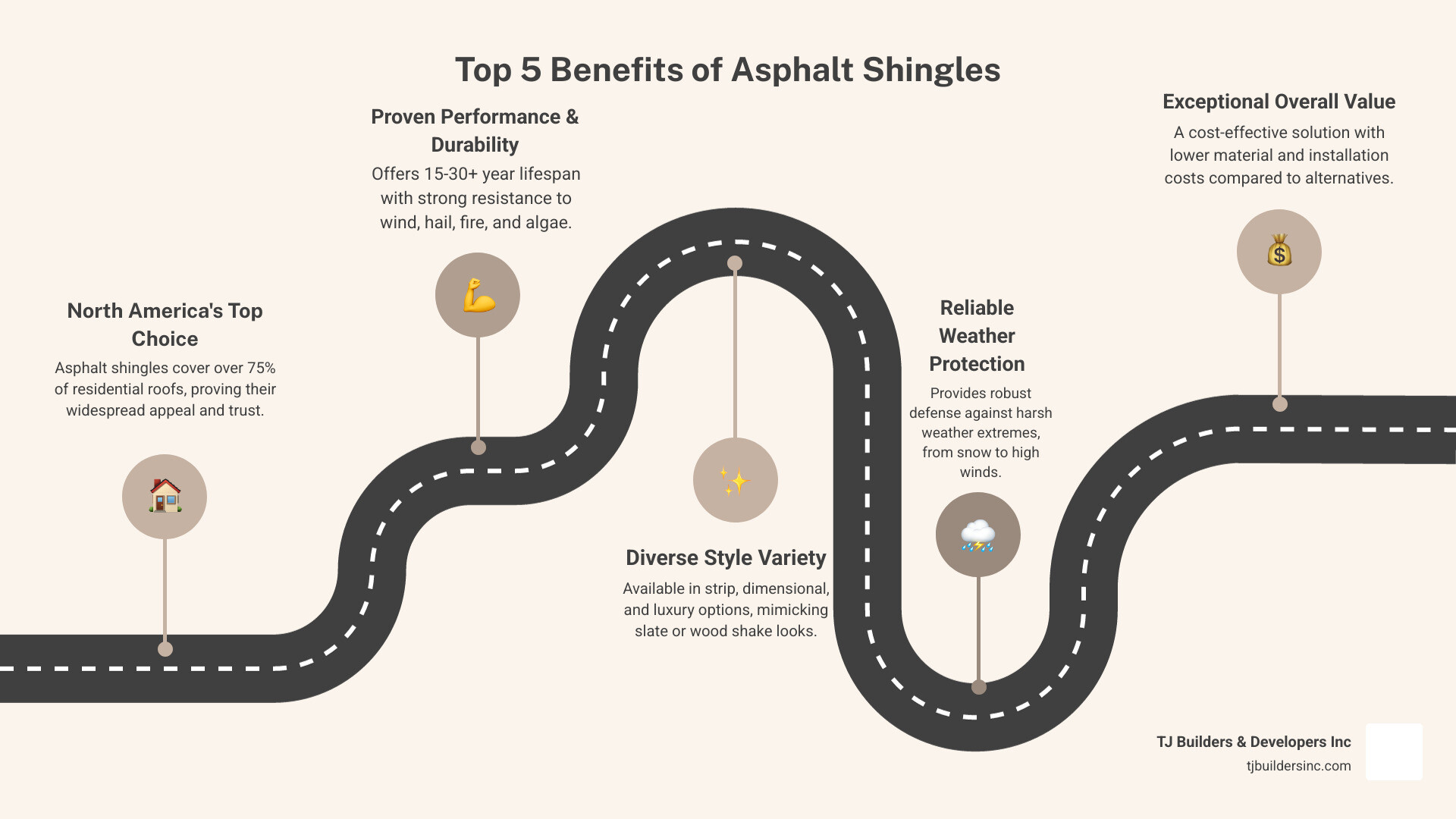
An asphalt shingle roof is the most popular roofing material in North America, accounting for more than 75% of all residential roofs. Here’s what makes them the go-to choice for homeowners:
- Affordability – Less expensive than wood, slate, tile, or metal
- Durability – Lasts 15-30+ years depending on type
- Variety – Available in strip, dimensional, and luxury styles
- Weather Protection – Wind, hail, fire, and algae resistance
- Easy Installation – Lower labor costs than alternatives
- Curb Appeal – Mimics natural slate or wood shake appearance
If you’re a homeowner in Northern Illinois dealing with a worn, leaky, or aging roof, understanding asphalt shingles is essential. These composite roofing materials combine a fiberglass mat base with waterproofing asphalt and protective mineral granules. They offer exceptional value, proven performance, and a wide range of colors and styles to match any home’s architecture.
Asphalt shingles have evolved significantly since their introduction in 1903. Early versions used organic felt, but modern fiberglass-based shingles—developed in the 1980s—are lighter, stronger, and longer-lasting. Today’s dimensional and luxury shingles can replicate the look of premium materials like cedar shake or natural slate, all while providing superior fire ratings and storm resistance.
Whether you’re replacing an old roof or building new, asphalt shingles deliver reliable protection against the weather extremes common in our region—from heavy snow and ice dams in winter to summer hail storms and high winds. They’re also recyclable, with over 1.1 million tons of reclaimed asphalt shingles (RAS) reused annually in road construction.
I’m Thomas Pruszynski, and at TJ Builders & Developers, we’ve been installing and repairing asphalt shingle roofs for over 20 years across Lakewood, Crystal Lake, Schaumburg, and surrounding Northern Illinois communities. Our team treats every asphalt shingle roof project with the care and precision needed to ensure long-term protection and performance for your home.
Easy asphalt shingle roof glossary:
The Anatomy of an Asphalt Shingle
To truly appreciate the resilience and versatility of an asphalt shingle roof, it helps to understand what these remarkable materials are made of. Modern asphalt shingles are a marvel of engineering, a composite product designed to stand up to the elements year after year.
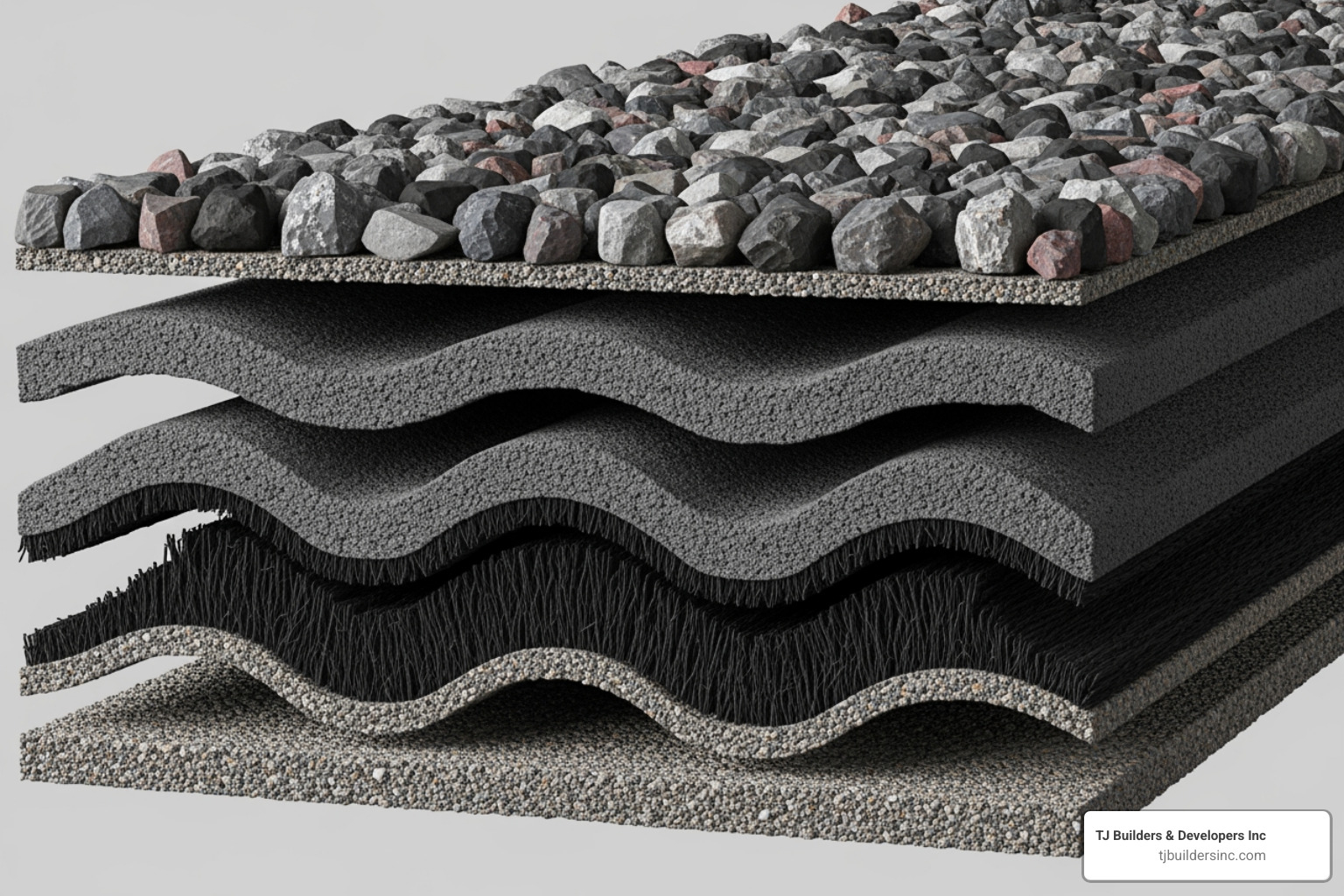
At its heart, an asphalt shingle consists of several key components:
- Fiberglass Mat Base: This is the backbone of the shingle, providing strength and stability. While early shingles used organic felt (made from recycled paper or wood fibers), fiberglass mats, introduced in the 1960s and dominant by 1982, offer superior fire resistance and a lighter, more stable base.
- Waterproofing Asphalt Layer: The fiberglass mat is saturated and coated with a layer of asphalt. This asphalt is typically mixed with crushed limestone powder to create a filled coating. This layer is crucial for the shingle’s waterproofing capabilities and flexibility. This mixture is heated to over 400°F during manufacturing to ensure proper adhesion and consistency.
- Mineral Granule Top Layer: Embedded into the top asphalt layer are ceramic-coated mineral granules. These aren’t just for aesthetics; they serve several vital functions:
- UV Protection: They shield the asphalt from the sun’s harsh ultraviolet rays, preventing premature aging and deterioration. Without granules, the asphalt would quickly dry out and become brittle.
- Color and Style: Granules come in a vast array of colors and blends, contributing to the shingle’s overall appearance and allowing for diverse aesthetic choices.
- Algae Resistance: Some granules are specially treated with copper to inhibit the growth of blue-green algae, which can cause unsightly dark streaks on roofs, especially in humid climates like ours.
- Self-Sealing Adhesive Strip: Along the bottom edge of each shingle, you’ll find a heat-activated adhesive strip. Once installed and warmed by the sun, this strip bonds the shingles together, creating a formidable barrier against wind uplift. This technology was a significant development in the 1950s to combat wind damage.
- Nailing Strip: This is the area where the shingles are fastened to the roof deck, usually with nails. Proper nailing is paramount for the shingle’s performance and wind resistance.
From their humble beginnings in 1903, when Henry Reynolds of Grand Rapids, Michigan, first used asphalt shingles, this roofing material has come a long way. The transition from organic felt to fiberglass in the 20th century marked a significant leap in durability and performance, cementing their status as the preferred choice for residential roofing.
For more detailed insights into the different options and components, check out our page on Asphalt Shingle Options.
Strip Shingles (3-Tab)
Strip shingles, often referred to as 3-tab shingles, are the most basic and economical type of asphalt shingle. They are easily recognizable by the cutouts, or “tabs,” along their lower edge, making each shingle appear as three separate pieces when installed, though it’s a single unit.
- Appearance: They offer a flat, uniform appearance, providing a classic, clean look. While once the predominant choice before designer shingles emerged in the 1980s, their aesthetic is simpler compared to modern options.
- Weight: Being single-layered, they are lighter than their dimensional and luxury counterparts.
- Lifespan: Typically, 3-tab shingles need to be replaced after 15–18 years. While they are a cost-effective option upfront, their shorter lifespan means they might require replacement sooner.
- Best Use: They are best suited for budget-conscious projects, rental properties, or homes where a basic, functional roof is the primary concern. They are also appropriate for roofs with lower slopes, typically between 2:12 and 4:12.
Dimensional Shingles (Architectural)
Dimensional shingles, also known as architectural or laminate shingles, are currently the most prevalent type of asphalt shingle roof on the market. They represent a significant upgrade in both aesthetics and performance over traditional 3-tab shingles.
- Appearance: These shingles are multi-layered and laminated, creating a much more textured, three-dimensional look. They are engineered to replicate the aesthetics of natural wood shakes or slate, offering improved curb appeal without the higher cost and maintenance of natural materials.
- Weight: Their multi-layered construction makes them heavier and more robust than 3-tab shingles.
- Durability and Lifespan: Dimensional shingles are considerably more durable, typically lasting 24–30 years. This extended lifespan makes them a popular choice for homeowners seeking a balance between cost, performance, and appearance.
- Best Use: They are ideal for most residential applications, especially for homes with average to high roof slopes (more than 6:12 or 8:12 to 12:12), where their visual depth can be fully appreciated.
Luxury Shingles
Luxury shingles sit at the pinnacle of asphalt shingle offerings, providing the ultimate in aesthetic appeal, durability, and performance.
- Appearance: These premium laminated shingles are specifically designed to offer the most realistic representation of old-world wood shake and quarried slate. They come in a variety of shapes and styles, including scalloped edges for Victorian homes or square, slate-like designs for Colonial architecture.
- Weight and Durability: Luxury shingles are the heaviest and most robust asphalt shingles available, often featuring multiple layers and improved materials for superior protection.
- Performance: They typically offer the highest performance ratings for wind, hail, and fire resistance, and often come with the longest warranties, sometimes up to 50 years (though usually prorated).
- Best Use: Homeowners seeking maximum curb appeal, long-term performance, and a roof that makes a significant architectural statement will find luxury shingles to be an excellent investment. They are well-suited for high-end homes and those in areas prone to severe weather.
Need Help With Your Home?
TJ Builders & Developers handles roofing, siding, gutters, windows, home additions, and fire damage restoration for homes and businesses in Lakewood, Crystal Lake, Schaumburg, and nearby McHenry County towns.
- Free, no-obligation estimates
- Licensed & insured
- 20+ years of local experience
Performance and Protection: What to Look for in an Asphalt Shingle Roof
When considering an asphalt shingle roof for your home in Northern Illinois, performance and protection are paramount. Our region experiences a full spectrum of weather conditions, from heavy winter snows and ice dams to strong spring winds and summer hail storms. Choosing the right shingles means understanding their capabilities and how they stand up to these challenges.

Beyond the shingles themselves, a complete roofing system is crucial. This includes proper underlayment, which acts as an additional barrier against moisture, and adequate attic ventilation, which prevents heat and moisture buildup that can prematurely age your shingles. Investing in a robust roofing system ensures that your home remains protected and your shingles last their full intended lifespan.
Durability and Resistance Ratings
Understanding industry ratings and standards is key to selecting durable asphalt shingles:
- Wind Resistance: This is a critical factor for any roof in our area. Shingles are tested for wind resistance under standards like ASTM D3161 and ASTM D7158.
- ASTM D3161 classifies shingles as Class A (60 mph), Class D (90 mph), or Class F (110 mph), based on continuous fan-induced wind exposure.
- ASTM D7158 offers more rigorous testing, with classifications like Class D (up to 115 mph), Class G (up to 150 mph), and Class H (up to 190 mph) in its latest revisions. Many manufacturers now rate their entire product line with high wind resistance, sometimes up to 130 mph, when installed according to manufacturer specifications with proper accessories. For more historical context on wind resistance, you can read An Historical Perspective on the Wind Resistance of Asphalt Shingles.
- Hail Impact Resistance: Hail damage can be a significant concern. The UL 2218 standard classifies impact-resistant shingles from Class 1 to Class 4, with Class 4 being the highest rating. While impact-resistant shingles help protect against damage, it’s important to note that most manufacturer warranties, like GAF’s, explicitly state they make no implied warranty about impact performance against hail and do not cover hail damage. However, some insurance companies may offer premium discounts for Class 4 rated roofs.
- Fire Resistance: Asphalt shingles naturally possess good fire resistance. They are classified by UL 790 or ASTM E108.
- Class A: The highest fire rating, indicating excellent resistance to fire penetration from exterior sources. Fiberglass shingles are typically Class A rated.
- Class B: Good fire resistance. Organic felt shingles generally have a maximum Class B rating.
- Class C: Moderate fire resistance.
Most asphalt shingle roofs achieve a Class A fire rating, providing peace of mind against external fire threats.
- Algae Resistance: Those unsightly dark streaks you sometimes see on roofs are often caused by blue-green algae. Many modern asphalt shingles incorporate copper-containing granules that inhibit algae growth. Products like GAF’s StainGuard Plus™ or StainGuard Plus PRO™ offer 25-30 year warranties against algae discoloration. This feature is particularly valuable in humid climates.
- Cool Roof Technology: For homes in sunny areas, or those looking to reduce cooling costs, “cool roof” shingles are an excellent option. These shingles use special solar reflective granules to reflect more sunlight and absorb less heat, helping to reduce the roof’s temperature. This can lead to lower attic temperatures and reduced air conditioning expenses. ENERGY STAR certifies roofing products that meet specific reflective criteria.
Choosing the Right Shingles for Your Home
Selecting the ideal asphalt shingles for your home involves weighing several factors unique to your property and our local climate in Northern Illinois.
| Shingle Type | Cost (Relative) | Lifespan (Years) | Appearance | Wind Resistance (Typical) |
|---|---|---|---|---|
| Strip (3-Tab) | Lowest | 15-18 | Flat, uniform | Standard (up to 60-90 mph) |
| Dimensional | Medium | 24-30 | Textured, layered (wood shake look) | Improved (up to 110-130 mph) |
| Luxury | Highest | 30-50+ | Highly sculpted (slate/shake look) | Superior (up to 130-190 mph) |
- Architectural Style: The style of your home plays a significant role. Dimensional or luxury shingles can greatly improve curb appeal, mimicking materials like natural slate or wood shakes that complement various architectural designs, from traditional to contemporary.
- Color and Aesthetic Choices: The color of your roof can dramatically impact your home’s exterior. Modern asphalt shingles come in a vast palette of colors and blends. Lighter colors can also contribute to a cooler roof, which is beneficial during our hot Illinois summers. To help visualize options, tools like CertainTeed’s ColorView® home exterior visualizer tool allow you to upload a picture of your own home and experiment with different roofing, siding, paint, and trim combinations.
- Impact of Roof Slope: The pitch, or slope, of your roof directly affects shingle selection and installation requirements:
- Low Slope (2:12 to 4:12): For roofs with a pitch between 2 units vertical in 12 units horizontal and 4 units vertical in 12 units horizontal, 3-tab shingles are generally acceptable, but a double layer of underlayment is required to prevent water penetration from wind-driven rain or ice dams. Asphalt shingles should never be installed on roofs with a slope less than 2:12 without specialized treatments.
- Standard Slope (4:12 and greater): Most asphalt shingles perform optimally on these slopes.
- Steeper Slopes (6:12 or 8:12 to 12:12): Architectural and luxury shingles truly shine on steeper roofs, where their dimensional qualities are more visible and improve the home’s aesthetics.
- Climate Considerations for Northern Illinois: Our local climate presents specific challenges:
- Heavy Snow and Ice Dams: Proper underlayment, particularly ice and water shield, is critical in areas prone to ice dams. Good attic ventilation also helps prevent heat loss from the home that contributes to ice dam formation.
- High Winds: Choosing shingles with high wind resistance ratings (Class G or H, or rated for 130 mph+) and ensuring they are installed with six nails per shingle, rather than the minimum four, is a smart investment.
- Summer Hail Storms: Impact-resistant (UL 2218 Class 4) shingles can offer additional protection, and may even qualify for insurance discounts.
- Algae Growth: Given the humidity we experience, algae-resistant shingles can save you from unsightly roof stains and potential damage.
By carefully considering these factors and consulting with experienced local professionals like us, you can choose an asphalt shingle roof that not only looks fantastic but also provides decades of reliable protection for your home.
Installation, Maintenance, and Replacement
A beautiful and durable asphalt shingle roof is only as good as its installation. Even the highest-quality shingles can fail prematurely if not installed correctly. That’s why professional installation is paramount, especially in a region like Northern Illinois where roofs endure significant weather stress.
At TJ Builders & Developers, we emphasize precision and adherence to manufacturer specifications. This not only ensures optimal performance but also preserves your shingle warranty, as many warranties can be voided by improper installation.
Essential Maintenance for Your Asphalt Shingle Roof
While asphalt shingles are relatively low-maintenance, a little proactive care can significantly extend their lifespan and prevent costly repairs. Here are our essential maintenance tips:
- Regular Visual Inspections: We recommend inspecting your roof every two to three years, ideally from the ground with binoculars. Look for any visible signs of damage, curling, or missing shingles. It’s also wise to inspect your attic for any signs of leaks, such as water stains or damp insulation, particularly after heavy storms.
- Gutter Cleaning: Clogged gutters can cause water to back up, leading to fascia damage, foundation issues, and even ice dams in winter. Regular cleaning ensures proper drainage, protecting your roof and home.
- Removing Debris: Leaves, branches, and other debris can accumulate on your roof, trapping moisture and encouraging moss or algae growth. Safely remove any large accumulations, especially from valleys and around chimneys.
- Addressing Moss or Algae Growth: While algae-resistant shingles help, moss and algae can still grow, especially on shaded portions of the roof. Widespread moss growth can lift shingles, hinder drainage, and potentially lead to leaks. For persistent issues, we can discuss appropriate cleaning methods or the installation of zinc or copper strips at the ridge, which leach minerals that inhibit growth. For any needed fixes, our Roof Repair services are always available.
Signs Your Asphalt Shingle Roof Needs Replacement
Even with diligent maintenance, all roofs eventually reach the end of their service life. Knowing the warning signs can help you plan for a replacement before minor issues escalate into major problems.
- Curling or Cupping Shingles: When shingles start to curl up at the edges or cup in the middle, it’s a clear sign that the asphalt has dried out and shrunk. This makes them brittle and highly susceptible to wind damage.
- Cracked or Missing Shingles: Cracks can indicate thermal shock (rapid temperature changes) or general aging. Missing shingles leave your roof deck exposed, inviting water damage.
- Widespread Granule Loss: If you notice a significant amount of granules accumulating in your gutters or dark patches on your shingles, it means the protective layer is wearing off. This exposes the asphalt to UV rays, accelerating its deterioration.
- Dark Streaks or Algae Stains: While some algae are cosmetic, extensive or long-standing algae and moss growth can indicate moisture retention, which can lift shingles and impede drainage, potentially leading to leaks.
- Roof Age: The age of your roof is a primary indicator. While dimensional shingles typically last 24–30 years, 3-tab shingles usually need replacement after 15–18 years. If your roof is approaching or exceeding 20 years, even without obvious damage, it’s wise to start planning for replacement.
- Water Spots on Interior Ceilings: This is the most undeniable sign that your roof is failing and water is penetrating your home’s interior. Don’t wait for this symptom to appear!
If you observe any of these signs, it’s time to have a professional assessment. We offer comprehensive evaluations and can guide you through the process of replacing your roof, ensuring your home remains protected for years to come. Learn more about our process in our Roof Installation & Replacement: The Complete Guide.
Need Help With Your Home?
TJ Builders & Developers handles roofing, siding, gutters, windows, home additions, and fire damage restoration for homes and businesses in Lakewood, Crystal Lake, Schaumburg, and nearby McHenry County towns.
- Free, no-obligation estimates
- Licensed & insured
- 20+ years of local experience
Environmental Impact and Recycling
As environmentally conscious builders, we understand the importance of addressing the lifecycle of building materials. For an asphalt shingle roof, this includes their potential for recycling, which helps mitigate environmental impact.
Historically, old shingles would end up in landfills. The U.S. generates approximately 11 million short tons of asphalt shingle waste annually. However, significant strides have been made in recycling efforts. Reclaimed Asphalt Shingles (RAS) are now being diverted from landfills and repurposed. In 2019, an estimated 1.1 million tons of RAS were accepted by asphalt plants, demonstrating a growing commitment to sustainability in the roofing industry.
The primary use for recycled asphalt shingles is in new asphalt pavement. When processed correctly, RAS can serve as a valuable component in road construction, reducing the need for virgin asphalt and aggregates. This not only conserves natural resources but also reduces landfill waste, creating a more circular economy for roofing materials.
While the recycling of asphalt shingles is a positive development, there are some considerations. Older shingles, particularly those manufactured before the early 1980s, may contain asbestos. Therefore, proper inspection and handling protocols are essential during the recycling process to ensure safety. Additionally, asphalt naturally contains polycyclic aromatic hydrocarbons (PAHs), which are monitored during recycling to prevent environmental contamination. For a deeper dive into these topics, you can explore Environmental Issues Associated With Asphalt Shingle Recycling.
We believe in offering eco-friendly roofing solutions where feasible, and that includes responsibly managing the disposal and recycling of old roofing materials from your home.
Your Trusted Partner for Roofing Excellence
As we’ve explored, asphalt shingles offer a superior combination of performance, style, and value, making them the leading choice for homeowners across North America, including right here in Northern Illinois. From their robust construction and diverse aesthetic options to their impressive resistance against wind, hail, and fire, an asphalt shingle roof provides reliable, long-lasting protection for your most important asset.
However, the key to maximizing the lifespan and protection of your asphalt shingle roof lies in proper installation. This means adhering strictly to manufacturer guidelines, utilizing quality underlayment and accessories, and employing skilled craftsmen who understand the nuances of roofing in our local climate. For homeowners in Lakewood, Crystal Lake, Schaumburg, Elk Grove Village, Rolling Meadows, South Barrington, Barrington, Bartlett, Palatine, Mount Prospect, and across the Chicago suburbs, ensuring your roof is installed by experienced professionals is crucial.
At TJ Builders & Developers Inc., we take immense pride in our expert craftsmanship and our commitment to lasting results. We don’t just install roofs; we build confidence and peace of mind, knowing your home is protected by a system designed to endure.
If you’re considering a new asphalt shingle roof, roof repair, or replacement, we invite you to experience the TJ Builders & Developers difference. Contact us today to learn more about our professional roofing services and let us help you protect your home with a beautiful, durable asphalt shingle roof.