
In Lakewood, a house fire can leave framing, roof, and walls unsafe, even in rooms the flames never reached. Heat weakens wood. Water from firefighting soaks insulation and subfloors.
We handle fire damage reconstruction from the foundation to the roof. That includes partial rebuilds and full reconstruction of the whole house. Homeowners in Lakewood, Crystal Lake, and Cary call us when cleanup is done and the real building work begins.
We are a builder, not only a cleanup crew. The same team rebuilds the structure, the roof, the siding, and the windows. You deal with one contractor and one schedule.
Every fire damage reconstruction project starts with a free on-site assessment. We check the structure room by room and photograph what we find. You get a written scope you can hand straight to your adjuster.
Fire damage is not always easy to see. A wall can look fine while the studs behind it are charred. We open up the house and check each part of the structure. Here is what we check before fire damage reconstruction in Lakewood homes:
Newer homes around Turnberry often use engineered trusses and floor joists. These lose strength in heat faster than solid lumber, so we check them closely. Saving what is sound keeps your rebuild cost and schedule down. If smoke cleanup is still ahead, see our fire damage restoration service.
Your insurance claim pays for fire damage reconstruction, so the scope has to be clear. We write a line-item scope with photos of every damaged area. Your adjuster can compare it directly with their own estimate.
On-site meetings: We meet your adjuster at the house in Lakewood and walk the damage together. Hidden damage found later is documented and sent as a supplement.
Like-for-like vs. code upgrades: Your policy may cover rebuilding what you had. Current code can require more, such as stronger connections or added insulation. We mark which items are code-driven, so you can ask your insurer how they are covered.
No pressure on timing: We do not push you to sign before your claim is settled. You decide when to start, with the numbers in front of you. The Illinois Department of Insurance also has help for homeowners filing a claim.
Fire damage reconstruction needs a permit. In the Village of Lakewood, we apply for it and schedule each inspection. You do not have to manage the paperwork.
Current code applies: A rebuild must meet the code in effect when the permit is issued. That can differ from the rules your house was built under. We plan for it from the start, so there are no surprises at inspection.
Plans and engineering: We prepare drawings and bring in a structural engineer where the code calls for one. If your original plans were lost in the fire, we measure the house and redraw them.
Design changes: Some owners use the rebuild to change a layout or add space. We price those changes apart from the insurance work, so your claim stays clean.
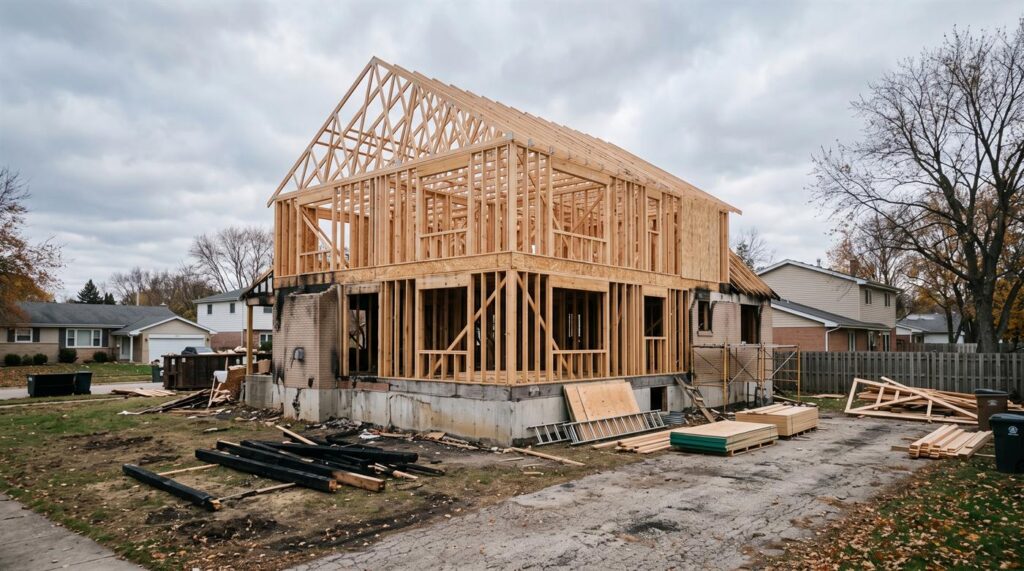
Once the site is cleared down to sound structure, fire damage reconstruction begins. We work from the bottom up, so each layer sits on something solid.
Lakewood winters do not wait for a rebuild. We close the house in fast and protect open framing with tarps between steps. Rebuilds near Crystal Lake follow the same plan. Learn more about our structural repair and modification work and our roofing services.
How does fire damage reconstruction in Lakewood work? We secure the house, check the structure, and write a scope for your insurer. Then we pull permits, rebuild from the foundation up, and pass final inspection.
Here is how each step of fire damage reconstruction works on a typical project:
Step 1 – Board-up and site safety: We board up openings and tarp the roof to stop more damage. The site is marked so no one walks into danger.
Step 2 – Structural assessment: We check framing, roof, foundation, and wall cavities room by room. A structural engineer reviews anything in question.
Step 3 – Scope and insurance: You get a line-item scope with photos. We meet your adjuster and document hidden damage as we find it.
Step 4 – Permits and plans: We prepare drawings and apply for permits with the Village of Lakewood. Inspections are scheduled as the work moves forward.
Step 5 – Demolition: We remove everything that cannot be saved and seal what stays. The house is cleared down to sound structure.
Step 6 – Rebuild: Framing, roof, windows, and siding go back in order. Each stage is inspected before the walls are closed.
Step 7 – Final inspection and walkthrough: We pass the final inspection and walk the house with you. For homes near Redtail, we plan exterior work around the weather so the house stays dry.
Here are common questions about fire damage reconstruction from homeowners in Lakewood, Crystal Lake, Cary, and nearby towns:
It depends on how much of the house was damaged, the permit review, and your insurance claim. A partial rebuild is usually shorter than a full reconstruction. We give you a written schedule with your scope, so you know what to expect.
Often, yes. Many foundations can be reused even when they look scorched. A structural engineer checks cracks and damaged concrete first. If parts are unsafe, we repair or replace them before framing starts.
Yes, structural rebuild work needs a permit from the Village of Lakewood. We apply for it, prepare the drawings, and schedule each inspection. You do not have to handle the paperwork yourself.
Yes, the rebuild must meet the code in effect when the permit is issued. That can mean stronger connections, more insulation, or other updates. We mark code-driven items in the scope so you can ask your insurer how they are covered.
Yes, we work with your adjuster from the first walkthrough. We provide a line-item scope with photos and meet the adjuster at the house. Hidden damage found during the work is documented and sent as a supplement.
Restoration cleans and repairs, while fire damage reconstruction rebuilds the structure itself. Restoration removes smoke, soot, and water and fixes finishes. Reconstruction replaces framing, roof, and walls that the fire weakened. Many projects need both.
Yes, smoke and heat travel inside wall cavities and attics. Soot and odor soak into insulation and wood. We open suspect areas and remove or seal what holds smoke before the walls are closed.
It depends on how much of the house is damaged. After a small fire, you may be able to stay in an unaffected part of the house. After major structural damage, it is not safe. We tell you which applies after our assessment.
Yes, we handle partial rebuilds as well as full reconstruction. A kitchen fire may only need one area rebuilt. We match new framing, roof, siding, and windows to the rest of the house.
First, make sure everyone is safe and the fire department has cleared the house. Then call your insurer and take photos of everything. Ask for a board-up to protect the house from weather and entry.
A fire-damaged house keeps losing ground while it sits open. Rain, snow, and freeze-thaw cycles get into exposed framing and make the damage worse. We offer free on-site assessments in Lakewood, Crystal Lake, Cary, and Barrington. We show you what can be saved before you commit to anything.
TJ Builders & Developers Inc handles the full rebuild: assessment, insurance scope, permits, demolition, framing, roofing, and exterior. You get one crew and one point of contact from start to finish. Call us today to book your fire damage reconstruction assessment.