
Vinyl siding in the Chicago suburbs takes a beating – freeze-thaw cycles, driving wind off Lake County, hail, and summer UV all degrade material that was not properly selected or installed. Homeowners in Lakewood, Crystal Lake, and Cary call us when their siding has failed, when they are replacing it as part of a renovation, or when they need a precise match for a section damaged by impact or water intrusion.
We are not a siding-only subcontractor. We handle the full exterior envelope – siding, house wrap, trim, soffit, fascia, and J-channel – so you get a weathertight installation from a single crew that understands how each component affects the others. Improper house wrap lapping, missed caulk lines at windows, and unsecured J-channel at the rake are where most siding failures start. We do not take shortcuts at those details.
Every siding project starts with a full exterior walkthrough. We document existing damage, check the sheathing and house wrap condition underneath, and identify any rot or moisture intrusion that needs to be addressed before new siding goes on. You get a written scope that covers the full installation – not just the panels.
Not all vinyl siding performs equally in our climate. Panel thickness, profile style, and insulation backing all affect how well the siding holds up through McHenry County winters and how good it looks five years after installation. Here is what we evaluate with every homeowner:
New siding over a compromised substrate is a waste of money. Before any panels go on, we pull back or remove the existing siding and inspect the sheathing and house wrap underneath. What we look for – and what we find more often than homeowners expect – includes:
Sheathing rot: Water infiltration at window flanges, failed caulk joints, and improperly lapped house wrap drives moisture into the OSB or plank sheathing behind the siding. Soft, delaminated, or discolored sheathing gets replaced before the new siding goes on. Installing new panels over rotted sheathing leaves the fasteners with nothing solid to hold into and the moisture damage continues underneath the new material.
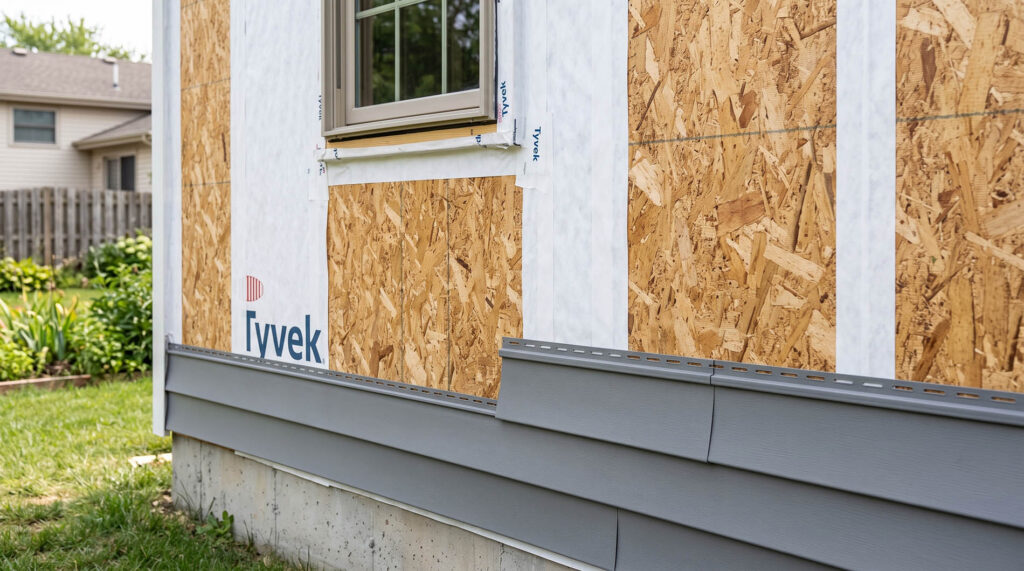
House wrap condition: Original housewrap on older Lakewood homes is often torn, improperly lapped, or missing entirely at corners and around penetrations. We install new house wrap – Tyvek HomeWrap or equivalent – with correctly overlapped seams (upper layer always laps over lower), taped window and door flanges, and properly integrated flashing at all horizontal interruptions. This is the most important step in a siding installation and the one most commonly skipped by budget contractors.
Window and door flashing: Every window and door opening gets head flashing and pan flashing before the new J-channel is set. Flashing tape bridges the gap between the window frame and the house wrap so that any water that gets past the siding is directed outward rather than into the wall cavity.
Rim joist and foundation transition: The bottom course of siding and the starter strip must terminate correctly at the foundation – not tucked into soil or mulch, which wicks moisture up into the wall. We install a proper termination and verify clearance from grade before the first course is set.
The quality of a siding installation is most visible at the details – corners, windows, doors, rakes, soffits, and the transitions between different materials. These are also where most long-term failures begin. Here is how we handle each:
Corner posts: We use post corners rather than J-channel miters at all outside corners. Post corners provide a stronger mechanical connection, resist wind uplift better, and give a cleaner finished appearance than field-cut miters. Inside corners get a dedicated inside corner post rather than two pieces of J-channel butted together.
Soffit and fascia: Vinyl soffit panels are vented or solid depending on attic ventilation requirements. We calculate the required net free area for your roof before selecting the soffit product. Fascia wraps are installed over existing wood fascia that has been cleaned and primed – we do not wrap over soft or rotted fascia board. If the underlying wood needs replacement, we do that as part of the scope.
Window and door trim: J-channel at windows and doors is cut at 45-degree miters at the corners and caulked with a paintable, flexible sealant rated for the temperature range we see in McHenry County. Butted J-channel corners are a common shortcut that opens up over time – we do not do it.
Utility trim and penetrations: Every pipe, wire, and fixture penetration through the siding plane gets a properly sized utility trim box or round utility mount – not a field-cut hole with caulk around the edge. This is a code requirement in Illinois and a significant moisture vulnerability when it is skipped.
Impact damage from hail, falling branches, or landscape equipment is the most common reason homeowners in Lakewood need a partial siding repair rather than a full replacement. Matching existing siding is a skill that requires knowing what you are looking for – and accepting that a perfect match is not always possible.
What we can match: Profile shape and exposure dimension can almost always be matched from current manufacturer stock. We carry samples from Mastic, Alside, and CertainTeed and compare them against your existing panels on-site in natural light before ordering material. Gloss level and texture grain also factor into how well a new panel blends with weathered existing siding.
What is difficult to match: Color. Vinyl siding fades over time in ways that vary by orientation – south and west elevations fade significantly faster than north and east faces. A new panel in the original color will almost always read as a patch on a weathered elevation. We are upfront about this before the work begins so you can decide whether a partial repair or a full elevation replacement makes more sense for your situation.
Insurance claims: Hail and wind damage to siding is a covered peril under most homeowner’s policies in Illinois. We provide photo documentation of the damaged area and a written scope that your adjuster can use in the claims process. We work alongside your adjuster – we do not chase storm work or pressure you on timing.
A siding replacement on a typical Lakewood home moves through a clear sequence. Here is how we run every project from first contact to final walkthrough:
Step 1 – Exterior assessment: We walk the full perimeter of the home, document existing damage, measure all elevations, and identify any substrate issues that need to be addressed. We check every window and door opening for flashing condition and assess soffit and fascia for replacement needs.
Step 2 – Material selection and order: We present profile, thickness, and color options based on your home’s style and your budget. Once you confirm the selection, we place the order and schedule the install date around the delivery window.
Step 3 – Tear-off and substrate inspection: We remove all existing siding, inspect the sheathing and house wrap underneath, and repair or replace anything that needs attention before the new installation begins. This phase takes one to two days depending on home size and substrate condition.
Step 4 – House wrap and flashing: New house wrap goes on before any panels. Window and door flanges are taped. Head and pan flashing is set at every opening. We do not skip this step or treat it as optional.
Step 5 – Panel installation: Starter strip, first course, and panel run from bottom to top. Nailing follows manufacturer specifications for the panel thickness and color selected. We check level every few courses and at every corner.
Step 6 – Trim, soffit, and fascia: Soffit panels, fascia wrap, corner posts, window and door trim, rake trim, and all utility penetration covers are installed and caulked as a final step.
Step 7 – Final walkthrough and cleanup: We walk the entire exterior with you, verify all trim is sealed, clean all debris from the site, and confirm the manufacturer warranty registration is filed before closing the job.
Here are common questions from homeowners in Lakewood, Crystal Lake, Cary, Barrington, and surrounding McHenry County areas – and our straight answers:
Quality vinyl siding – .046 inch or thicker – installed correctly over sound sheathing and proper house wrap will last 30 to 40 years in our climate. Thinner panels, improper nailing, and missing or damaged house wrap all shorten that lifespan significantly. The biggest cause of early failure in McHenry County is moisture intrusion behind the panels due to failed flashing or improperly lapped house wrap – issues that are invisible until the damage to the sheathing underneath is already extensive.
A permit is generally not required for a like-for-like siding replacement in the Village of Lakewood — replacing existing siding with new siding of the same type and profile. However, if the project involves changes to the exterior envelope, addition of insulated sheathing, or any structural modifications to the wall, a permit may be required. We confirm the specific requirements for your project before work begins.
Oil-canning is the wavy, buckled appearance that develops on vinyl siding panels over time. It is caused by two things: panels that are too thin to hold their shape across their unsupported face, and panels that have been face-nailed too tightly — leaving no room for thermal expansion. We prevent it by specifying .046-inch or thicker panels, using insulated siding where budget allows, and following manufacturer nailing specs that allow 1/32-inch movement at every fastener. Oil-canning on properly installed thick panels is essentially non-existent.
For most Lakewood homes, yes. Insulated siding adds R-3 to R-5 to the wall assembly at a cost premium of 15 to 25 percent over standard panels. In a climate with 6,000-plus heating degree days per year, that additional insulation delivers a measurable reduction in heating bills — particularly in homes built before 1990 with minimal wall cavity insulation. Insulated siding also dramatically reduces oil-canning and provides better impact resistance. We model the payback period for your specific home if you want to evaluate it against the cost difference.
Profile and exposure can almost always be matched from current manufacturer stock. Color match depends on how much the existing siding has weathered — south and west elevations fade faster than north and east faces. We bring samples on-site and compare them in natural light before ordering. If the color difference will be visible and bothersome, we discuss whether a full elevation replacement makes more sense than a patch. We are upfront about this before any material is ordered.
Vinyl siding becomes brittle below 40 degrees Fahrenheit and can crack if forced during installation. We do not install vinyl siding in temperatures below that threshold. Cold-weather installation also requires adjusted nailing patterns to account for the fact that the panels are contracted — if nailed tightly in cold weather, they will buckle when they expand in summer. We schedule our Lakewood installs for spring through fall and work around temperature windows in shoulder seasons.
Cracking is almost always impact damage or cold-weather brittleness. Warping or buckling is caused by face-nailing too tightly, leaving no room for thermal expansion — a common mistake by inexperienced installers. Panels pulling away from the house are usually caused by improper locking between courses or panels that were not allowed to expand at the nail slots. All three are installation errors, not material failures — which is why installer quality matters as much as panel quality in our climate.
Our full siding replacement projects include soffit panels and fascia wrap as part of the standard scope. Soffit and fascia are integral to the weathertightness of the roof-to-wall transition and replacing siding without addressing them leaves the most vulnerable detail exposed. If your soffit and fascia are in good condition and only the wall panels need replacement, we can scope wall panels only — but we walk the fascia condition with you first so you are not replacing siding around failing fascia boards a year later.
New siding consistently ranks among the top exterior renovation projects for return on investment in Chicagoland. Buyers in McHenry County respond positively to fresh, clean exteriors and negatively to visible siding damage, chalking, or fading. A full siding replacement with quality panels and proper installation typically returns 70 to 80 percent of its cost at resale in our market — higher when combined with updated trim and window treatment. It also reduces buyer inspection concerns about moisture and envelope integrity.
Repair makes sense when damage is isolated — a few cracked or broken panels from impact, a single elevation with localized damage, or a recent installation that has a defective run. Replacement makes sense when panels are broadly faded, chalking, cracked across multiple elevations, or when the house wrap and sheathing underneath are showing moisture damage. The threshold question is substrate condition — if the sheathing is compromised in multiple areas, a repair-only approach means you are repeatedly patching visible symptoms while the underlying damage continues. We assess the substrate as part of every exterior evaluation and give you a straight recommendation based on what we actually find.
Failing siding in McHenry County is not just an aesthetic issue – it is an envelope failure that lets moisture into your wall assembly every time it rains. The longer damaged or deteriorated siding stays on a Lakewood home, the more the sheathing and framing underneath are exposed to moisture cycling through freeze-thaw. We offer free exterior assessments across Lakewood, Crystal Lake, Cary, and Barrington – and we tell you exactly what we find, including the sheathing condition, before you commit to anything.
TJ Builders & Developers Inc handles the full installation: tear-off, substrate repair, house wrap, panels, trim, soffit, and fascia – under one contract, one crew, one point of contact. Call us today to schedule your assessment.