Understanding the Fundamentals of Flat Roofing Systems
Flat roofing materials are the waterproof membranes and systems used to protect low-slope roofs — and choosing the right one makes the difference between decades of reliable performance and a costly, recurring headache.
Here’s a quick overview of the most common options:
| Material | Lifespan | Cost (per sq ft) | Best For |
|---|---|---|---|
| TPO | 30-40 years | $5-$8 | Energy efficiency, commercial |
| EPDM | 20-30 years | $4.50-$8 | Cold climates, residential |
| PVC | 30-40 years | $6-$10 | Chemical/grease exposure |
| Modified Bitumen | 15-20 years | $4-$7 | Budget installs, complex geometry |
| BUR (Tar & Gravel) | 20-30 years | $5-$9 | High-traffic, proven durability |
| Metal (Standing Seam) | 30-50 years | $4-$30 | Long-term investment, eco-friendly |
Flat roofs — technically called low-slope roofs — are common on commercial buildings, home additions, garages, and porches. Unlike pitched roofs that shed water by gravity, flat roofs rely on a continuous waterproof membrane to keep water out. Get that membrane wrong, and water has nowhere to go.
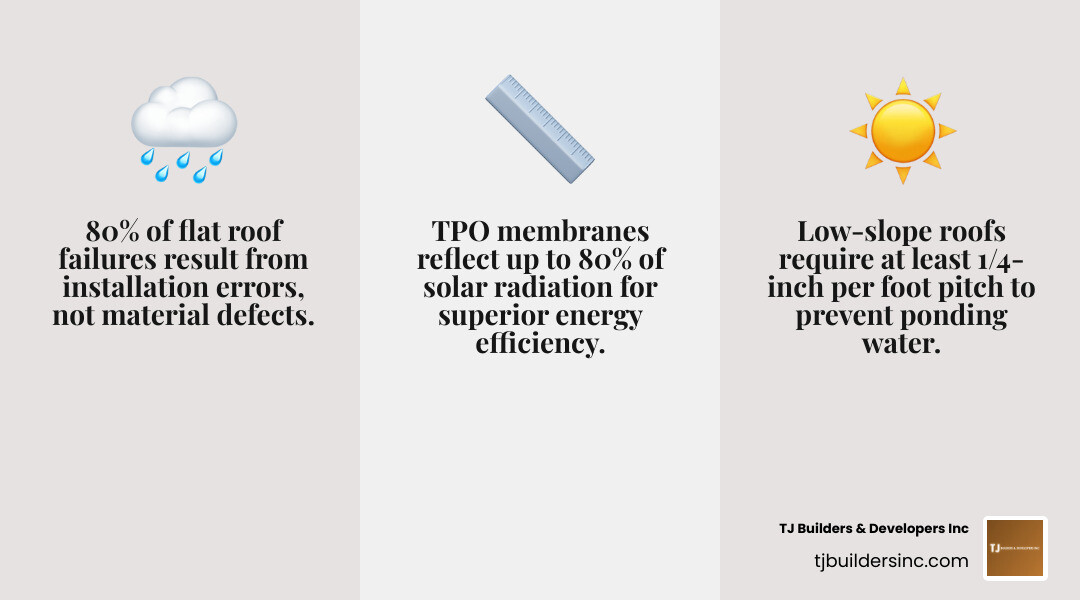
The tricky part? There’s no single “best” material. The right choice depends on your climate, building type, budget, and how the roof will be used. And here’s something worth knowing upfront: roughly 80% of flat roof failures come from installation errors, not the materials themselves. That makes contractor selection just as important as material selection.
This guide walks you through every major flat roofing option — what each one is, how it performs, and where it fits best — so you can make a confident, informed decision.
I’m Thomas Pruszynski from TJ Builders & Developers Inc, and over the past 20+ years I’ve worked with homeowners and businesses across Northern Illinois — including Lakewood, Crystal Lake, and Schaumburg — helping them select and install the right flat roofing materials for their specific needs. Whether you’re dealing with a leaking low-slope roof or planning a new addition, understanding your material options is the first step toward a roof that holds up for decades.
Similar topics to Flat roofing materials:
When we talk about flat roofs, we aren’t talking about a surface as level as a kitchen table. In the roofing world, “flat” is a bit of a misnomer. Every roof must have some degree of slope to prevent water from becoming a permanent resident on your building.
Essential Slope and Drainage for Flat Roofing Materials
Building codes generally require a minimum slope of 1/4 inch per foot. This slight pitch ensures that gravity can do its job, guiding water toward the edges or internal drains. Without this 1/4-inch pitch, you run into the dreaded “ponding water” — defined as water that stands on the roof for more than 48 hours after a rain. Ponding is the enemy of all flat roofing materials; it adds immense weight to the structure and accelerates the degradation of the membrane.
To manage this water, we use several diversion methods:
- Scuppers: Openings in the perimeter walls (parapets) that allow water to flow off the roof.
- Internal Drains: Similar to a shower drain, these are placed in low spots and connected to pipes inside the building.
- Gutters: Used on roofs where at least one edge is open, allowing water to spill into a traditional trough system.
Proper substrate preparation is also vital. We often install “tapered insulation” to create a slope where the original structure is too level. For more details on these structural requirements, check out this Complete Guide to Flat Roofing Systems (2026) | ShinglesCalculator.
Common Causes of Flat Roof Failure
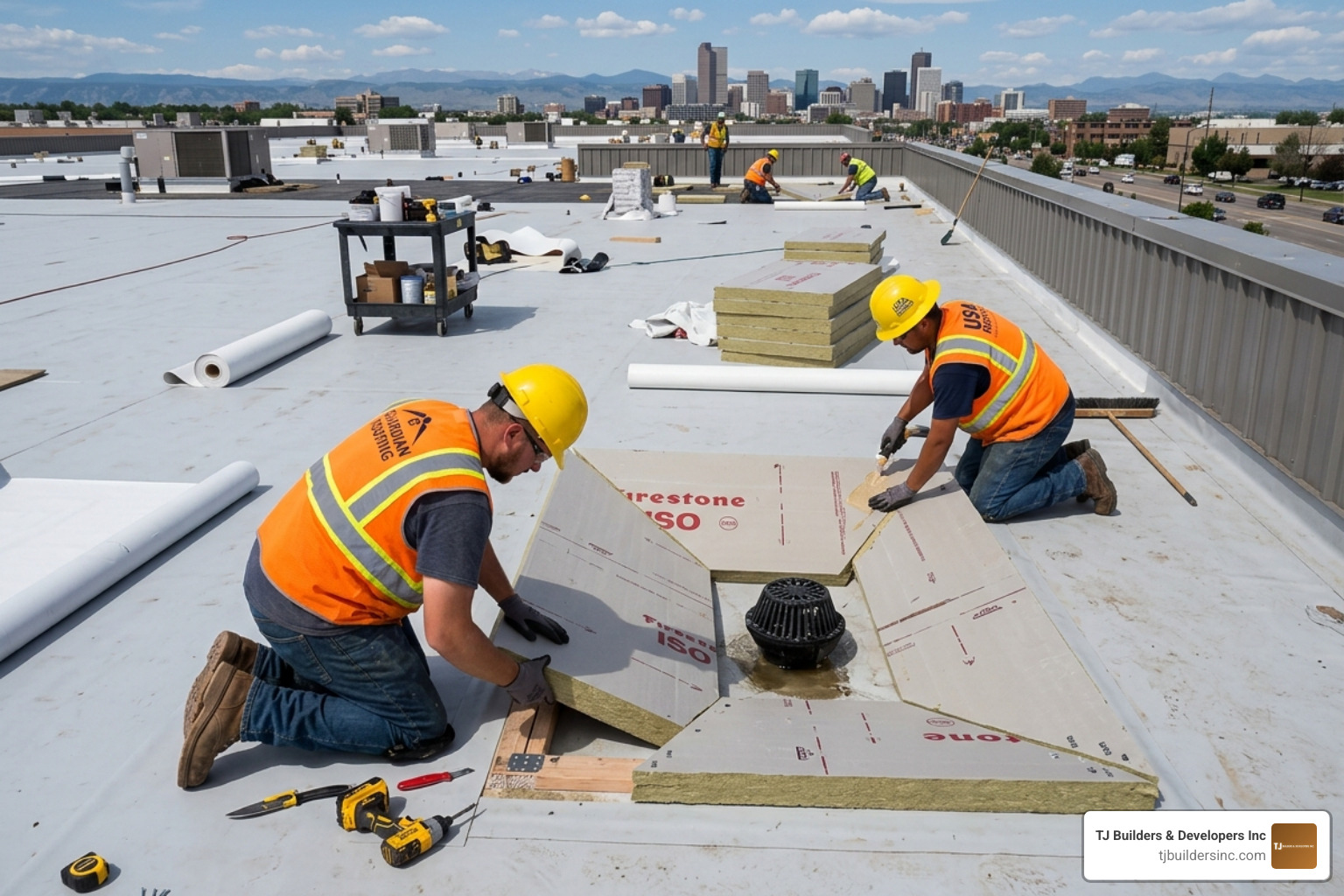
Even the highest-quality flat roofing materials can fail if they aren’t respected. In our experience across Crystal Lake and Algonquin, the most common issues include:
- Installation Errors: As mentioned, this accounts for the vast majority of leaks. Poorly sealed seams or improperly flashed penetrations (like vents or chimneys) are the primary culprits.
- Seam Separation: Single-ply membranes rely on their seams. If the heat-welding or adhesive fails, water finds its way under the sheets.
- UV Degradation: Constant sun exposure can make materials brittle over time, especially older formulations.
- Puncture Damage: Dropped tools, heavy foot traffic, or even sharp debris can poke holes in thinner membranes.
Comparing Single-Ply Flat Roofing Materials
Modern flat roofing is dominated by single-ply membranes. These are large, flexible sheets of synthetic materials that are rolled out and fastened to the roof deck. When comparing these, you’ll often see “mil” ratings. A mil is one-thousandth of an inch. While 45-mil is common, we often recommend 60-mil or higher for better puncture resistance. For a deep dive into these technical differences, see this Flat Roof Materials Compared: TPO, EPDM, PVC, and Modified Bitumen (2026 Guide) — RoofRanked.
TPO: The Energy-Efficient Modern Standard
Thermoplastic Polyolefin (TPO) has skyrocketed in popularity, now making up over 40% of the commercial market. It is a blend of rubber and plastic materials that offers the best of both worlds.
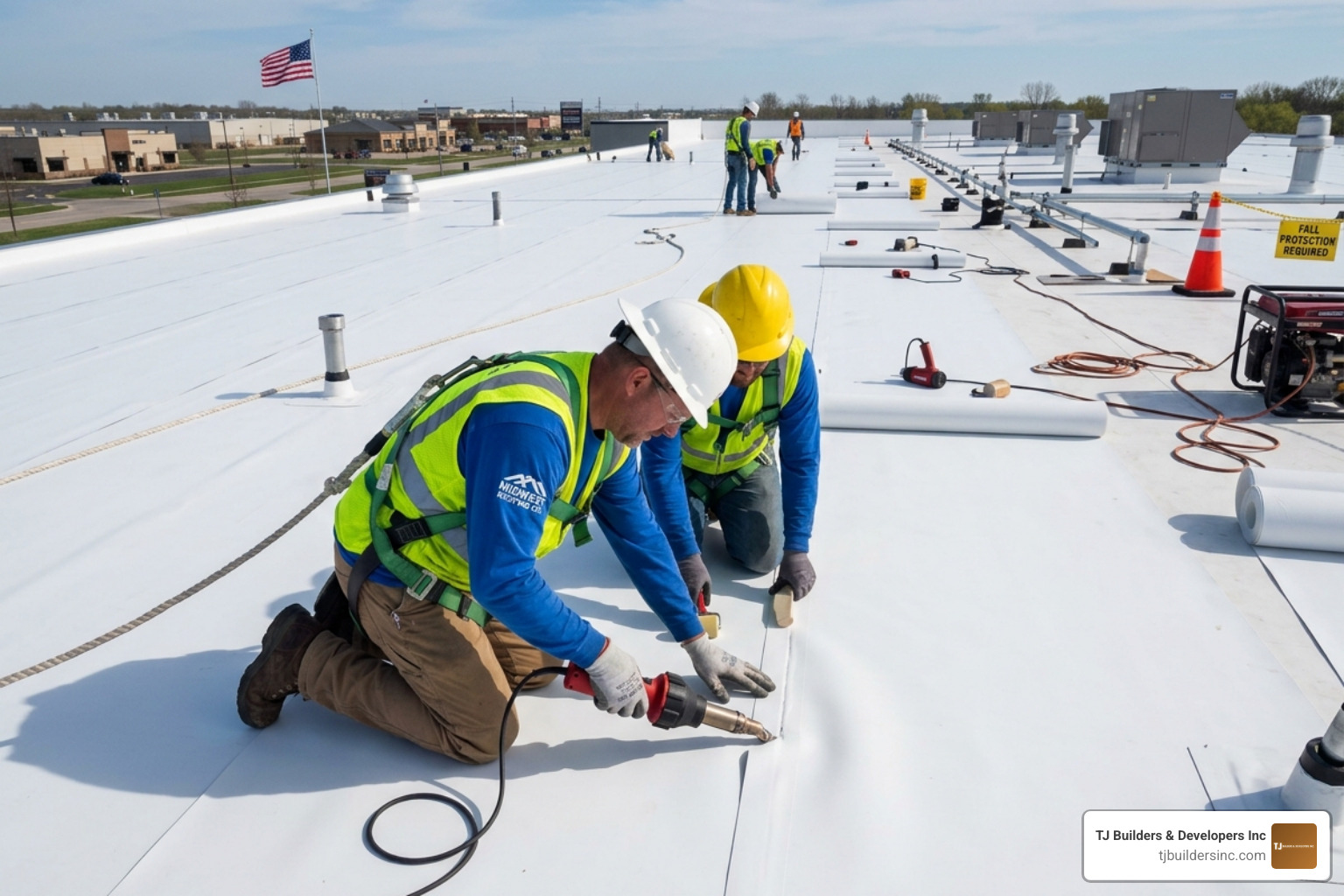
The standout feature of TPO is its energy efficiency. White TPO membranes can reflect up to 80% of solar radiation, earning them an Energy Star rating. This “cool roof” effect significantly reduces cooling costs during our humid Illinois summers. TPO seams are heat-welded with hot air, creating a physical bond that is actually stronger than the membrane itself.
EPDM: The Durable Rubber Solution
Ethylene Propylene Diene Monomer (EPDM) is essentially a giant sheet of high-tech rubber. It has been a staple in the industry since the 1960s and has a proven track record of lasting 30 years or more.
EPDM is a favorite for Northern Illinois because of its incredible flexibility. It features 465% elongation, meaning it can stretch and contract during our extreme freeze-thaw cycles without cracking. Black EPDM is also helpful in snowy regions like Woodstock and McHenry, as the dark surface absorbs heat to help melt snow and ice faster. While traditionally the seams were a weak point because they were glued, modern seam tapes have greatly improved reliability. You can find more about the value of this material in our guide on rubber roofing prices that won’t bounce your bank account.
If you are looking for specific product specs, the EPDM 45 Mil Black Rubber Roofing 15′ Wide is a standard benchmark for residential and light commercial projects.
PVC: Superior Chemical and Grease Resistance
Polyvinyl Chloride (PVC) is the high-end choice for single-ply membranes. Like TPO, its seams are heat-welded. However, PVC has a unique chemical makeup that makes it resistant to oils, greases, and many chemicals.
This makes PVC the only viable option for restaurants (where kitchen exhaust fans spray grease onto the roof) or industrial facilities. It is also highly fire-resistant and maintains its flexibility for decades. While it is generally the most expensive single-ply option, its durability in harsh environments is unmatched.
Need Help With Your Home?
TJ Builders & Developers handles roofing, siding, gutters, windows, home additions, and fire damage restoration for homes and businesses in Lakewood, Crystal Lake, Schaumburg, and nearby McHenry County towns.
- Free, no-obligation estimates
- Licensed & insured
- 20+ years of local experience
Traditional Multi-Layer and Metal Systems
While single-ply membranes are the “new school,” traditional systems still have their place, especially where heavy foot traffic or extreme durability is required.
Built-Up Roofing (BUR): The Grandfather of Flat Roofs
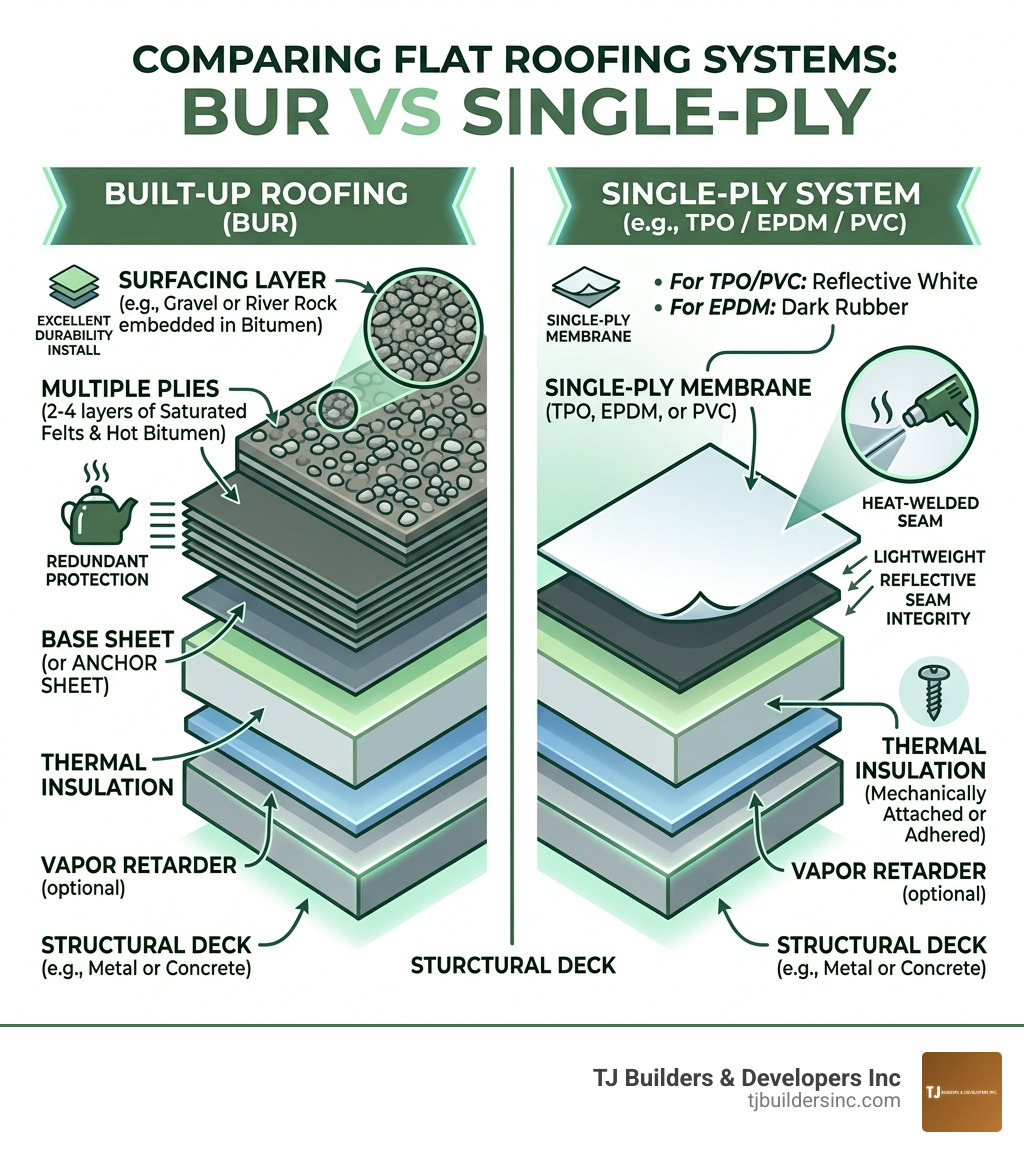
Built-Up Roofing, or “tar and gravel,” consists of multiple layers (plies) of asphalt-saturated felt bedded in hot bitumen. The top layer is usually covered with gravel or river rock to protect the asphalt from UV rays.
The beauty of BUR is its redundancy. If the top layer is damaged, you still have several layers of protection underneath. It is incredibly tough and handles foot traffic better than almost any other system. However, it is very heavy and the installation process involves hot kettles and strong odors, which can be disruptive. For more on how these are layered, visit our page on flat roof installation.
Modified Bitumen: The Reliable Analog Option
Think of Modified Bitumen (Mod-Bit) as the modern evolution of BUR. It comes in rolls of asphalt that have been “modified” with plastic or rubber polymers (like SBS or APP) to increase flexibility and durability.
Mod-Bit is often installed in two or three layers. It can be applied using a torch (torch-down), cold adhesives, or even self-adhering sheets. It’s a fantastic “middle ground” material that offers the redundancy of BUR with the easier installation of modern membranes. Products like Flintlastic® GMS | CertainTeed and POWERply® Standard Smooth | Tremco are excellent examples of the high-performance membranes available in this category today.
Metal Flat Roofing Materials and Longevity
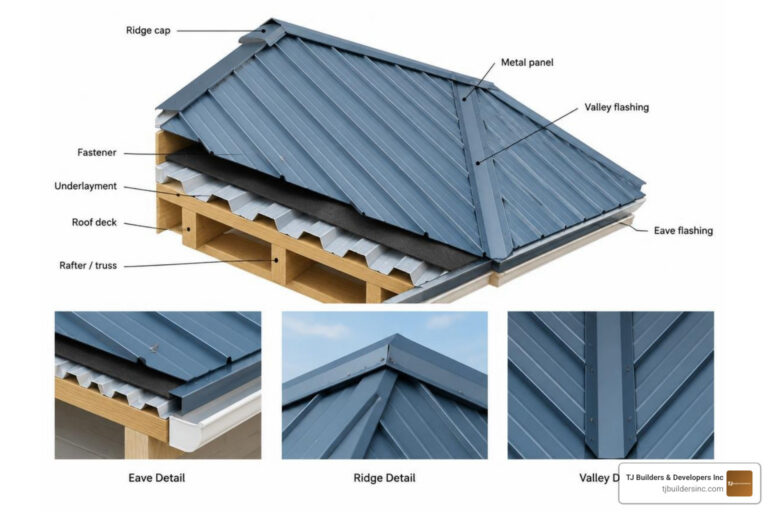
While we usually associate metal with sloped roofs, standing seam metal panels are a premium option for low-slope applications (typically requiring at least a 2:12 pitch). Metal roofs made of steel, aluminum, or copper can last 50 years or more.
They are the most eco-friendly choice because they are often made from recycled content and are 100% recyclable at the end of their life. However, they require expert installation to account for thermal expansion — metal grows and shrinks significantly with temperature changes, and if the fasteners aren’t designed to allow for that movement, the roof will eventually tear itself apart.
Performance, Maintenance, and Climate Suitability
In Northern Illinois, our flat roofing materials have to survive everything from -20°F winters to 100°F summers. This “thermal shock” is what kills most roofs.
Maximizing Lifespan for Different Flat Roofing Materials
Maintenance isn’t just a suggestion; it’s a requirement for your warranty. We recommend bi-annual inspections (Spring and Fall).
- Debris Removal: Leaves and branches trap moisture and can clog drains, leading to ponding.
- Seam Inspections: We check for any “fish-mouthing” or lifting at the seams.
- Walkway Pads: If you have HVAC units on your roof, we install thick rubber walkway pads to prevent technicians from accidentally puncturing the membrane.
- Reflective Coatings: For older Mod-Bit or BUR roofs, applying a silicone or acrylic coating can add years of life and improve energy efficiency.
A high-quality Henry EPDM Membrane is a great example of a weather-resistant solution that performs well in these fluctuating temperatures if maintained properly.
Supporting Rooftop Features: Decks, Solar, and Green Roofs
One of the best things about a flat roof is the usable space.
- Rooftop Decks: You can’t just throw a wooden deck on top of a membrane. We use pedestal-mounted pavers that “float” above the roof, allowing water to flow underneath to the drains.
- Solar Panels: Flat roofs are ideal for solar. We use ballasted racking systems that hold the panels down with weight rather than penetrating the roof membrane.
- Green Roofs: These vegetative layers help with stormwater management and provide incredible insulation. However, they are very heavy and require a structural engineer to verify the building can handle the load.
Need Help With Your Home?
TJ Builders & Developers handles roofing, siding, gutters, windows, home additions, and fire damage restoration for homes and businesses in Lakewood, Crystal Lake, Schaumburg, and nearby McHenry County towns.
- Free, no-obligation estimates
- Licensed & insured
- 20+ years of local experience
Frequently Asked Questions About Flat Roofs
Can I install standard asphalt shingles on a flat roof?
Absolutely not. Standard shingles rely on a steep slope and gravity to shed water. On a roof with a pitch lower than 2:12, water will get under the shingles, rot the wood deck, and cause leaks almost immediately. Flat roofs require a continuous, sealed membrane.
How long does a typical flat roof last in Northern Illinois?
While material lifespans vary, you can generally expect 20 to 30 years from a well-maintained TPO or EPDM roof. Modified Bitumen usually lasts 15 to 20 years. The key is preventing ponding water, which can cut those numbers in half.
Is it safe to walk on a flat roof for maintenance?
Yes, most flat roofing materials are designed to handle occasional foot traffic for maintenance. However, you should avoid walking on them in extreme heat (when they are soft) or extreme cold (when they can be brittle). Always wear soft-soled shoes and stay away from the edges!
Conclusion
Choosing between the various flat roofing materials doesn’t have to be overwhelming. Whether you prioritize the energy savings of TPO, the rugged flexibility of EPDM, or the multi-layer protection of Modified Bitumen, the goal is the same: a watertight seal that protects your investment.
At TJ Builders & Developers Inc, we pride ourselves on professional workmanship and helping our neighbors in Lakewood, Cary, and Schaumburg choose the right system for their specific home or business. We don’t just install roofs; we provide long-term protection against the unpredictable Illinois weather.
Ready to stop worrying about your low-slope roof? Contact our roofing experts today for a professional evaluation and a roof that won’t let you down.