Why Corrugated Roof Sheeting Deserves a Closer Look Before You Choose
Corrugated roof sheeting is one of the most widely used roofing materials in the world — and for good reason. It combines structural strength, long lifespan, and relatively straightforward installation into a single solution that works for homes, farms, and commercial buildings alike.
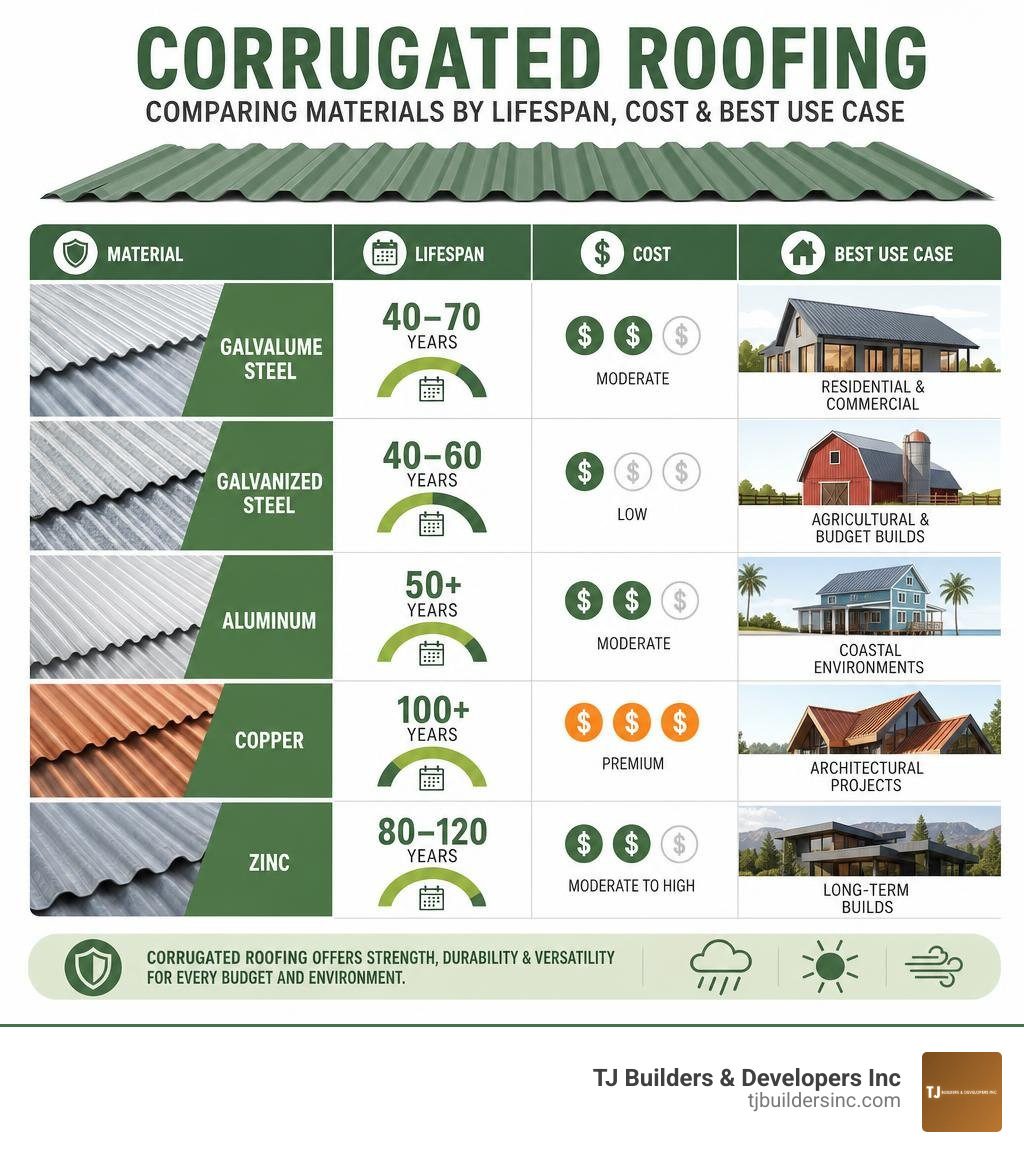
If you’re comparing corrugated roofing materials, here’s a quick snapshot of what’s available:
| Material | Lifespan | Best For | Key Advantage |
|---|---|---|---|
| Galvalume Steel | 40-70 years | Residential & commercial | Corrosion resistance, energy efficiency |
| Galvanized Steel | 40-60 years | Agricultural & budget builds | Edge protection, low cost |
| Aluminum | 50+ years | Coastal environments | Rust-proof, lightweight |
| Copper | 100+ years | Architectural projects | Self-patinating, premium appeal |
| Zinc | 80-120 years | Long-term builds | Self-healing, low maintenance |
Each material brings its own strengths, trade-offs, and price points. The right choice depends on your climate, budget, and how long you need the roof to perform.
The global corrugated roofing market was valued at roughly $8.5 billion in 2023 and is projected to reach $12.3 billion by 2030. That growth reflects real demand from homeowners and builders who want roofing that lasts, performs in harsh weather, and doesn’t require constant upkeep.
This guide breaks down each major material type side by side — so you can make a confident, informed decision before your next roofing project.
I’m Thomas Pruszynski from TJ Builders & Developers, and over 20 years of hands-on exterior construction work across Northern Illinois has given me direct experience with every major type of corrugated roof sheeting — from standard galvanized panels on agricultural outbuildings to premium metal systems on full residential re-roofs. That field experience shapes everything in this comparison.
Quick corrugated roof sheeting terms:
Understanding Corrugated Roof Sheeting: Materials and Manufacturing
To truly understand why corrugated roof sheeting performs so exceptionally well under the extreme weather conditions we experience in Northern Illinois, we have to look at how it is made. The secret to its structural strength lies not just in the metal itself, but in its geometry.
The manufacturing process relies on a cold-form method known as precision roll-forming. A flat sheet of metal is fed through a series of heavy rollers that gradually press the material into its characteristic wavy or ridged profile.

This shaping process does something incredible: it dramatically increases the sheet’s tensile strength and stiffness. Flat sheet metal is highly flexible and will sag under its own weight. However, once it is roll-formed into a corrugated pattern, it exhibits anisotropic behavior. This is a fancy engineering term meaning the material has different physical properties in different directions. Specifically, it becomes incredibly stiff and resistant to bending across the corrugations, allowing it to span much larger distances between roof supports without sagging under heavy snow loads.
When looking at corrugated profiles, you will encounter several key dimensions:
- Rib Height: The vertical distance from the lowest point of the panel (the valley) to the highest point (the crest). Common residential and commercial panels feature rib heights of 1/2″, 3/4″, or 7/8″.
- Pitch (Rib Distance): The distance between the center points of two adjacent crests. A standard 7/8″ corrugated panel typically features a 2.67″ pitch.
- Coverage Width: The actual width of the roof covered by the panel once it has been overlapped with its neighbor. For example, a panel with an overall width of 39″ might provide a net coverage of 34.67″ to 37″ depending on whether you overlap by one or two corrugations.
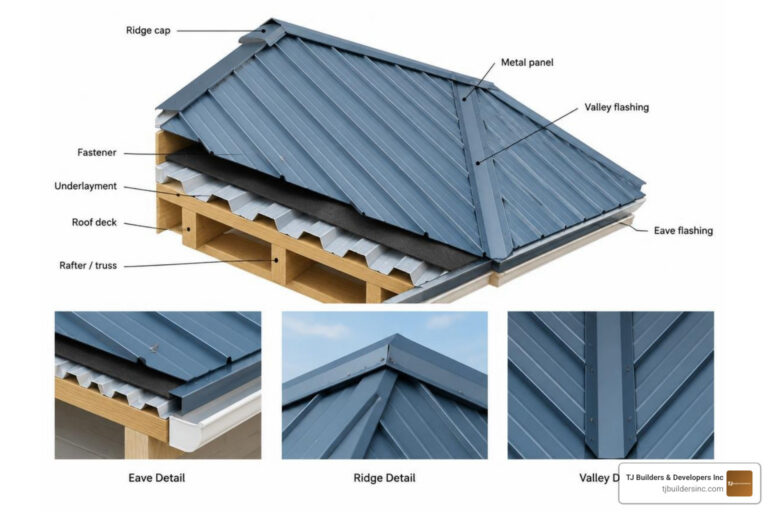
Corrugated panels are historically known as exposed fastener systems. This means they are secured to the roof structure using specialized screws that penetrate directly through the face of the metal panel, leaving the fastener heads visible.
The Chemistry of Steel Corrugated Roof Sheeting
When it comes to steel corrugated roof sheeting, the metal is only as good as the protective barrier coating applied to it. Raw, untreated steel will rust almost immediately when exposed to the elements. To prevent this, manufacturers apply advanced metallic coatings.
The two primary metallic coatings used in the industry are:
- Galvanized Steel: This steel is coated in a layer of 100% pure zinc. Zinc acts as a sacrificial anode, meaning it will corrode first to protect the underlying steel. Galvanized steel provides excellent edge and scratch protection because the surrounding zinc will actively migrate to seal minor cuts or scratches in the metal.
- Galvalume Steel: This is a highly advanced alloy coating consisting of 55% aluminum, 43.4% zinc, and 1.6% silicon. By combining these elements, Galvalume offers the barrier protection of aluminum alongside the sacrificial protection of zinc.
According to experts Exploring Corrugated Metal Roofing Sheets, Galvalume provides significantly better overall corrosion resistance and energy efficiency compared to traditional galvanized coatings. However, galvanized steel remains a highly reliable choice for specific environments where edge-cut protection is the primary concern.
Alternative Materials for Corrugated Roof Sheeting
While steel remains the most common choice, it is far from the only material used to manufacture corrugated panels. Depending on your building’s architectural style, structural requirements, and local climate, several alternative materials are highly effective:
- Aluminum Panels: Naturally rust-proof and exceptionally lightweight. Aluminum is a favorite for harsh or highly humid environments because it does not require a heavy metallic coating to resist oxidation.
- Architectural Copper: The ultimate luxury option. Copper is incredibly durable, lasting well over a century. Over time, it transitions from a bright metallic orange to a deep brown, and eventually to its signature green patina. It can also be soldered to create completely watertight transitions on complex roof shapes.
- Zinc Systems: Zinc is a highly durable, modern building material. Systems like the RHEINZINK® – Corrugated Roof Sheeting System utilize a premium alloy of 99% zinc with trace additions of titanium and copper. Zinc requires absolutely no paint or surface protection because it naturally develops a protective patina that heals its own minor scratches over time, boasting an impressive life expectancy of 80 to 120 years.
- Polycarbonate and Fiberglass Sheets: These translucent or transparent plastic panels are frequently used for skylights, greenhouses, and patio covers. They allow natural light to filter through while maintaining the same structural corrugated profile as their metal counterparts.
Need Help With Your Home?
TJ Builders & Developers handles roofing, siding, gutters, windows, home additions, and fire damage restoration for homes and businesses in Lakewood, Crystal Lake, Schaumburg, and nearby McHenry County towns.
- Free, no-obligation estimates
- Licensed & insured
- 20+ years of local experience
Comparing Corrugated Roofing Materials: A Product Roundup
Selecting the right corrugated roof sheeting requires a careful look at the technical specifications, durability ratings, and aesthetic finishes of each option. Let’s look at how these materials perform across several key categories:
| Feature | Galvalume Steel | Aluminum | Copper | Zinc |
|---|---|---|---|---|
| Standard Gauges | 22, 24, 26, 29 | 0.032″, 0.040″ | 16 oz, 20 oz, 24 oz | 0.80 mm, 1.00 mm |
| Weight (per sq. ft.) | ~1.0 to 1.6 lbs | ~0.4 to 0.6 lbs | ~1.1 to 1.6 lbs | ~1.1 to 1.4 lbs |
| Wind Resistance | Up to 140 mph | Excellent | Outstanding | Outstanding |
| Corrosion Resistance | High | Extremely High | Immune to Rust | Self-healing |
| Primary Aesthetic | Painted / Metallic | Painted / Matte | Natural Patina | Natural Blue-Grey |
Galvalume and Galvanized Steel Panels
Steel is the workhorse of the residential and commercial roofing industry. Modern steel panels are available in a massive array of colors and finishes, allowing homeowners in Lakewood, Crystal Lake, and Schaumburg to achieve everything from a classic rustic farmhouse look to a sleek, modern industrial aesthetic.
The secret to a steel panel’s long-term beauty is its paint system. High-quality steel panels, such as those detailed in the 7/8” CORRUGATED specifications, utilize advanced finishes:
- Silicone Modified Polyester (SMP): A highly durable, mid-range paint finish that offers excellent resistance to chalking, fading, and scratching. It typically carries a 40-year limited warranty.
- PVDF (Kynar 500 / Hylar 5000): The gold standard in metal coatings. PVDF resin-based paint systems provide unmatched resistance to UV radiation, ensuring that even deep, dark colors retain their vibrant hue for decades without fading.
For commercial properties or agricultural builds, local suppliers like Metal Panels | Huntley Metal Sales provide rugged, structural profiles designed to handle heavy wind and snow loads. To ensure these systems perform flawlessly in the unpredictable Chicagoland weather, we work closely with trusted regional fabricators to source panels engineered precisely for our local building codes.
Aluminum and Copper Corrugated Panels
For homeowners who want a roof that is structurally immune to rust, aluminum is an outstanding choice. Because aluminum does not contain iron, it cannot rust. This makes it highly desirable for properties near lakes or areas with high humidity. It is also incredibly lightweight, which puts less stress on your home’s framing and structural supports.
If you are looking for a true legacy material, copper has no equal. Copper has been used as a premium roofing material for thousands of years. It is highly malleable, allowing it to conform to complex architectural curves, and it possesses a natural antimicrobial property that prevents algae and moss growth.
According to product documentation like the CORRUGATED technical sheets, copper panels can be ordered in various weights (such as 16oz or 20oz) to match the structural requirements of your home, ensuring a lifetime of protection that actually grows more beautiful with age.
Key Advantages and Disadvantages of Corrugated Panels
Every roofing material has its trade-offs. To choose the best option for your home, it is important to weigh the pros and cons of corrugated roof sheeting objectively.

The Advantages:
- High Strength-to-Weight Ratio: The corrugation process allows incredibly thin sheets of metal to carry immense structural loads. This means you get a roof that can easily support heavy winter snow in McHenry or Barrington without adding unnecessary dead weight to your home’s rafters.
- Exceptional Energy Efficiency: Metal is highly reflective. A corrugated metal roof can reflect up to 90% of solar radiation. By preventing solar heat from entering your attic, a metal roof can reduce your summer cooling costs by 20% to 30%.
- Superior Durability: Metal panels are completely non-combustible, earning a Class A fire rating. They also resist rot, mold, insect damage, and severe impact from hail (Class 4 impact resistance).
- Extended Lifespan: While traditional asphalt shingles need to be replaced every 15 to 30 years, a properly installed corrugated metal roof will easily last 40 to 70 years or more.
The Disadvantages:
- Exposed Fasteners: Because the screws penetrate through the face of the panel, there are thousands of potential leak points on the roof. Over time, the rubber washers on these screws can degrade due to UV exposure, requiring routine inspection and maintenance.
- Oil Canning: This is a visual phenomenon characterized by a wavy, distorted appearance on the flat areas of metal panels. It is an inherent characteristic of light-gauge metal and does not affect the structural integrity of the roof, but some homeowners find it visually unappealing.
- Noise Levels: During a heavy rainstorm or hailstorm, metal roofs can be louder than asphalt shingles. However, this is easily mitigated by installing high-quality solid underlayments and thick attic insulation.
Corrugated vs. Standing Seam Systems
When homeowners begin researching metal roofing, they quickly find themselves choosing between corrugated panels and standing seam systems.
The main difference lies in how they are fastened:
- Corrugated Panels: Use exposed fasteners. The panels overlap and are screwed directly to the deck. This makes the system faster to install and highly cost-effective—typically costing about half as much as a standing seam roof.
- Standing Seam Systems: Use a concealed fastening system. The panels lock together at raised vertical seams, and the fasteners are hidden beneath the metal surface. This completely eliminates the risk of leaks from exposed screws and allows the metal to slide freely during thermal expansion and contraction.
While standing seam is a premium option, a corrugated roof is an incredibly durable, budget-friendly alternative. To learn more about how these systems are constructed, check out our comprehensive guide on standing seam metal roof installation a step by step masterclass.
Need Help With Your Home?
TJ Builders & Developers handles roofing, siding, gutters, windows, home additions, and fire damage restoration for homes and businesses in Lakewood, Crystal Lake, Schaumburg, and nearby McHenry County towns.
- Free, no-obligation estimates
- Licensed & insured
- 20+ years of local experience
Installation Standards and Maintenance Best Practices
A metal roof is only as good as its installation. To ensure your corrugated roof sheeting lasts for its full expected lifespan, professional installers must adhere to strict industry standards.

- Minimum Roof Pitch: Corrugated panels perform best on roofs with a slope of 3:12 or greater. This ensures that rainwater and melting snow drain quickly. For lower slopes (down to 1:12), specialized butyl tape sealant must be applied along every lap joint to prevent water from siphoning backward under the panels.
- Solid Underlayment: We always recommend installing a high-quality, self-adhered synthetic underlayment across the entire roof deck. This acts as a secondary waterproof barrier, protecting your home’s structural framing from any moisture infiltration.
- Proper Fastening: Screws must be driven straight and tightened to the perfect depth. Under-tightened screws will allow water to leak past the washer, while over-tightened screws will crush the EPDM rubber washer, causing it to split and fail prematurely.
Professional Installation and Repair
In Northern Illinois, our roofs must withstand intense weather—from freezing winter blizzards to violent summer thunderstorms with high winds. That is why we install panels that meet the rigorous UL 580 Class 90 Wind Uplift standard, which ensures the roof can withstand wind speeds up to 140 mph.
If your existing metal roof has sustained minor damage over years of service, you don’t necessarily need a full replacement. Simple issues can often be addressed with targeted repairs. To learn how to handle minor issues safely, read our guide on simple fixes for metal roof holes and punctures.
For a complete look at what it takes to install a beautiful, watertight metal roof on your home, we encourage you to explore the ultimate guide to metal roof and skylight installation in lakewood.
If you are looking for local resources or comparing options in your specific neighborhood, you can consult local municipal guidelines or regional building departments. For our neighbors across McHenry and Kane counties, understanding regional building standards is key to ensuring a successful, code-compliant installation.
Frequently Asked Questions About Corrugated Roofing
How long does a corrugated metal roof last?
With professional installation and basic maintenance, a high-quality Galvalume or aluminum corrugated metal roof will easily last 40 to 70 years. Premium materials like zinc and copper can last anywhere from 80 to over 100 years. This is significantly longer than traditional asphalt shingles, which typically require replacement every 15 to 30 years.
What is the minimum slope required for corrugated panels?
The recommended minimum slope for corrugated panels is 3:12 (a 3-inch rise for every 12 inches of horizontal run). This slope allows water to shed naturally. If your roof has a lower pitch, down to 1:12, you can still install corrugated panels, but you must apply double-sided butyl tape sealant along all panel overlaps to prevent water from backing up under the sheets.
Can corrugated roofing be installed over existing shingles?
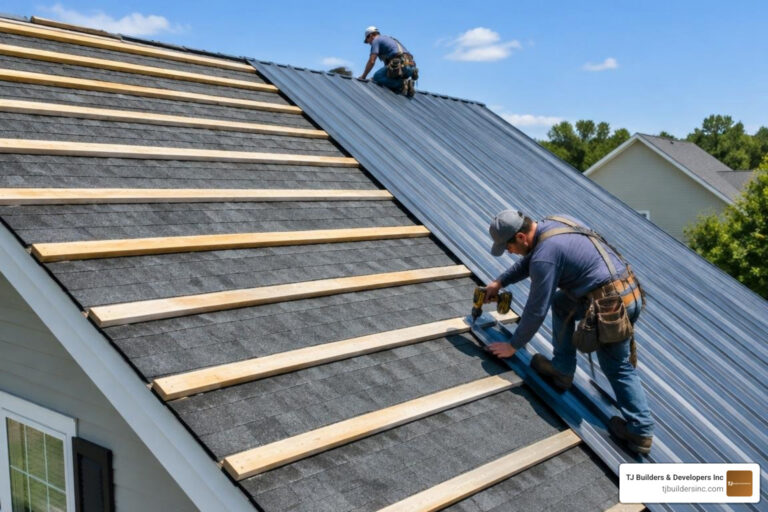
Yes, in many cases, corrugated metal roofing can be installed directly over existing asphalt shingles. Because metal is so lightweight, it rarely exceeds the structural weight limits of the home’s framing. However, this process requires installing a new layer of underlayment or wood furring strips (purlins) over the old shingles to provide a flat, secure fastening surface. Always consult with a professional contractor to ensure your roof structure is sound before proceeding.
Conclusion
Choosing the right corrugated roof sheeting is a smart, long-term investment in your home’s safety, energy efficiency, and curb appeal. Whether you select the rugged durability of Galvalume steel, the lightweight protection of aluminum, or the timeless elegance of copper or zinc, you are choosing a roof engineered to stand the test of time.
At TJ Builders & Developers Inc, we are committed to providing homeowners across Northern Illinois—including Lakewood, Crystal Lake, Schaumburg, and the surrounding suburbs—with exceptional workmanship, premium materials, and reliable service. We believe in doing the job right the first time, ensuring your home is protected against whatever weather the future brings.
Ready to upgrade your home with a beautiful, high-performance roof? Explore our comprehensive roofing services today, and let us help you build a home that lasts for generations.