Why a Hole in Your Metal Roof Demands Immediate Attention
Knowing how to fix a hole in a metal roof quickly can mean the difference between a simple patch job and thousands of dollars in water damage, mold, and structural repairs. Even a small puncture can let in enough moisture to ruin insulation, warp wood framing, and trigger mold growth within 48 hours.
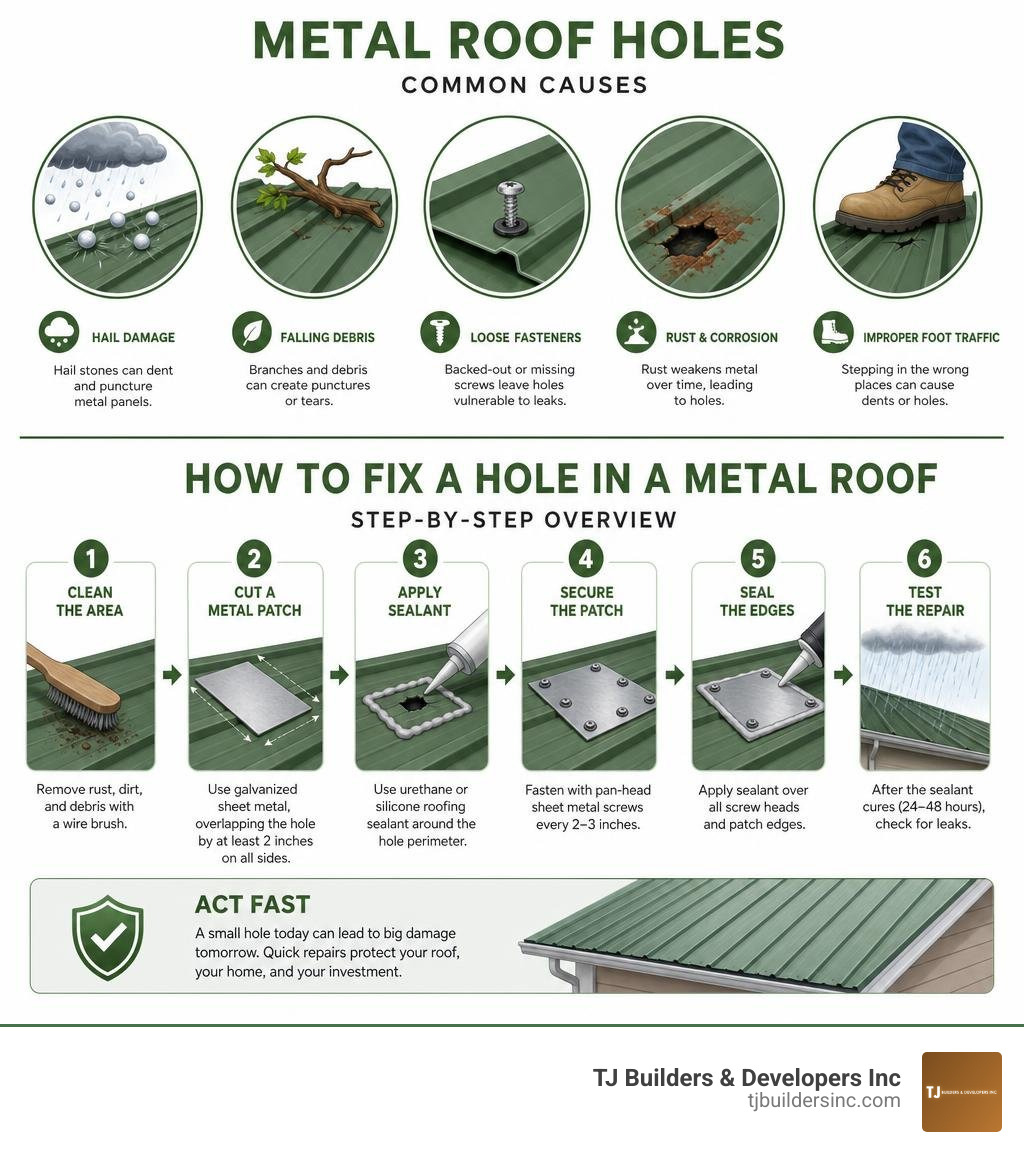
Here’s how to fix a hole in a metal roof — quick answer:
- Clean the area — Remove rust, dirt, and debris with a wire brush
- Cut a metal patch — Use galvanized sheet metal, overlapping the hole by at least 2 inches on all sides
- Apply sealant — Use urethane or silicone roofing sealant around the hole perimeter
- Secure the patch — Fasten with pan-head sheet metal screws every 2–3 inches
- Seal the edges — Apply sealant over all screw heads and patch edges
- Test the repair — After the sealant cures (24–48 hours), check for leaks
Metal roofs are built to last 40–70 years, but they aren’t invincible. Hail, falling branches, rust, and loose fasteners — which account for roughly 60% of all metal roof leaks — can all punch through or compromise the surface over time. The good news: most holes can be repaired without replacing the entire roof.
I’m Thomas Pruszynski from TJ Builders & Developers Inc, and over more than 20 years of exterior restoration work across Northern Illinois, I’ve helped countless homeowners fix holes in metal roofs before small problems became major ones. In the sections below, I’ll walk you through everything you need to know to assess, repair, and protect your roof.
Fix hole in metal roof terms simplified:
Common Causes and How to Safely Inspect a Metal Roof
Before climbing onto your roof with a caulk gun, it is vital to understand why the hole occurred and where the water is actually entering. Metal roof leaks are notoriously tricky because water rarely travels in a straight line. Gravity, roof pitch, and horizontal purlins can cause water to enter at one point and drip into your living room fifteen feet away.
The Culprits: What Causes Metal Roof Holes?
- Thermal Expansion and Contraction: Metal panels expand and contract constantly with changing temperatures. In Northern Illinois, where we experience freezing winters and hot, humid summers, this movement places incredible stress on fasteners. Over time, screws back out or shear off, leaving open holes.
- Storm Damage: High winds can loft heavy branches, while severe hailstorms can dent, scratch, or puncture protective coatings, exposing the bare steel to rust.
- Galvanic Corrosion: This occurs when two incompatible metals (like copper and steel) touch in the presence of moisture, rapidly eating holes through the panels.
- Improper Installation: Screws driven at crooked angles or over-tightened washers that split are prime targets for leaks.
How to Safely Locate the Leak
Safety must be your absolute highest priority when working on any roof, especially a metal one. Metal surfaces can be extremely slick, particularly if there is a light morning dew, algae growth, or a steep pitch.
- Start in the Attic: Before climbing up, grab a flashlight and head into your attic during or immediately after a rainstorm. Look for damp insulation, water stains on rafters, or active drips. Mark these areas so you know where to focus your search on the exterior.
- Use Proper Safety Gear: Always wear rubber-soled, non-slip shoes. If your roof has a steep pitch, use a safety harness anchored securely to a structural member. Never step directly on the metal panels between support trusses unless you are using a weight-distribution board (such as a 1/2-inch thick piece of plywood measuring at least 2×4 feet) laid across the rafters.
- Perform a Water Test: If you cannot find the hole visually, have an assistant stand in the attic with a flashlight while you gently run a garden hose over suspected areas on the roof, starting from the bottom and working your way up.
For a deeper dive into locating tricky leaks, check out The Ultimate Guide to Professional Roof Leak Inspection and Repair.
Need Help With Your Home?
TJ Builders & Developers handles roofing, siding, gutters, windows, home additions, and fire damage restoration for homes and businesses in Lakewood, Crystal Lake, Schaumburg, and nearby McHenry County towns.
- Free, no-obligation estimates
- Licensed & insured
- 20+ years of local experience
Essential Tools and Materials to Fix Hole in Metal Roof
Using the wrong materials is the number one reason DIY roof repairs fail within a season. For example, using standard acidic-cure silicone (which smells like vinegar) will actually corrode steel over time. Similarly, black asphalt-based roofing tars or cheap caulk will dry out, crack, and trap moisture against the metal, accelerating rust.
To ensure your repair lasts for a decade or more, gather these professional-grade tools and materials:
- Wire Brush and Scuff Pad: To remove rust, loose paint, and old sealant.
- Simple Green or Degreaser: To clean the surface thoroughly.
- Tin Snips: For cutting and rounding the metal patch.
- Galvanized Sheet Metal: To create the patch (always match your patch metal to your roof metal to prevent galvanic corrosion).
- Butyl Tape: To create a gasket seal beneath the patch.
- High-Quality Sealant: Urethane or neutral-cure silicone.
- Pan-Head Sheet Metal Screws: Equipped with neoprene or EPDM washers.
- Caulk Gun and Putty Knife: For applying and tooling the sealant.
To help you choose the right adhesive for your project, refer to this breakdown of common sealant types:
| Sealant Type | Estimated Lifespan | Best Use Case | Pros & Cons |
|---|---|---|---|
| Polyurethane Sealant | 10–15 Years | Sealing patch edges, joints, and flashing | Excellent adhesion, highly flexible; can be difficult to tool |
| Neutral-Cure Silicone | 15–20 Years | Small holes, screw heads, and seams | Exceptional UV resistance, does not corrode metal; cannot be painted |
| Butyl Tape (Gasket) | 15–20 Years | Underneath patches and panel overlaps | Creates a watertight gasket, stays flexible; must be mechanically fastened |
| Asphaltic Tar / Caulk | 1–2 Years | Avoid entirely on metal roofs | Cheap and easy to apply; cracks quickly, damages metal coatings |
For further advice on choosing compatible materials, you can consult How to Repair Metal Roof: Simple Fixes – Lowe’s .
Step-by-Step Guide: How to Patch a Metal Roof Hole
Now that you have gathered your tools and safely located the damage, it is time to apply a permanent patch. This process works best on dry days when the temperature is above 50°F, allowing your sealants to cure properly.

Step 1: Clean and Prep the Surface
A patch is only as good as its adhesion. If you apply sealant over dirt, rust, or old peeling paint, it will pull away during the next freeze-thaw cycle.
Begin by using a stiff wire brush to scrape away any loose rust, flaking paint, or degraded sealant around the hole until you reach bare, shiny metal. Spray the area with a heavy-duty cleaner like Simple Green, scrub it down with a scuff pad to create microscopic scratches (which help the sealant bond), and rinse it clean. Allow the surface to dry completely before proceeding.
Step 2: Cut and Shape the Patch to Fix Hole in Metal Roof
Measure the damaged area. Your patch must overlap the hole by at least 2 inches on all sides. For example, a 1-inch puncture requires a patch that is at least 5×5 inches.
Using your tin snips, cut the patch from a sheet of matching galvanized metal. Crucial tip: Always round the corners of your metal patch. Sharp, square corners are easily caught by snow, ice, or tree branches, which can peel the patch right off the roof over time.
For more details on preparing and sizing patches properly, refer to How to Repair a Hole in a Metal Roof System .
Step 3: Apply Sealant and Secure the Patch
Flip your metal patch over and apply a continuous ring of high-quality butyl tape or a thick bead of urethane sealant around the underside perimeter, about 1/2-inch from the edge. This creates a watertight gasket that prevents water from backing up under the patch.
Place the patch directly over the hole. Using your drill and self-tapping pan-head sheet metal screws (equipped with EPDM washers), secure the patch to the roof. Space the screws every 2 to 3 inches around the perimeter. As you tighten the screws, you should see a small, uniform bead of sealant squeeze out from the edges of the patch.
Use a putty knife to tool this excess sealant smoothly along the edge, creating a sloped transition that sheds water. Finally, dab a small dollop of sealant over every screw head to protect the washers from UV damage.
If you are looking for more handy maintenance tips, take a look at Stop the Drip with These Simple DIY Roof Repair Tips.
Repairing Different Metal Roof Profiles and Seams
The physical profile of your metal roof greatly dictates how you should approach a repair. A flat panel behaves very differently than a raised seam or a corrugated ridge.
Patching Flat Panels vs. Raised Seams
On flat metal panels, a rigid metal patch works beautifully because the surface is uniform. However, raised seams (such as those on standing seam roofs) are designed to slide, expand, and contract freely to accommodate temperature swings.
If you attempt to screw a rigid metal patch across a raised seam, the intense thermal movement will shear the screws or tear the metal within a few seasons. Instead, raised seams must be repaired using flexible materials. This involves applying a layer of elastomeric roof coating, embedding a flexible membrane fabric over the seam, and applying a second topcoat of elastomeric sealant. This creates a highly flexible, waterproof bridge that moves with the roof.
To learn more about how standing seam systems are engineered, read Standing Seam Metal Roof Installation: A Step-by-Step Masterclass.
How to Fix Hole in Metal Roof Fasteners and Seams
Screws that have backed out or stripped their holes are the single most common source of metal roof leaks.
If you find a loose screw, do not simply tighten it, as the wooden purlin underneath is likely stripped. Instead:
- Back the old screw out completely.
- Inspect the hole. If it is enlarged, replace it with a larger diameter “oversized” roofing screw (such as a #14 screw to replace a #10 screw).
- Ensure the new screw has a fresh EPDM or neoprene washer.
- Drive the screw in straight until the rubber washer compresses slightly past the edge of the metal cap. Do not over-tighten, or you will split the washer and cause a new leak.
For emergency situations where multiple fasteners are failing, read our guide on Emergency Roof Repair Leak Detection.
Need Help With Your Home?
TJ Builders & Developers handles roofing, siding, gutters, windows, home additions, and fire damage restoration for homes and businesses in Lakewood, Crystal Lake, Schaumburg, and nearby McHenry County towns.
- Free, no-obligation estimates
- Licensed & insured
- 20+ years of local experience
When to Choose Professional Restoration Over DIY Patching
While patching a single small puncture from a fallen branch is a highly manageable weekend project for a handy homeowner, there are times when a DIY patch is simply not enough.

Structural and Safety Red Flags
- Widespread Rust and Corrosion: If rust has eaten through multiple areas of a panel, patching is a temporary band-aid on a terminal problem. The panel has lost its structural integrity and must be replaced.
- Large Holes or Severe Storm Damage: If a tree limb has torn a hole larger than 6 inches, or if more than 30% of a roof section is dented and punctured, full panel replacement is required.
- Steep Pitches and Multi-Story Homes: Climbing onto a high, steep roof is incredibly dangerous. Professional crews have the scaffolding, safety harnesses, and specialized training to work safely at heights.
- Warranty Concerns: Many modern metal roofs carry 30- to 50-year manufacturer warranties. Performing your own repairs will almost certainly void these warranties. Manufacturers typically require that any repairs or modifications be performed by certified, licensed roofing contractors.
At TJ Builders & Developers Inc, we specialize in evaluating whether your roof can be safely repaired or if a panel replacement is the most cost-effective, long-term solution for your home. We serve homeowners across Northern Illinois, including Lakewood, Crystal Lake, Schaumburg, and surrounding areas, ensuring your home remains completely protected from our unpredictable Midwestern weather.
To understand the financial differences between a simple patch and structural work, read The Price of a Dry Ceiling and Other Roof Repair Costs.
Frequently Asked Questions About Metal Roof Repairs
How long does a metal roof patch last?
A professionally installed metal patch secured with high-quality butyl tape, urethane sealant, and screws can easily last 10 to 20 years. However, the sealant itself is the limiting factor. While the metal patch will not degrade, the exposed sealant along the edges can dry out or crack after a decade of intense UV exposure. Routine annual inspections are key to ensuring the sealant remains intact.
Can you patch a rusted metal roof?
Yes, but only if the rust is localized and has not structurally weakened the metal panel. You must thoroughly scrub away all loose rust using a wire brush, apply a high-quality rust converter (which chemically changes iron oxide into a stable protective barrier), prime the area with a metal primer, and then apply your patch. For historic or traditional flat-seam metal roofs, traditional soft soldering is often the preferred preservation method, as detailed in Repairing Holes In A Sheetmetal Roof . If the rust is widespread or flakey throughout the panel, the entire sheet must be replaced.
Will a DIY patch void my metal roof warranty?
In almost all cases, yes. Most manufacturer warranties dictate that any repairs, penetrations, or alterations must be handled by a licensed, certified roofing contractor using approved materials. If you apply a DIY patch and later experience a major warranty-related issue, the manufacturer may deny your claim. If your roof is still under warranty, always call a professional first.
Conclusion
A hole in your metal roof is a problem that only gets more expensive the longer you ignore it. Whether you decide to tackle a small, straightforward puncture yourself or call in the experts for a complex repair, taking swift action is the key to preserving your home’s structural integrity.
At TJ Builders & Developers Inc, we pride ourselves on delivering top-tier workmanship, durable materials, and reliable home exterior solutions to our neighbors in the Village of Lakewood, Crystal Lake, Schaumburg, and across Northern Illinois. We understand the unique demands our local climate puts on residential roofing, and we are here to ensure your home stays dry, safe, and beautiful for decades to come.
If you suspect your metal roof has a leak, or if you want a professional, worry-free repair backed by years of local expertise, contact us today or visit our Roof Repair page to schedule a comprehensive inspection.