Why Metal Roof Installation Is One of the Best Long-Term Investments for Your Home
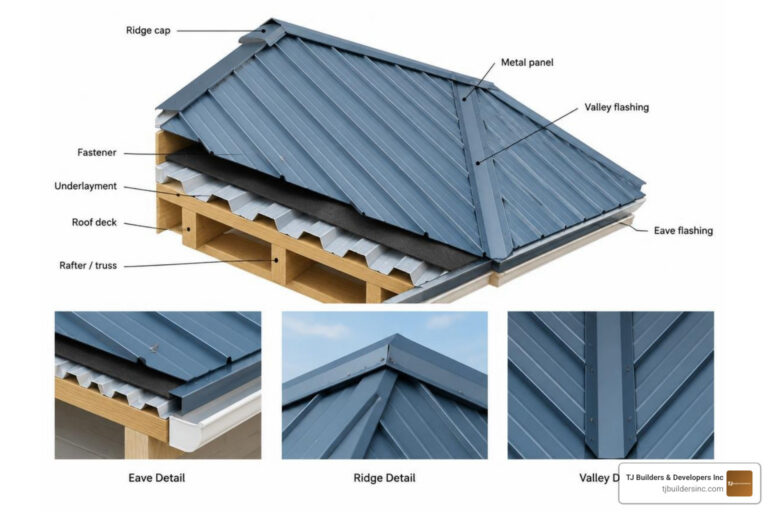
Metal roof installation is the process of fitting durable, weather-resistant metal panels onto a home’s roof structure — including underlayment, trim, flashing, fasteners, and ridge caps — to create a watertight, long-lasting roofing system.
Here is a quick overview of what professional metal roof installation involves:
- Inspect and prepare the roof deck — check for damage, add sheathing if needed
- Install underlayment — synthetic or ice-and-water shield, lapped correctly
- Attach drip edge and eave trim — directs water away from the fascia
- Set and fasten metal panels — aligned square, fastened with rubber-washered screws
- Overlap and seal panel joints — butyl tape or sealant at all seams
- Install flashing — around skylights, chimneys, vents, and all penetrations
- Secure the ridge cap — foam closure strips and sealed overlaps at the peak
- Final inspection — check fasteners, seals, and alignment throughout
Metal roofs have been trusted for over 2,000 years — and for good reason. They last 40 to 70 years, weigh far less than asphalt shingles (40–120 lbs per square versus 200–350 lbs), and are virtually 100% recyclable. For homeowners in Lakewood and the surrounding Northern Illinois area, that durability matters. Harsh winters, freeze-thaw cycles, and seasonal storms put real stress on any roofing system. Metal stands up to all of it better than most alternatives.
Metal roofing has also grown significantly — now holding around 17% of the residential roofing market, up from just 4% a decade ago. More homeowners are recognizing that the higher upfront cost pays off in reduced maintenance, lower energy bills, and long-term property protection.
I’m Thomas Pruszynski, and at TJ Builders & Developers Inc, I’ve spent over 20 years helping homeowners across Lakewood and Northern Illinois with metal roof installation and exterior restoration projects. My team treats every roof as if it were our own — and in this guide, I’ll walk you through everything you need to know.

Metal roof installation terms to learn:
Essential Components and Materials for Metal Roof Installation
Choosing the right material is the first step in ensuring your home remains protected for decades. In the Chicago suburbs, we deal with everything from heavy snow loads to high winds, so the “flavor” of metal you choose matters.
| Material | Lifespan | Best For | Key Attribute |
|---|---|---|---|
| Steel | 40-60 Years | General Residential | Strong and cost-effective; requires coating. |
| Aluminum | 50+ Years | Coastal/High Humidity | Naturally rust-resistant; expands more than steel. |
| Copper | 100+ Years | Historic/Luxury | Develops a beautiful green patina; very expensive. |
| Zinc | 80-100 Years | Modern Architectural | Self-healing and highly moldable. |
Metallic Coatings and Finishes
Raw steel wouldn’t last a week in a wet Illinois spring without protection. We use Galvalume®, an alloy of 55% aluminum and 45% zinc, which offers the best of both worlds: the barrier protection of aluminum and the “sacrificial” galvanic protection of zinc. For traditional galvanized steel, a G90 rating (0.90 ounces of zinc per square foot) is the industry standard for high-quality residential work.
The “face” of your roof is the paint system. High-performance PVDF finishes, often known by trade names like Kynar 500® or Hylar 5000®, use a resin blend of 70% fluoropolymer and 30% acrylic. These are essential in areas like Schaumburg or Elk Grove Village because they resist chalking and fading from UV exposure better than cheaper polyester paints.
Thermal Expansion and Gauge
Metal is a living material—it breathes. Aluminum, for instance, expands and contracts twice as much as steel. We must account for this thermal movement during metal roof installation to prevent “oil canning” (that wavy look) or fastener failure. Thickness is measured in gauges; for residential roofing, we typically use 24 to 26 gauge steel. Remember: the lower the number, the thicker the metal!
Structural vs. Non-Structural Metal Roof Installation
Not all metal panels are created equal. Some are designed to hold up the weight of the world, while others are there for the “pretty face.”
- Structural Panels: These can span across open framing (like purlins or trusses) without a solid wood deck underneath. They are heavy-duty and carry the structural load of snow and wind.
- Non-Structural Panels: These require a solid substrate, like plywood or OSB sheathing. Most residential homes in Lakewood use non-structural panels because they already have a solid roof deck.
Hydrokinetic vs. Hydrostatic
This sounds like a high school physics pop quiz, but it’s actually quite simple. Hydrokinetic systems are “water-shedding.” They rely on a steep slope (usually 3:12 or greater) to pull water down quickly. Hydrostatic systems are “water-tight.” These are used on very low-slope roofs (as low as 1/4:12) and feature tall, mechanically seamed ribs that can actually handle standing water for short periods without leaking. For more on choosing the right system, check out our Roof Installation & Replacement Complete Guide.
Need Help With Your Home?
TJ Builders & Developers handles roofing, siding, gutters, windows, home additions, and fire damage restoration for homes and businesses in Lakewood, Crystal Lake, Schaumburg, and nearby McHenry County towns.
- Free, no-obligation estimates
- Licensed & insured
- 20+ years of local experience
Panel Attributes and Side-Joint Configurations
The way panels lock together determines how your roof handles a Barrington thunderstorm.
- Standing Seam: The gold standard. The fasteners are hidden under the ribs, meaning there are no holes in the metal exposed to the rain. The seams can range from 1 inch to 3 inches high.
- Corrugated and Ribbed: These use “exposed fasteners.” You’ll see the screw heads on the surface. While more affordable, they require more maintenance to ensure the rubber washers don’t dry out over time.
- Anti-Siphon Channels: High-quality panels feature a small groove on the under-lap of the rib. This channel uses gravity to catch any water that tries to “wick” up into the seam and directs it safely down to the eave.
Professional Standards for Substructures and Underlayment

A metal roof is only as good as what’s underneath it. Before we even think about the metal, we perform a rigorous deck inspection. We check for rot, sagging, and “deflection.” If a roof deck flexes too much (more than 1/240th of the span), the metal seams could pull apart.
The Importance of Underlayment
In the Chicago suburbs, we don’t use old-fashioned felt paper. We use high-temp synthetic underlayment rated for 240°F+. Metal gets hot—really hot—and standard felt can literally stick to the bottom of the panels or degrade.
- Ice and Water Shields: These are non-negotiable in Illinois. We install these self-healing membranes along the eaves and in valleys to protect against ice dams.
- Slip Sheets: Sometimes, a layer of rosin paper is needed between the underlayment and the metal to prevent the two from sticking together during thermal expansion.
- Vapor Barriers: Proper ventilation is key to preventing condensation. Without it, moisture can trap under the metal, leading to “white rust” or deck rot. If you’re considering an upgrade, read about our reroofing and retrofit considerations.
The Step-by-Step Process of Professional Metal Roof Installation
1. Squaring the Roofline
We never assume a house is perfectly square. We use the 3-4-5 method (a bit of Pythagorean theorem for the job site) to snap a perfectly square reference line. If the first panel is off by even a quarter inch, by the time you reach the other side of the house, you’ll be inches out of alignment.
2. Eaves and Drip Edges
The eave trim is installed first. We use butyl tape sealant between the metal and the trim to create a gasket-like seal. This prevents wind-driven rain from being blown up under the panels.
3. Panel Overlapping and Foam Closures
As we set the panels, we ensure the “overlap” side (the one with the anti-siphon channel) is positioned correctly. At the eaves and the ridge, we insert foam closure strips. These are shaped exactly like the panel profile to block out bugs, birds, and snow while still allowing the roof to breathe.
Precision Fastening in Metal Roof Installation
Fastening is where most DIY projects go wrong. It’s not just about “screwing it down.”
- Clip Systems: In standing seam systems, we use clips that allow the panel to “float.” This lets the metal expand in the summer sun without pulling the screws out of the wood.
- Self-Tapping Screws: For exposed fastener roofs, we use screws with neoprene or EPDM washers.
- Torque Settings: If you under-tighten, it leaks. If you over-tighten, you crush the washer and it cracks within two years. We drive them until the washer is just slightly visible past the screw head.
To avoid galvanic corrosion, we never mix metals. You can’t use copper flashing with a steel roof—the two will have a chemical reaction that “eats” the metal. We always match our fasteners and trim to the panel material. For repairs on older systems, see our expert roof repair standards.
Need Help With Your Home?
TJ Builders & Developers handles roofing, siding, gutters, windows, home additions, and fire damage restoration for homes and businesses in Lakewood, Crystal Lake, Schaumburg, and nearby McHenry County towns.
- Free, no-obligation estimates
- Licensed & insured
- 20+ years of local experience
Specialized Flashing for Skylights and Penetrations
Skylights are the “high-risk” areas of any metal roof installation. We prefer curb-mounted skylights, which allow us to build a “mini-wall” that the metal panels can be flashed against.
- Chimney Crickets: If your chimney is wider than 30 inches, Illinois code often requires a “cricket”—a small peaked structure behind the chimney to divert water.
- Pipe Boots: We use flexible EPDM boots that stretch over vent pipes and seal tightly to the metal profile.
- Maintenance-Free Detailing: We avoid relying solely on caulk. A professional install uses mechanical “locks” and folds to shed water, with sealant acting only as a secondary backup. This is similar to the precision needed in flat roof installation techniques.
Safety, Handling, and Quality Control Standards
Safety isn’t just a suggestion; it’s a requirement. Metal panels are incredibly slippery, especially with a morning dew in Crystal Lake.
- Fall Protection: We use full-body harnesses and OSHA-approved anchor points on every job.
- Preventing White Rust: If metal panels get wet while they are still stacked in a pile, they can develop “storage stain” or white rust. We always store materials off the ground and under a breathable tarp.
- Tool Selection: We never use a circular saw with a standard blade to cut metal—it “burns” the factory finish and leads to rust. We use aviation snips, electric shears, or specialized “cold-cut” blades.
Our final inspection checklist includes checking every single fastener, ensuring all metal shavings (swarf) have been swept off (to prevent rust spots), and verifying that all sealants are continuous. We follow the MCA (Metal Construction Association) manual to ensure every install meets national standards.
Frequently Asked Questions about Metal Roofing
How long does a metal roof last in Northern Illinois?
In our local climate, a properly installed steel or aluminum roof will easily last 40 to 70 years. Copper and zinc can last over a century. This is significantly longer than the 15–20 years you might get from traditional shingles.
Can you install metal panels over existing asphalt shingles?
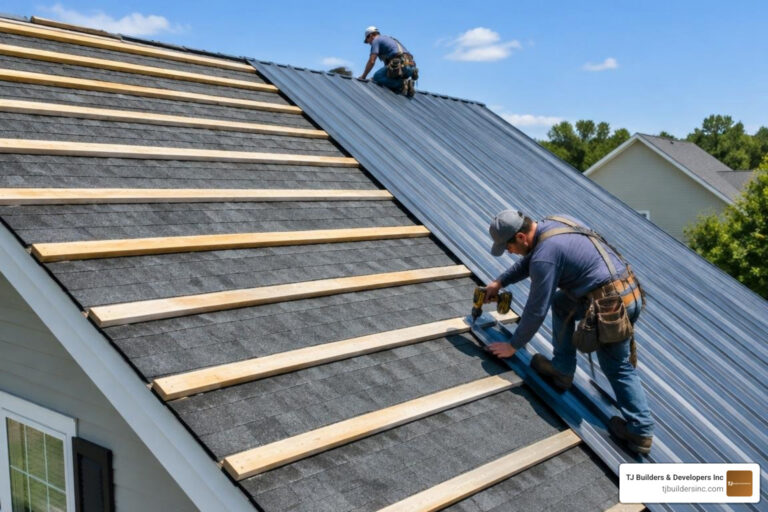
Yes, it is possible, but we usually recommend a full tear-off. Removing the old shingles allows us to inspect the wood deck for rot and ensures the new underlayment lays perfectly flat. If we do go over shingles, we often use a “batten” system to create an air gap.
What maintenance is required for a residential metal roof?
Very little! We recommend a quick annual check to clear debris from valleys and ensure that pipe boots and sealants are still in good shape. Unlike shingles, metal won’t grow moss or algae, making it a “set it and forget it” option for many homeowners.
Conclusion
At TJ Builders & Developers Inc, we believe that a roof should be more than just a cover—it should be a lifetime investment. Serving Lakewood, Crystal Lake, Schaumburg, and the surrounding Chicago suburbs, we bring professional workmanship and eco-friendly solutions to every project. Whether you are dealing with storm damage or simply want the most durable roof on the block, our team is here to help.
Ready to protect your home with a roof that lasts a lifetime? Contact our professional roofers in Lakewood, IL today for a consultation and experience the difference of expert metal roof installation.