
Why Choosing the Right Illinois Roofing Contractors Matters for Your Home
Illinois roofing contractors vary widely in quality, licensing, and reliability — and picking the wrong one can cost you thousands in repairs down the road.
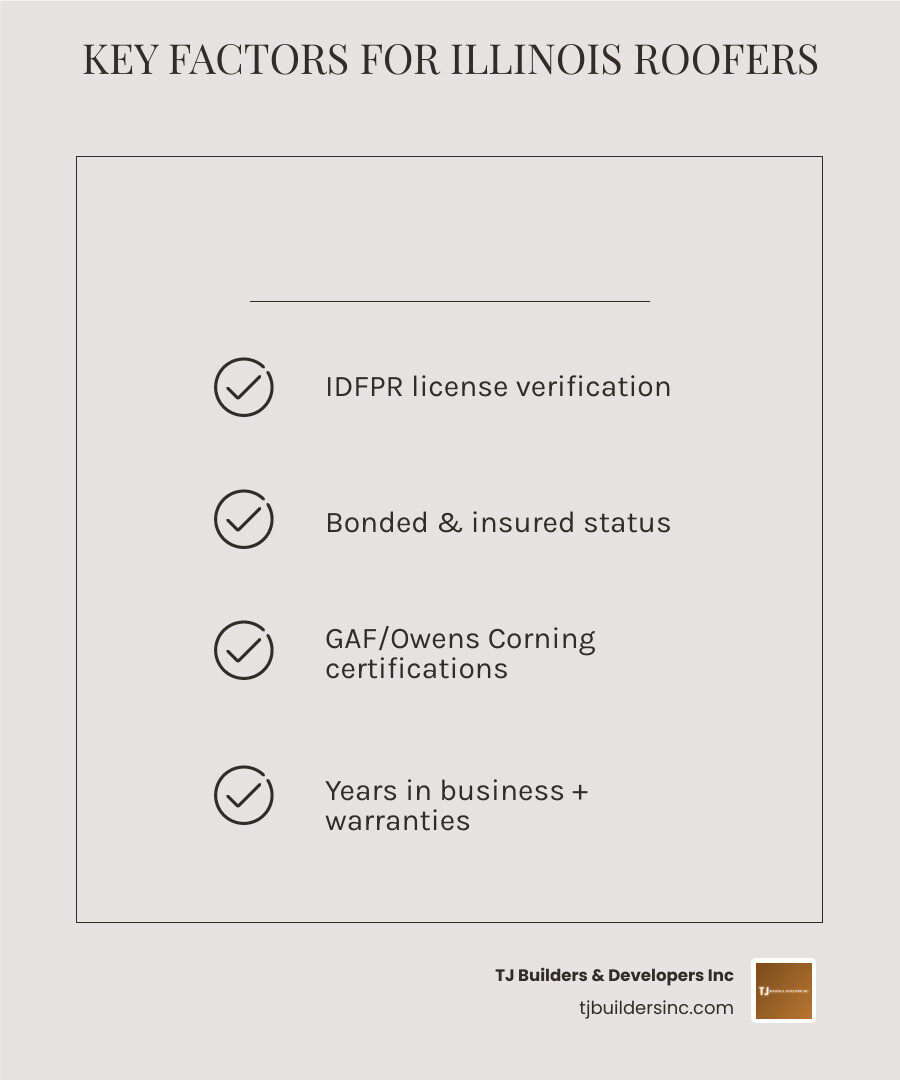
Here’s a quick look at what to prioritize when evaluating roofers in Illinois:
| What to Check | Why It Matters |
|---|---|
| IDFPR license | Required by Illinois law for all roofing contractors |
| Insurance (bonded & insured) | Protects you if something goes wrong on the job |
| Manufacturer certifications (GAF, Owens Corning) | Signals training, quality standards, and access to stronger warranties |
| Years in business | Longer track record means more accountability |
| Written warranty | Covers both workmanship and materials |
| Local service area knowledge | Illinois weather — ice, wind, hail — demands regional expertise |
Illinois roofs take a beating. Harsh winters, spring storms, and temperature swings from one extreme to the other put real stress on any roofing system. A poorly installed or poorly maintained roof doesn’t just look bad — it puts your entire home at risk of water intrusion, structural damage, and energy loss.
That’s why who you hire matters just as much as what materials they use.
I’m Thomas Pruszynski from TJ Builders & Developers Inc., and after 20+ years working with Illinois homeowners on exterior restoration and roofing projects, I’ve seen what separates reliable Illinois roofing contractors from the ones that leave you with bigger problems than you started with. This list will help you make a confident, informed decision.
Illinois roofing contractors word list:
Essential Licensing for Illinois roofing contractors
In the state of Illinois, roofing isn’t just a trade; it’s a strictly regulated profession. If you are talking to someone who says they can “do your roof” but can’t produce a state-issued license number, that is your cue to politely close the door.
The Illinois Department of Financial and Professional Regulation (IDFPR) is the governing body that oversees the industry. Under the Roofing Industry Licensing Act, any person or business operating as a roofing contractor must be licensed. This isn’t just a piece of paper; it ensures the contractor has met specific professional regulations, including holding the proper insurance and naming a “Qualifying Party.”
The Qualifying Party is a designated individual within the company who has sat for and passed a rigorous state examination. This person is responsible for ensuring the company follows all Roofing Industry Licensing Rules.
Before you sign any contract, we always recommend homeowners use the License Look Up tool. You can search by business name or license number (which usually starts with 104 or 105 in Illinois). This simple step confirms the license is active and in good standing.
Critical Selection Criteria for Homeowners
Choosing between various Illinois roofing contractors can feel like a toss-up if you only look at the price. However, the “cheapest” option often becomes the most expensive when the roof starts leaking two years later and the contractor is nowhere to be found.
When we talk to homeowners in Lakewood or Schaumburg, we emphasize these three pillars of selection:
- Years in Business: Experience matters. A company that has survived 20 or 30 years in the Chicago suburbs has weathered the same storms your roof has. They understand the local building codes and the unique challenges of Midwestern architecture.
- Customer Reviews: Don’t just look at the star rating. Read the stories. Did the crew clean up the nails in the driveway? Did the project manager communicate when the weather delayed the start date? Real testimonials reveal the true character of a business.
- Professionalism and Documentation: A reliable contractor provides a detailed, written scope of work. If you’re feeling overwhelmed by the technical jargon, check out our Roof Installation & Replacement Complete Guide to understand exactly what should be in your proposal.
Manufacturer Certifications for Illinois roofing contractors
One of the best ways to vet a contractor is to see what the manufacturers think of them. Companies like GAF and Owens Corning don’t just hand out certifications to anyone.
For example, a GAF Master Elite contractor is part of a small percentage of roofers who have met high standards for insurance, licensing, and ongoing training. These certifications are your gateway to better warranties. While any roofer can buy shingles, only certified contractors can offer enhanced protection like the Silver Pledge™ or Golden Pledge warranties.
When exploring Asphalt Shingle Options, look for contractors who prioritize Asphalt Roof Installation techniques that meet or exceed manufacturer specifications. This ensures your warranty remains valid for decades.
Service Areas and Local Expertise of Illinois roofing contractors
Local expertise isn’t just about knowing the shortcuts to the job site; it’s about knowing the weather. Roofers in Lakewood IL and surrounding areas like Crystal Lake or Barrington know that a roof in Northern Illinois faces a different set of challenges than one in Southern Illinois.
We deal with “lake effect” snow, high-velocity winds, and summer humidity that can turn a poorly ventilated attic into a sauna. When performing Reroofing, we look at the entire system—ventilation, underlayment, and flashing—to ensure it can handle the brutal Midwestern cycle.
Comprehensive Exterior Services and Restoration
A roof doesn’t exist in a vacuum. It works in tandem with your siding, gutters, and windows to keep your home dry. Often, a roofing project is triggered by a sudden event, like a severe hailstorm.
If your neighborhood was recently hit, you might need Storm Hail Damage Restoration. Hail can bruise shingles, knocking off the protective granules and leaving the asphalt mat exposed to UV rays. Over time, this leads to leaks. Identifying a Hail Damage Roof early can save you from a full structural replacement later.
For more immediate issues, such as a tree limb falling or a sudden leak during a downpour, you need Emergency Roof Repair & Leak Detection. We use digital assessments to pinpoint exactly where moisture is entering, whether it’s a residential shingle roof or a Flat Roof Installation on a commercial building.
Specialized Maintenance and Exterior Care
In Northern Illinois, maintenance is a year-round job. Many homeowners don’t realize that winter is actually one of the hardest seasons for a roof.
- Ice and Snow: We specialize in Ice Dam Removal and Roof Snow Removal. When snow melts and refreezes at the gutters, it backs up under the shingles. Without proper ice and water shields, this leads to interior ceiling damage.
- Organic Growth: If your roof has North-facing slopes or heavy tree cover, you might notice green or black streaks. We provide Moss Removal Roof services to prevent organic matter from eating away at your shingles.
- Skylights and Gutters: A leak isn’t always the roof’s fault. Sometimes it’s a cracked seal on a window or a clogged gutter. We offer Skylight Repair Lakewood and full gutter installations to ensure water is directed away from your foundation.
Navigating Warranties and Insurance Claims
Understanding the difference between warranties is crucial. Many homeowners think they are “fully covered” only to find out their warranty only applies to the shingles themselves, not the labor to fix them.
| Warranty Type | What it Typically Covers | Who Provides It |
|---|---|---|
| Manufacturer Warranty | Defects in the shingles (cracking, curling) | The Shingle Maker (e.g., GAF) |
| Workmanship Warranty | Errors made during installation | The Roofing Contractor |
| Extended/System Warranty | Both materials and labor for up to 50 years | Certified Contractors + Manufacturer |
For those dealing with storm damage, the insurance restoration process can be a headache. We work to provide clear documentation for your insurance company, but in complex cases, some homeowners choose to hire a public adjuster to represent their interests. Whether you are doing a simple Roof Repair or a full replacement, having a contractor who understands the Roofing System Limited Warranty requirements is essential for your long-term protection.
Red Flags to Avoid During the Hiring Process
Not all Illinois roofing contractors are created equal. In fact, after a big storm, “storm chasers” often flood the Chicago suburbs. These are out-of-state companies that knock on doors, collect insurance checks, and disappear.
Watch out for these red flags:
- High-Pressure Sales: If they tell you the “deal” is only good for today, walk away.
- No Physical Address: Reliable companies have an office in places like Lakewood, Schaumburg, or Palatine. A P.O. Box is a warning sign.
- Unlicensed or Uninsured: Always ask for proof of workers’ comp and general liability insurance. If a worker gets hurt on your property and the contractor isn’t insured, you could be liable.
- Vague Contracts: A contract should list the specific materials (brand and color), the timeline, and the cleanup process.
When you’re looking at the factors to consider when budgeting for your roof replacement, quality labor and high-grade materials are an investment in your home’s equity.
Frequently Asked Questions about Illinois Roofers
How do I verify if a roofing contractor is licensed in Illinois?
Homeowners should use the Illinois Department of Financial and Professional Regulation (IDFPR) online portal to perform a license look-up. This ensures the contractor holds a valid license (either “Limited” for residential or “Unlimited” for all types) and has a designated qualifying party who has passed the state exam.
What are the most durable roofing materials for the Illinois climate?
Due to extreme temperature fluctuations and storm activity, high-performance asphalt shingles (like GAF Timberline HDZ) are the most popular. However, metal roofing and synthetic slate are gaining traction for their incredible wind resistance and ability to shed snow quickly during Northern Illinois winters.
How does the insurance claim process work for storm damage?
A professional contractor will perform a thorough inspection—often including a digital assessment with photos—to document the damage. They provide this documentation to your insurance adjuster. Once the claim is approved, the contractor works within the allowed budget to restore your property to its pre-storm condition, ensuring all work meets current local building codes.
Conclusion
Your home is likely your largest investment, and the roof is its first line of defense. At TJ Builders & Developers Inc., we take that responsibility seriously. Based in Lakewood and serving Crystal Lake, Schaumburg, and the surrounding Chicago suburbs, we pride ourselves on maintaining the highest professional construction standards.
Whether you need a simple repair, a full Roofing replacement, or restoration after a fire or storm, our goal is to provide homeowner education and workmanship that lasts. Don’t let a “bad nail” ruin your home’s protection—choose a contractor who knows Illinois and stands by their work.