Why Snow Guards for Metal Roofs Are Essential for Your Home
Snow guards for metal roofs are devices installed on the roof surface to hold accumulated snow in place, allowing it to melt gradually or shed in small, harmless amounts — rather than sliding off all at once in a dangerous roof avalanche.
Quick answer: Do you need snow guards on your metal roof?
- Yes, if you live in an area with regular snowfall (like Northern Illinois)
- Metal roofs are smooth and slick — snow slides off far faster than on asphalt shingles
- Without snow guards, a single warm day can send tons of snow crashing off your eaves
- That sliding snow can tear off gutters, damage vehicles, destroy landscaping, and injure anyone standing below
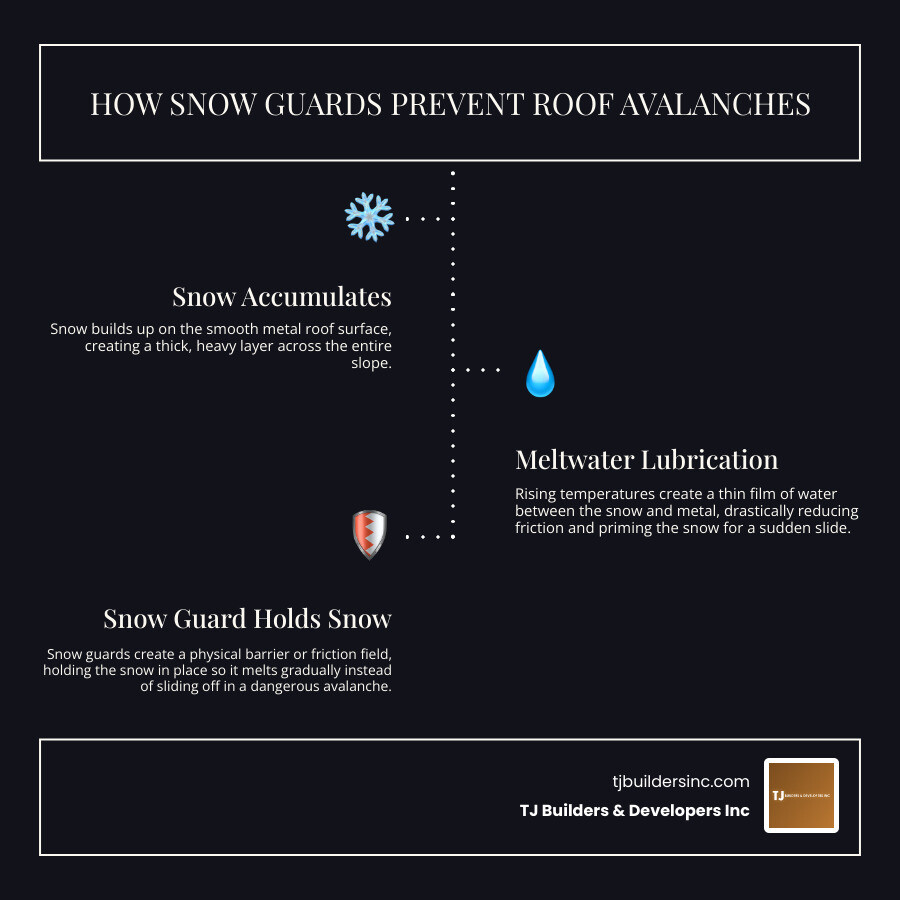
- Snow guards prevent this by creating a “holding field” across the roof surface
Metal roofs are excellent at shedding water — but that same smooth surface becomes a hazard in winter. When temperatures rise even slightly, a thin film of meltwater forms between the snow and the roof, acting like a lubricant. The result? A sudden, uncontrolled avalanche of snow and ice off your eaves with no warning.
I’m Thomas Pruszynski, owner of TJ Builders & Developers Inc, and over more than 20 years of exterior construction work across Lakewood and Northern Illinois, I’ve seen the gutter damage and safety hazards that the right snow guards for metal roofs can prevent. In this guide, I’ll walk you through everything you need to know to choose and install the right system for your home.
Explore more about snow guards for metal roofs:
Why Your Home Needs Snow Guards for Metal Roofs
Living in Northern Illinois communities like Crystal Lake, Woodstock, and McHenry means preparing our homes for winters that bring heavy, sustained snowpack. When that snow settles onto a sloped metal roof, it creates a ticking time bomb.
Without a reliable retention system, homeowners face the very real threat of a “gutter rip” — where a massive slab of sliding ice and snow shears gutters completely off the eaves. Beyond property damage, there is a legal liability risk if a sudden roof avalanche injures a visitor on your walkway or driveway. To understand why this happens, we have to look at the physics of how snow behaves on a metal surface.

The Physics of Roof Avalanches
Modern metal roof finishes, such as Kynar or Hylar, are premium coatings engineered to resist dirt, chalking, and fade. However, these slick finishes are chemically similar to Teflon. Trying to keep snow on a bare metal roof without mechanical help is like trying to tape an item to a non-stick frying pan.
When winter temperatures fluctuate, a temperature-sensitive bond forms between the accumulated snowpack and the roof. As the roof surface warms from home heat loss or the sun, a microscopic layer of meltwater lubricates this interface.
Once this lubrication occurs, gravity takes over. The snow does not slide off in a slow, controlled melt; instead, the entire blanket of snow releases at once. When snow shears, it doesn’t always break in a straight line from the ridge to the eave. Instead, it shears diagonally, creating a massive, wedge-shaped load. This unpredictable diagonal movement concentrates immense pressure on the lower sections of the roof, pushing tons of force toward your eaves.
Protecting Your Roof Seams and Gutters
This heavy movement of snowpack doesn’t just threaten your gutters; it also places immense mechanical strain on your roof’s seams. In a standing seam metal roof, the panels lock together to allow for natural thermal expansion and contraction. However, when heavy snow accumulates unevenly — particularly in drift-prone zones near parapet walls, dormers, or chimneys — it creates localized pressure points.
During freeze-thaw cycles, melted snow runs down the panels and can pool against these temporary blockages. If this water freezes inside the seam channels, the expanding ice acts like a wedge. It exerts outward pressure that can gradually widen micro-gaps, creating active entry points for water infiltration.
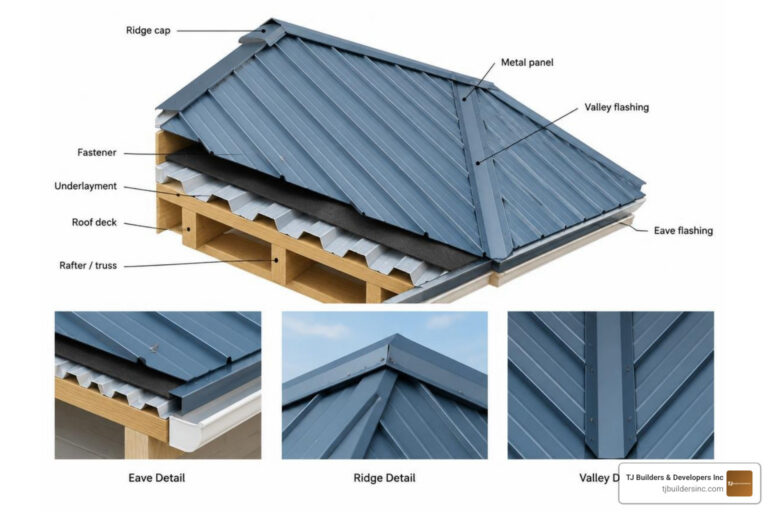
By installing a properly engineered snow retention system, we distribute the weight of the snowpack evenly across the structural rafters. This prevents the heavy shifting that strains fasteners and protects the delicate seams of your roof. For homeowners looking to protect their home’s envelope, understanding how your roof is constructed is key. You can read more about these details in our Ultimate Guide To Metal Roof And Skylight Installation In Lakewood.
If you are dealing with an active winter backup or heavy ice accumulation, we highly recommend looking into professional ice dam removal and roof snow removal services to protect your home before structural damage occurs.
Need Help With Your Home?
TJ Builders & Developers handles roofing, siding, gutters, windows, home additions, and fire damage restoration for homes and businesses in Lakewood, Crystal Lake, Schaumburg, and nearby McHenry County towns.
- Free, no-obligation estimates
- Licensed & insured
- 20+ years of local experience
Pad, Bar, and Fence: Choosing Your Snow Retention Style
Selecting the right snow guard system is not a one-size-fits-all decision. The pitch of your roof, your local snow load, and the specific metal profile (whether standing seam or exposed fastener) will dictate which style is best.
Generally, snow guards function in one of two ways: they either act as friction elements to keep the snow blanket in place, or they serve as a solid physical barrier.
| Retention Style | Primary Function | Best Roof Types | Ideal Snow Load Capacity | Aesthetic Profile |
|---|---|---|---|---|
| Pad-Style | Friction hold (keeps snow blanket in place) | Exposed fastener & standing seam | Low to Moderate | Low-profile, individual “gems” |
| Bar-Style / Pipe-Style | Continuous physical barrier | Standing seam & corrugated | Moderate to Heavy | Modern, clean architectural lines |
| Fence-Style | Heavy-duty physical barrier | Standing seam (heavy alpine) | Very Heavy (75+ PSF) | Traditional split-rail appearance |
Pad-Style Snow Guards for Metal Roofs
Pad-style snow guards (often referred to as “snow gems” or “snow cleats”) are individual units placed in a staggered pattern across the roof. Rather than acting as a solid wall, they act as cleats that increase friction, holding the snow blanket in place so it can melt slowly.
These guards are typically categorized by their profile size:
- Small Profile Guards: Have a pad surface area of less than 4 square inches (such as the ST6, which features just under 3 square inches). These are highly discreet and work well on residential homes with moderate pitches.
- Large Profile Guards: Have a pad face greater than 4 square inches (up to 15 square inches). These provide a larger physical block and are spaced according to specific engineering layouts.
For those seeking a durable, heavy-duty metal option, products like SnowTrax Metal Roof Snow Guards – 304 Stainless Steel – Pewter Gray are an excellent choice. Made of 304 stainless steel, these guards measure 4-1/4 inches wide, 2-1/8 inches long, and 3 inches high. They are available in 28 powder-coated colors to ensure seamless aesthetic integration with your roof panels.
Alternatively, clear polycarbonate guards (like the Sno-Safe Original or Sno-Safe Wide) are popular because they are virtually invisible on any roof color. The Sno-Safe Original Polycarbonate Snow Guards are priced around $2.05 per unit and hold up to 1,220 lbf when fastened with adhesive only, or 2,280 lbf when combined with screws. The Sno-Safe Wide Polycarbonate Snow Guards cost approximately $6.70 per unit and hold an impressive 2,480 lbf with adhesive alone.
Bar-Style and Pipe-Style Systems
If you prefer a streamlined, continuous look, a bar-style or pipe-style system is often considered the gold standard for standing seam metal roofs. These systems utilize continuous metal bars or pipes mounted to brackets that clamp onto the standing seams.
A popular choice is the S-5! DualGard™ Metal Roof Snow Guards | Snow Bars, which is a highly engineered two-pipe system. Designed for both standing seam and corrugated metal profiles, DualGard utilizes a 1-inch (25 mm) diameter pipe and average costs run approximately $12.48 to $17.68 per linear foot of assembly (excluding labor).
For a highly customizable look, the S-5!® ColorGard 2.0 with Z Clamps | Rocky Mountain Snow Guards allows you to insert a 2-inch wide, 29-gauge strip of your actual metal roofing material directly into the face of the unpunched bar. This creates a perfect color match that preserves your home’s clean architectural lines.
To prevent smaller sheets of ice and snow from migrating under the bar, we often install add-on components like SnoClips or DualClips. These clips hang from the bar and sit flat in the pan of the roof panel to catch smaller debris.
Heavy-Duty Fence-Style Systems
For homes in areas with extreme winter weather or very steep pitches, heavy-duty fence-style systems are the preferred choice. These systems resemble miniature split-rail fences and are designed to handle massive snowpack loads (often recommended where ground snow loads exceed 75 pounds per square foot). They provide a rugged, traditional look that complements custom homes, mountain cabins, or rustic commercial designs.
Materials, Warranties, and Non-Penetrating Installation
When planning a snow guard installation on a premium metal roof, material compatibility and installation methods are critical. The last thing any homeowner wants is to void their manufacturer’s warranty or cause galvanic corrosion by mixing dissimilar metals.
Best Practices for Installing Snow Guards for Metal Roofs
For standing seam roofs, the industry standard is to use non-penetrating clamp-on systems. These clamps grip the vertical seam of the panel without piercing the metal.
- Preserving the Warranty: Puncturing a standing seam roof with screws can immediately void your water-tightness warranty. Non-penetrating clamps preserve the panel’s ability to slide during thermal expansion and contraction.
- Round-Point Setscrews: High-quality clamps, such as those used in the Clamp on Snow guards for Metal Roofs – Roof Snow Bars | S-5! systems (which average $9.88 to $14.56 per linear foot of assembly), use specialized round-point setscrews. Unlike cheap cup-point screws that cut through the paint and protective zinc coating, round-point screws compress the metal seam safely without causing corrosion.
- Torque Specifications: These setscrews must be tightened using a calibrated torque wrench to the exact manufacturer specifications (typically around 90 to 115 in-lbs) to ensure they achieve their ultimate load-to-failure strength, which can exceed 1,800 to 3,000 pounds.
For exposed-fastener roofs (where panels are already screwed down into the wood decking), we use screw-down snow guards. When installing these, we always use premium fasteners with integrated EPDM rubber gaskets or neoprene washers to create a permanent, watertight seal.
If you are using adhesive-mounted polycarbonate guards, we recommend Surebond SB-190 clear adhesive. It is important to note that Surebond SB-190 requires a full 28-day curing period at temperatures above 50°F before it can be exposed to snow loads. This means adhesive installations must be planned and completed in the late summer or early fall.
Polycarbonate vs. Stainless Steel Durability
While high-quality polycarbonate guards are impact-resistant and UV-stabilized, they do have a shorter lifespan than metal options. Over a decade or more of exposure to intense summer sun and freezing winter temperatures, polymers can eventually become brittle.
For the ultimate in longevity, 304 stainless steel or structural aluminum is the superior choice. A heavy-duty option like the SnowCatchers Stainless Steel Snow Guards – 25 Pack (Canada) | Snow Guards Canada | Snow Guards & Snow Rails for Metal Roofs in Canada | Snow Guards Direct features 16-gauge stainless steel construction. These kits come contractor-ready with pre-applied gasket tape and mounting screws, offering robust, corrosion-resistant protection that will last the entire lifespan of your metal roof.
To learn more about keeping your metal roof in top shape and avoiding common issues, check out our guide on Simple Fixes For Metal Roof Holes And Punctures.
Need Help With Your Home?
TJ Builders & Developers handles roofing, siding, gutters, windows, home additions, and fire damage restoration for homes and businesses in Lakewood, Crystal Lake, Schaumburg, and nearby McHenry County towns.
- Free, no-obligation estimates
- Licensed & insured
- 20+ years of local experience
Frequently Asked Questions About Metal Roof Snow Retention
Are snow guards required by building codes?
In most municipalities across Northern Illinois, local building codes do not explicitly mandate the installation of snow guards. Building codes focus primarily on ensuring that the roof’s structural framing can handle the static weight of a local snow load.
However, installing snow guards is highly recommended as a safety and liability preventative measure. If your roof overhangs a public sidewalk, a busy entryway, or a driveway, you may be held liable for property damage or personal injury caused by a sudden snow slide.
Will installing snow guards void my roof warranty?
If you have a standing seam metal roof and use a non-penetrating clamp-on system (like S-5! clamps with round-point setscrews), your roof warranty will remain fully intact. These systems are specifically engineered to preserve the roof’s protective coatings and allow for thermal movement.
However, using screw-down guards on a standing seam roof, or using copycat clamps with sharp cup-point setscrews that pierce the metal, will likely void your panel finish and water-tightness warranties.
Can snow guards be retrofitted on an existing metal roof?
Yes! Both clamp-on systems for standing seam roofs and screw-down systems for exposed-fastener roofs can be retrofitted at any time. The installation process does not require removing or modifying your existing panels.
If you are retrofitting, it is highly recommended to have a professional inspect your roof’s current structural condition first to ensure the underlying decking and purlins can support the localized weight of retained snow.
Conclusion
Investing in snow guards for metal roofs is one of the smartest decisions you can make to protect your gutters, your landscaping, and your family during our harsh Northern Illinois winters. From the modern, color-matched lines of a bar system to the heavy-duty reliability of stainless steel pad guards, there is a perfect solution for every home.
At TJ Builders & Developers Inc, we pride ourselves on providing exceptional workmanship, reliable communication, and long-term property protection for our neighbors in Lakewood, Crystal Lake, Algonquin, Schaumburg, and the surrounding suburbs. We understand the unique challenges that local winter weather presents, and we install every roof system to the highest industry standards.
Ready to secure your home before the next winter storm? Schedule a professional consultation with our roofing experts today, and let us help you find the perfect snow retention system for your metal roof!