
Commercial Roof Replacement: A Quick Cost and Planning Overview
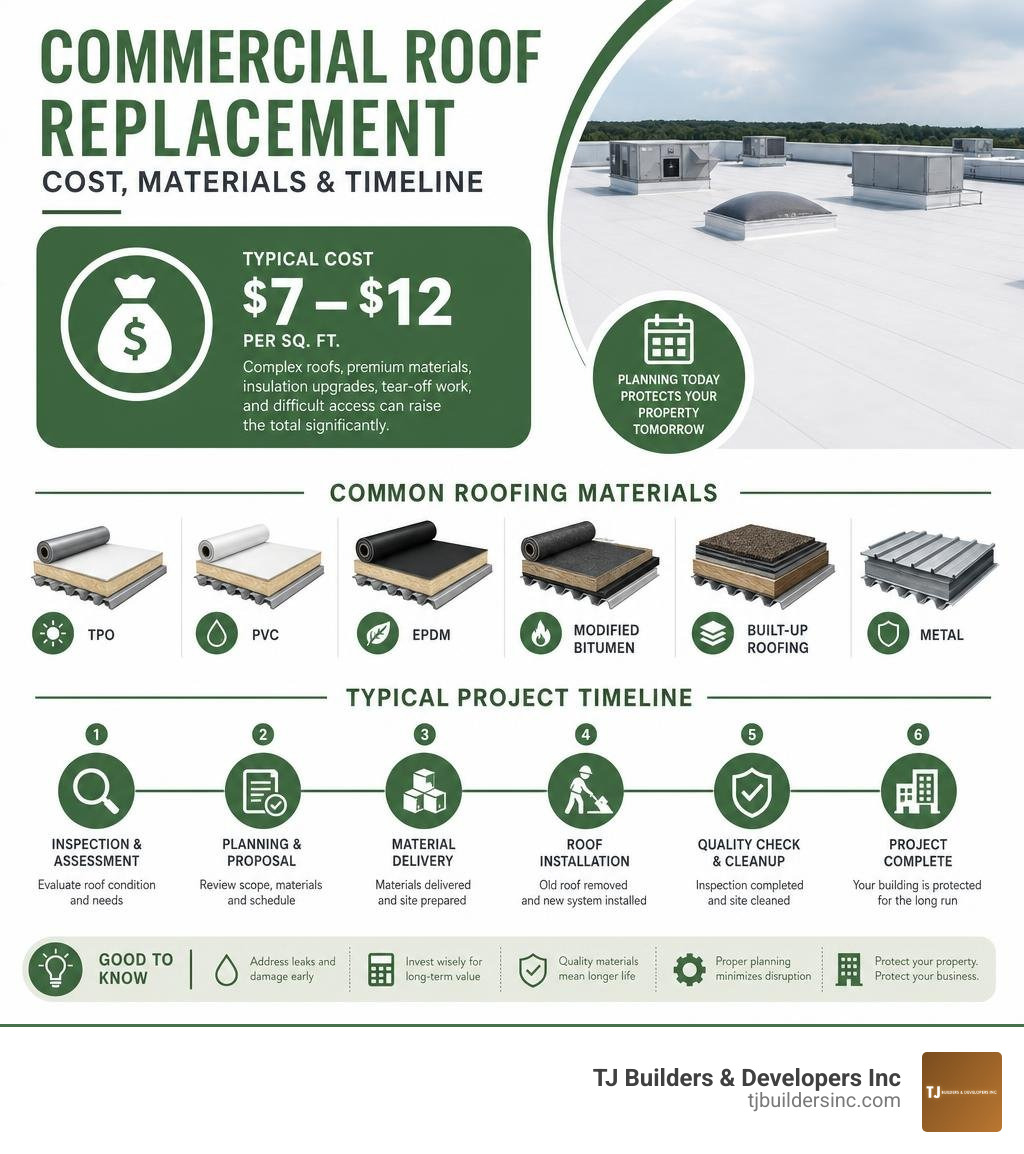
A commercial roof replacement is a major property investment that usually costs about $7 to $12 per square foot for a standard low-slope system, while complex roofs, premium materials, insulation upgrades, tear-off work, and difficult access can raise the total significantly.
| Quick answer | What to expect |
|---|---|
| When replacement makes sense | Repeated leaks, widespread membrane damage, wet insulation, or repair costs that keep growing |
| Common materials | TPO, PVC, EPDM, modified bitumen, built-up roofing, and metal |
| Typical timeline | A few days for small buildings; one to two weeks or longer for large or complex properties |
| Can business continue? | Often yes, with careful scheduling, safety controls, and daily cleanup |
| Best way to estimate cost | Get an on-site inspection, moisture testing, and an itemized written proposal |
The right choice is not always a full tear-off. Some roofs can be repaired, re-covered, or restored, but trapped moisture, failing insulation, and aging materials can make short-term fixes more expensive over time.
I am Thomas Pruszynski, owner of TJ Builders & Developers Inc, and I have spent more than 20 years helping homeowners and businesses protect and improve their properties through quality exterior construction, repairs, and renovations. That practical experience helps inform a clear, long-term approach to commercial roof replacement and property protection.
Relevant articles related to commercial roof replacement:
Repair, Re-Cover, or Replace: Making the Right Decision
Deciding whether to patch, re-cover, or perform a complete commercial roof replacement comes down to structural integrity, insulation condition, and long-term operating costs. In Northern Illinois communities like Lakewood, Crystal Lake, and Huntley, commercial roof assemblies endure heavy freeze-thaw cycles, winter snow loads, and hot summer UV exposure. These seasonal swings accelerate wear on flashings and single-ply membranes.
Signs You Need a Residential Roof Replacement
While commercial property managers often oversee multi-unit residential structures, office parks, and retail centers, recognizing warning signs early prevents catastrophic moisture intrusion. Look out for these critical indicators across your facility:
- Recurring Interior Leaks: Water stains on ceiling tiles, wall drywall, or structural framing in multiple locations signal systemic membrane failure rather than isolated flashing issues.
- Saturated Decking & Insulation: When moisture core samples or thermal imaging reveal that more than 25% of the underlying polyiso insulation is wet, patching top layers only traps water inside the assembly.
- Severe Surface Degradation: Extensive cracking, seam separation, membrane shrinkage, or blistering across flat surfaces means the material has reached the end of its useful life.
- Unexplained Energy Cost Spikes: Saturated insulation loses its thermal resistance (R-value), forcing HVAC equipment to run continuously to maintain interior temperatures.
- Soaring Maintenance Invoices: When annual patch and maintenance spending crosses 5% to 10% of total replacement value, continuous short-term repairs become a drain on operating capital.
Comparing Repair, Re-Cover, and Full Tear-Off
When evaluating property options, building owners generally consider three paths: localized repair, installing a re-cover system, or performing a full tear-off and replacement.
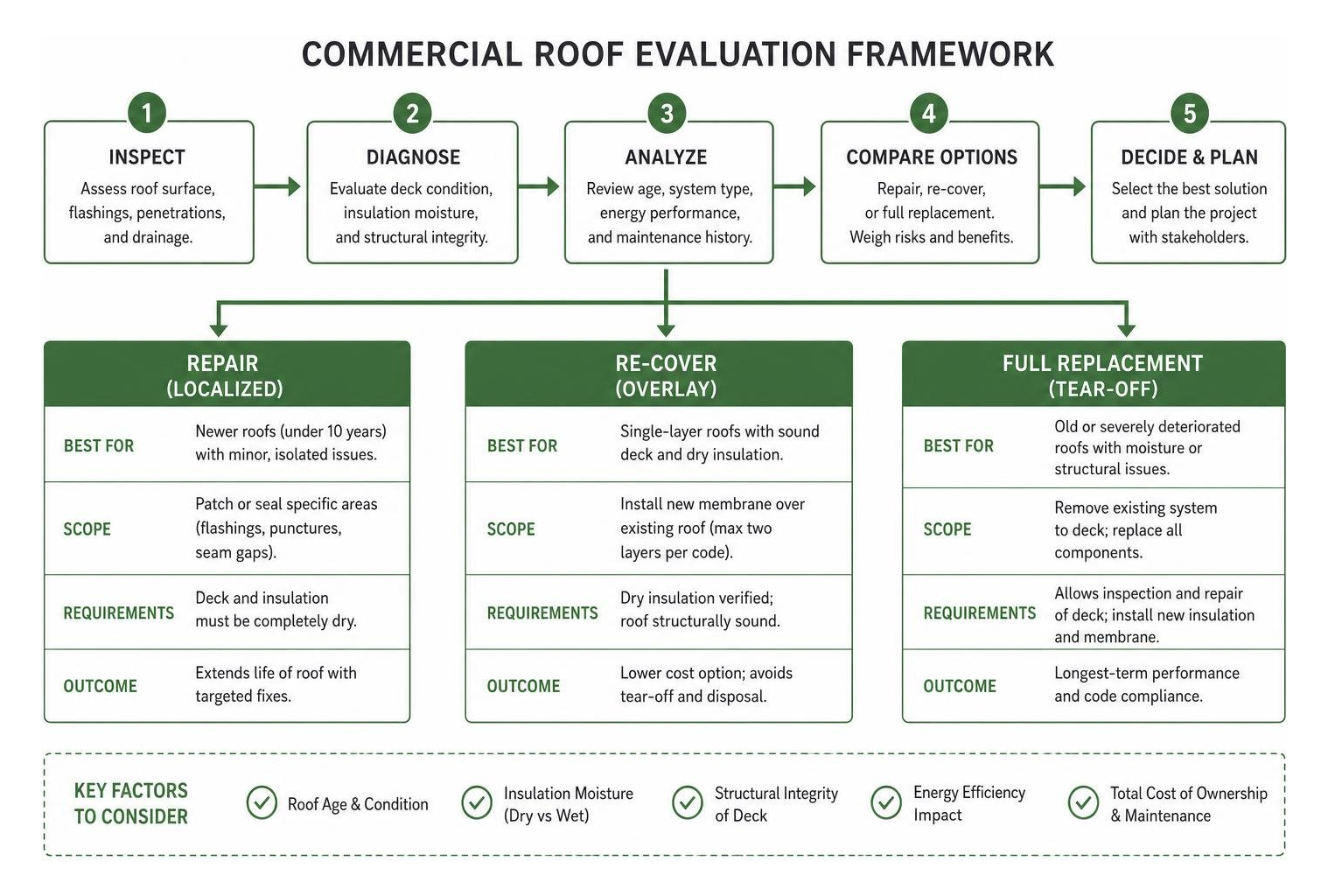
- Localized Repair: Best suited for newer assemblies (under 10 years old) with minor perimeter flashing wear, mechanical punctures, or isolated seam gaps where insulation remains completely dry.
- Roof Re-Cover: Involves installing a new membrane directly over an existing single-layer roof system. Under the International Building Code (IBC 1511), a building can host a maximum of two roofing layers. A re-cover can eliminate initial tear-off labor and disposal fees. However, a re-cover is only viable if the underlying deck is sound and moisture surveys confirm the existing insulation is completely dry. To understand how overlay installations work, explore our guide to reroofing solutions.
- Full Tear-Off and Replacement: Strips the roof assembly down to the underlying structural deck (metal, concrete, or wood substrate). This process allows crews to remove all wet insulation, replace rusted or rotted decking panels, install modern code-compliant polyiso insulation, and heat-weld a new continuous waterproof membrane.
Here is a decision summary matrix to keep in mind when evaluating building assets:
- If wet insulation is below 25% and 1 layer exists: Re-cover or targeted restoration coating can be considered.
- If wet insulation exceeds 25% or 2 layers exist: Full tear-off and replacement is legally required and structurally necessary.
- If annual repair costs exceed 10% of replacement budget: Full tear-off delivers the highest long-term return on investment.
Residential Roofing Systems: Materials, Costs, and Lifespans
Selecting the ideal roofing system requires balancing mechanical durability, energy efficiency, chemical exposure, and expected lifespan.
Single-Ply and Shingle Options: Asphalt Shingles, TPO, and PVC
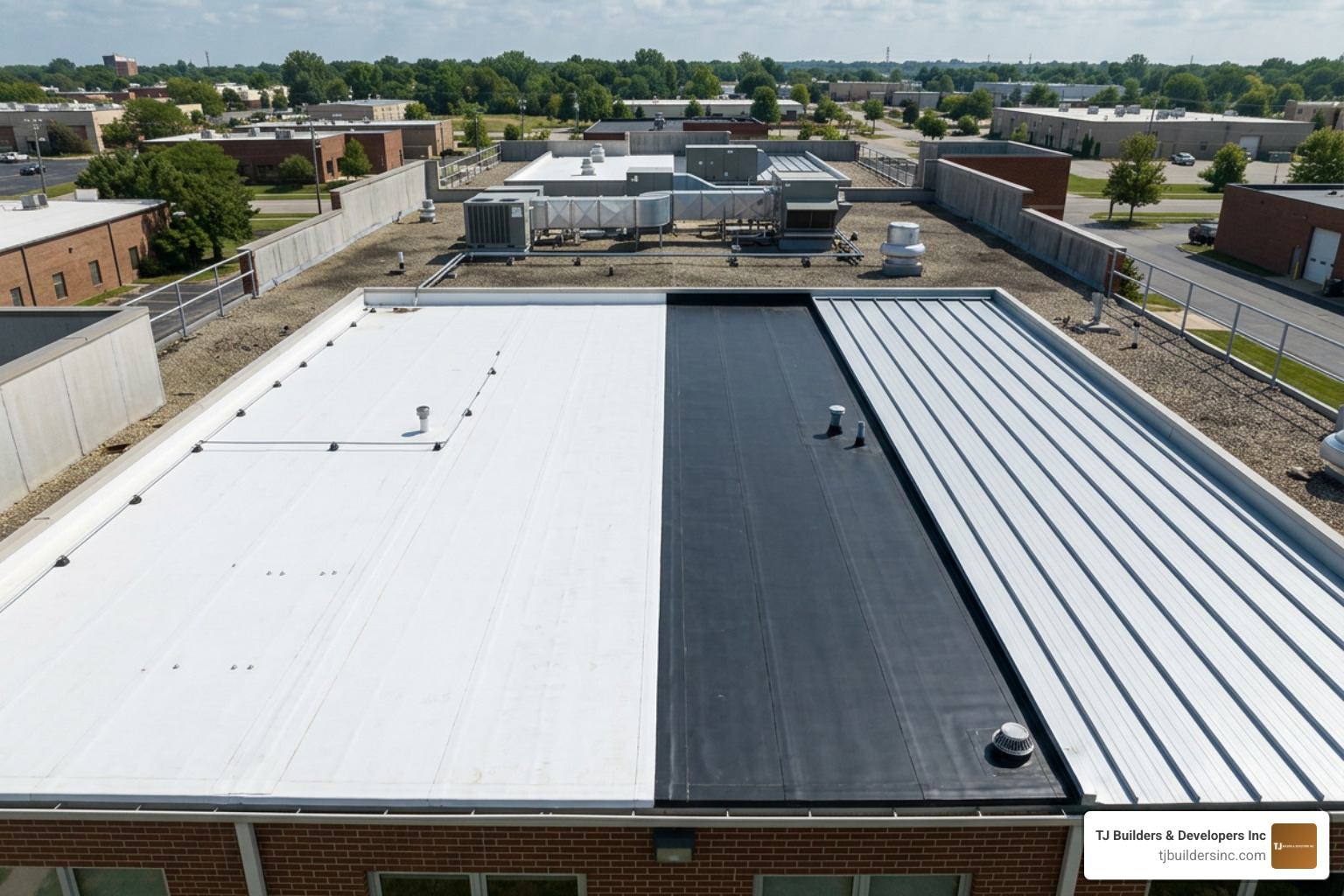
Single-ply membranes represent the vast majority of flat and low-slope commercial installations across McHenry, Kane, and Cook counties due to their heat-welded seam integrity and energy efficiency.
- TPO (Thermoplastic Polyolefin): TPO is the dominant single-ply membrane in the commercial sector. Naturally reflective white TPO surfaces lower cooling demands by reflecting solar heat. Mechanically attached 60-mil TPO systems typically cost $7 to $9 per square foot, while fully adhered systems run $8 to $12 per square foot. Expect a operational lifespan of 20 to 25 years with proper maintenance. Property owners managing multi-family or office spaces can read more about commercial flat roofing solutions for specific design profiles.
- PVC (Polyvinyl Chloride): High-performance PVC membranes deliver superior flame resistance, chemical durability, and grease resistance, making PVC the gold standard for restaurants, food processing plants, and commercial kitchens. Installed fully adhered 60-mil PVC systems typically run $9 to $15 per square foot in 2026, offering an expected lifespan of 25 to 30 years.
- EPDM (Ethylene Propylene Diene Monomer): EPDM synthetic rubber membranes offer flexibility during extreme freeze-thaw conditions. Mechanically attached or fully adhered EPDM ranges from $6 to $10 per square foot with lifespans stretching 22 to 30 years.
- Asphalt Architectural Shingles: For sloped commercial properties, steep-roof offices, or residential communities, high-grade architectural asphalt shingles provide an attractive, weather-resistant outer layer lasting 25 to 30 years.
Built-Up Roofing (BUR) and Modified Bitumen
Traditional multi-ply asphalt systems offer redundant layers of physical protection against mechanical foot traffic and hail.
- Built-Up Roofing (BUR): Composed of alternating layers of bitumen-soaked felt and hot asphalt topped with aggregate gravel, BUR provides robust protection against heavy foot traffic around HVAC equipment. Installed costs range between $10 and $18 per square foot, with useful service lives spanning 20 to 30 years.
- Modified Bitumen (SBS/APP): Polymer-modified asphalt sheets (rubberized SBS or plasticized APP) are installed in 2-ply or 3-ply configurations using heat-welded torches or cold adhesives. Running $7 to $12 per square foot, modified bitumen handles severe thermal expansion exceptionally well.
Metal Roofing Systems
For unmatched durability, structural metal roofing remains a premier choice for commercial, municipal, and industrial facilities in Schaumburg, Elgin, and Woodstock.
- Standing Seam Metal Panels: Heavy-gauge Galvalume or aluminum standing seam panels conceal fasteners beneath raised vertical seams, eliminating leak entry points. Installed standing seam systems range from $14 to $22 per square foot in 2026, providing a long lifespan of 40 to 60 years.
- Insulated Metal Panels (IMP): Combining exterior metal cladding with factory-injected rigid foam cores, IMP systems offer high thermal performance for climate-controlled warehousing at $16 to $26 per square foot.
Check out our technical breakdown on standing seam metal roof installation to review concealed clip attachments and panel expansion details.
| System Material | Average Installed Cost (2026 / Sq Ft) | Expected Lifespan | Primary Advantages |
|---|---|---|---|
| TPO (60-mil Single-Ply) | $7 – $12 | 20 – 25 Years | Energy reflective, heat-welded seams, durable weather barrier |
| PVC (60-mil Single-Ply) | $9 – $15 | 25 – 30 Years | Chemical & grease resistance, fire resistant |
| EPDM Synthetic Rubber | $6 – $10 | 22 – 30 Years | Impact absorption, extreme cold elasticity |
| Modified Bitumen (2-Ply) | $7 – $12 | 20 – 25 Years | Puncture resistance, redundant waterproofing layers |
| Built-Up Roofing (BUR) | $10 – $18 | 20 – 30 Years | Heavy foot traffic resistance, multi-ply toughness |
| Standing Seam Metal | $14 – $22 | 40 – 60 Years | Maximum longevity, low maintenance, high wind rating |
Residential Roof Replacement Cost Drivers and 2026 Benchmarks
Understanding total replacement expenditure requires looking beyond basic surface membrane costs. Total project pricing involves material selection, labor dynamics, structural substrate repairs, and regional building energy requirements.
Core Factors Influencing Total Replacement Expenses
For standard 20,000 square foot commercial warehouse buildings in Northern Illinois, replacing an aged membrane with a mechanically attached 60-mil TPO system over continuous R-25 polyisocyanurate insulation typically ranges from $140,000 to $180,000 ($7.00 to $9.00 per square foot base rate). Adding complex flashings, parapet wall caps, crane lifts, or decking repairs brings total project investments closer to $180,000 to $240,000.
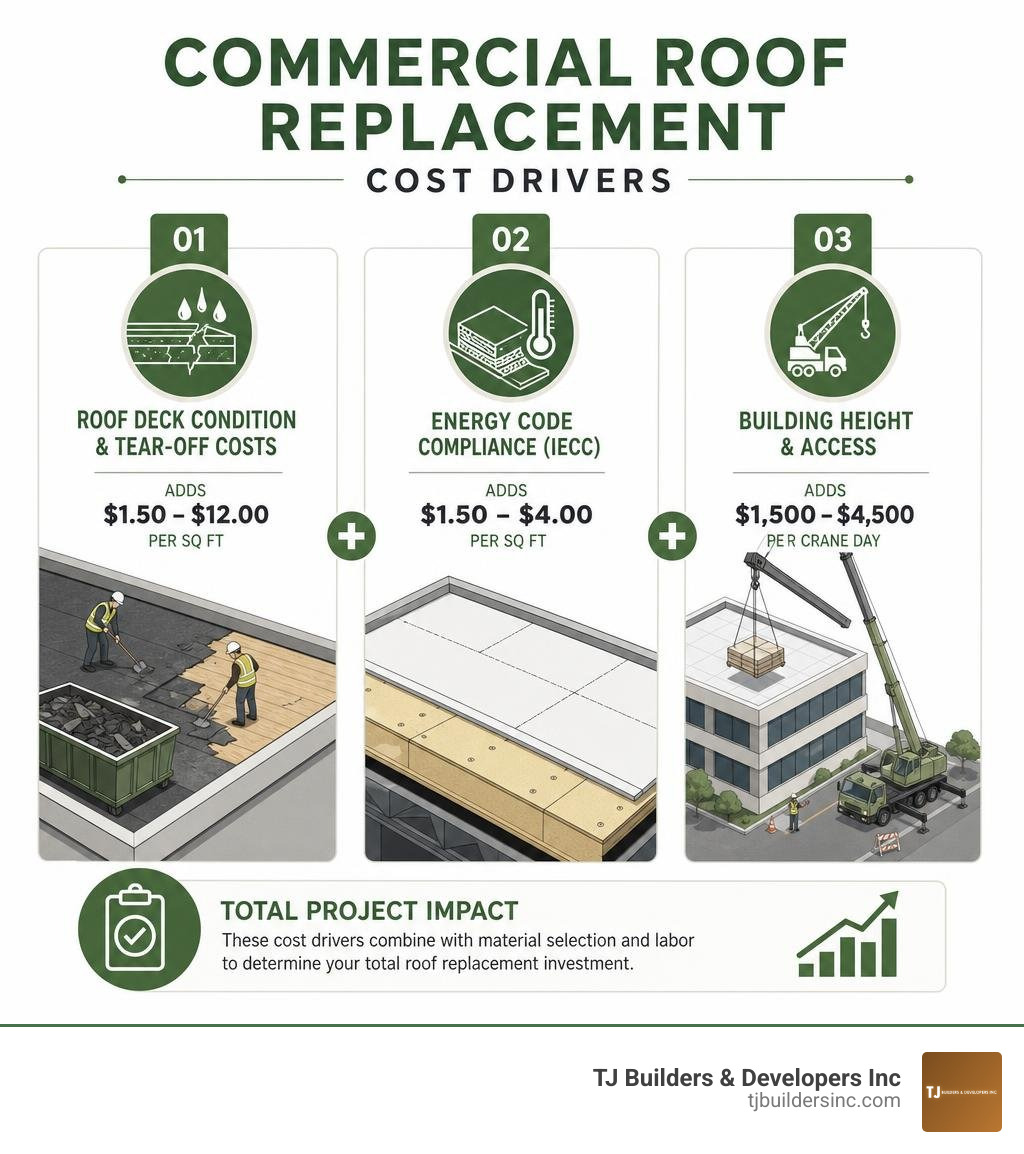
Key financial cost drivers include:
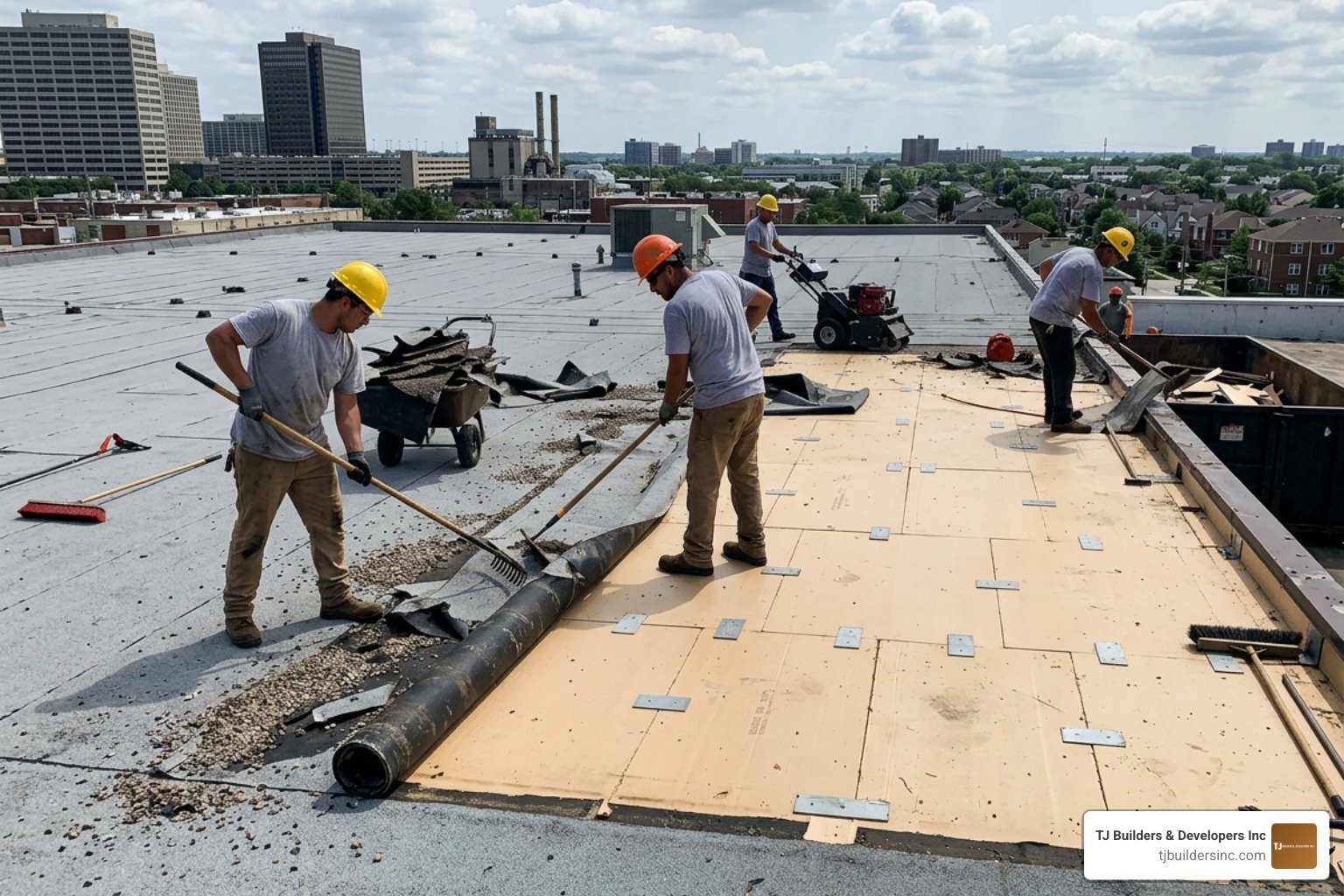
- Roof Deck Condition & Tear-Off Costs: Removing multi-layer assemblies and disposing of saturated insulation costs $1.50 to $3.50 per square foot in labor and dump fees. Replacing damaged metal decking or decayed wood decking adds $5.00 to $12.00 per square foot across affected structural bays.
- Energy Code Compliance (IECC): Modern energy codes mandate minimum thermal resistance standards across commercial roof replacements. In cold Midwest climates, bringing a replacement assembly up to R-30 polyiso insulation standards adds $1.50 to $2.50 per square foot in polyiso material thickness. Tapered insulation systems required to eliminate standing water ponds add another $2.00 to $4.00 per square foot.
- Building Height and Access: Multi-story commercial complexes in urban centers like Schaumburg require crane permits, street closure logistics, staging areas, and material hoists, adding $1,500 to $4,500 per crane day to total mobilization fees.
- Labor Trends: Regional commercial skilled labor costs continue to rise 5% to 8% annually across Illinois, making efficient project staging and crew productivity essential for keeping bids on schedule.
To review detailed per-square-foot cost breakdowns, explore this 2026 commercial roof replacement cost analysis.
Warranties, Financing, and Tax Incentives
Protecting capital investments requires pairing high-performance commercial installation standards with robust warranty coverage and favorable tax strategies.
- NDL (No Dollar Limit) Manufacturer Warranties: Unlike standard material-only pro-rated warranties, an NDL warranty covers 100% of material and labor repair costs for roof failures across 15, 20, or 30-year terms without a financial cap. Obtaining an NDL warranty requires installation by manufacturer-certified commercial contractors and independent third-party roof inspections.
- Contractor Workmanship Warranties: Reputable commercial installers provide dedicated workmanship warranties ranging from 5 to 10 years to protect against flashing, drainage, or penetration installation errors.
- C-PACE Financing: Commercial Property Assessed Clean Energy (C-PACE) enables building owners to fund 100% of energy-efficient roof replacements (such as reflective TPO combined with enhanced R-value insulation) through long-term, fixed-rate financing attached to property tax assessments spanning up to 20 or 30 years.
- Section 179 & Depreciation Incentives: Under current tax regulations, qualifying commercial roof replacements may qualify for immediate capital expenditure deductions under Section 179 or accelerated 39-year depreciation schedules. Building owners should consult their financial advisors to maximize capital timing.
Step-by-Step Process for Residential Roof Replacement
Executing a seamless commercial roof replacement requires precise scheduling, rigorous safety protocols, and proactive tenant communication to keep daily business operations running smoothly.
Project Execution, Timeline, and Homeowner Continuity
A standard 20,000 square foot commercial property replacement typically takes 1 to 2 weeks, depending on rain or wind interruptions. Small suburban commercial properties may take as little as 3 to 5 days, while major industrial facilities can span 3 to 4 weeks.
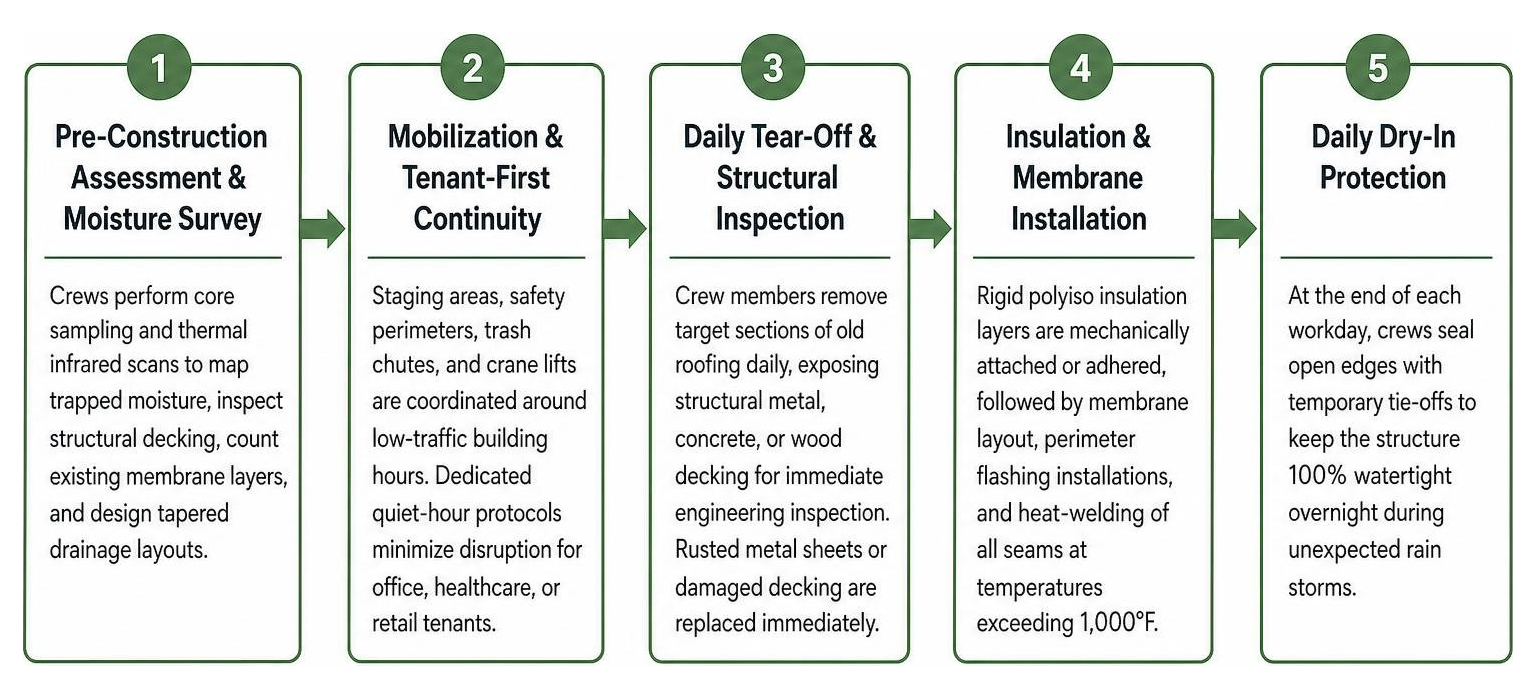
- Pre-Construction Assessment & Moisture Survey: Crews perform core sampling and thermal infrared scans to map trapped moisture, inspect structural decking, count existing membrane layers, and design tapered drainage layouts.
- Mobilization & Tenant-First Continuity: Staging areas, safety perimeters, trash chutes, and crane lifts are coordinated around low-traffic building hours. Dedicated quiet-hour protocols minimize disruption for office, healthcare, or retail tenants.
- Daily Tear-Off & Structural Inspection: Crew members remove target sections of old roofing daily, exposing structural metal, concrete, or wood decking for immediate engineering inspection. Rusted metal sheets or damaged decking are replaced immediately.
- Insulation & Membrane Installation: Rigid polyiso insulation layers are mechanically attached or adhered, followed by membrane layout, perimeter flashing installations, and heat-welding of all seams at temperatures exceeding 1,000°F.
- Daily Dry-In Protection: At the end of each workday, crews seal open edges with temporary tie-offs to keep the structure 100% watertight overnight during unexpected rain storms.
- Final Inspection & NDL Certification: The technical rep from the membrane manufacturer conducts a field audit to verify seam integrity, attachment spacing, and flashing detail before issuing official NDL warranty documentation.
Property owners seeking a detailed walk-through of project phases can read our comprehensive roof installation and replacement guide.
Contractor Selection and Avoiding Red Flags
Choosing the right commercial roofing contractor is critical for avoiding change-order surprises or premature system failures.
- Demand Detailed Itemized Proposals: Beware of lump-sum bids that lack clear specifications. Accurate proposals must specify exact membrane mil thickness (e.g., 60-mil minimum), insulation R-value, cover board details, fastener density patterns, unit pricing for deck repair, and crane inclusions.
- Watch for Bid-Rigging and Predatory Low Bids: Bids clustered within 1% to 2% of each other in private negotiations can signal bid manipulation. Conversely, an abnormally low bid that comes in 25% to 40% below industry standards usually indicates omitted specs, unlisted crane or permit fees, or deliberate setups for aggressive change orders later.
- Verify Manufacturer Certifications: Ensure the contractor holds current master installer certifications from top single-ply manufacturers (e.g., Carlisle, Firestone/Elevate, GAF) to guarantee eligibility for No Dollar Limit (NDL) warranties.
- Review Safety Standards: Confirm the contractor maintains full commercial liability insurance, workers’ compensation coverage, and strict OSHA safety compliance programs.
To evaluate qualifications and bidding standards, consult our educational guide on how to choose qualified roofing contractors.
Frequently Asked Questions About Residential Roofing
How long does a residential roof replacement take?
A typical commercial or multi-family flat roof replacement on a 10,000 to 20,000 square foot building takes between 5 and 10 working days under normal weather conditions. Large warehousing facilities or complex high-rise structures may take 2 to 4 weeks. Weather delays such as heavy rain or high winds will pause tear-off operations to ensure the interior building spaces remain completely dry.
Can my family remain home during residential roof replacement?
Yes, commercial facilities and multi-family properties can remain open and operational throughout the entire replacement process. Experienced commercial crews implement strict safety zones, establish designated pedestrian scaffolding walkways, schedule noisy fastening operations outside peak operational hours, and perform continuous site cleanup to ensure complete safety for tenants, employees, and visitors.
What roof warranties are available for residential properties?
Commercial roof replacement systems offer two distinct warranty protections:
- Manufacturer NDL Warranties: Covering 10 to 30 years, NDL (No Dollar Limit) manufacturer warranties guarantee that material defects and installation workmanship failures will be fully repaired without financial limits on labor or materials.
- Contractor Workmanship Warranties: Issued directly by the installing contractor, these warranties cover initial site installation details, flashing seals, and roof drainage attachments, usually spanning 5 to 10 years.
Conclusion: Securing Your Residential Property Investment
A commercial roof replacement represents one of the most critical capital investments a property owner or asset manager will make. By understanding key warning signs, evaluating membrane performance options, requiring itemized bid proposals, and insisting on certified installation standards, you protect your building asset and secure long-term durability.
At TJ Builders & Developers Inc, based in Lakewood, IL, we bring over two decades of expert craftsmanship, professional communication, and structural reliability to commercial, multi-family, and residential properties across Northern Illinois. Whether your property is located in Crystal Lake, Huntley, Schaumburg, McHenry, or surrounding communities, our dedicated project management ensures smooth execution with zero operational surprises.
When you are ready to evaluate your commercial building envelope, schedule a professional inspection and roof repair evaluation with our team to explore reliable, long-term property protection solutions.