Why Electric Heat Cable Is the Smartest Defense Against Ice Dam Damage
An electric heat cable is a low-wattage heating system installed along roof edges, gutters, downspouts, or pipes to prevent ice from building up and causing serious structural damage. Here’s a quick overview of what you need to know:
- What it does: Generates controlled heat to keep snow and ice from freezing into damaging ice dams or blocking drainage
- Main types: Self-regulating (adjusts heat output automatically) and constant-wattage (fixed power output)
- Primary uses: Roof and gutter de-icing, pipe freeze protection, underfloor heating, and snow melting
- Key benefit: Protects your home from water intrusion, burst pipes, and costly structural repairs
- Safety note: Look for ETL, UL, or CSA certification — and follow National Electrical Code rules for safe installation
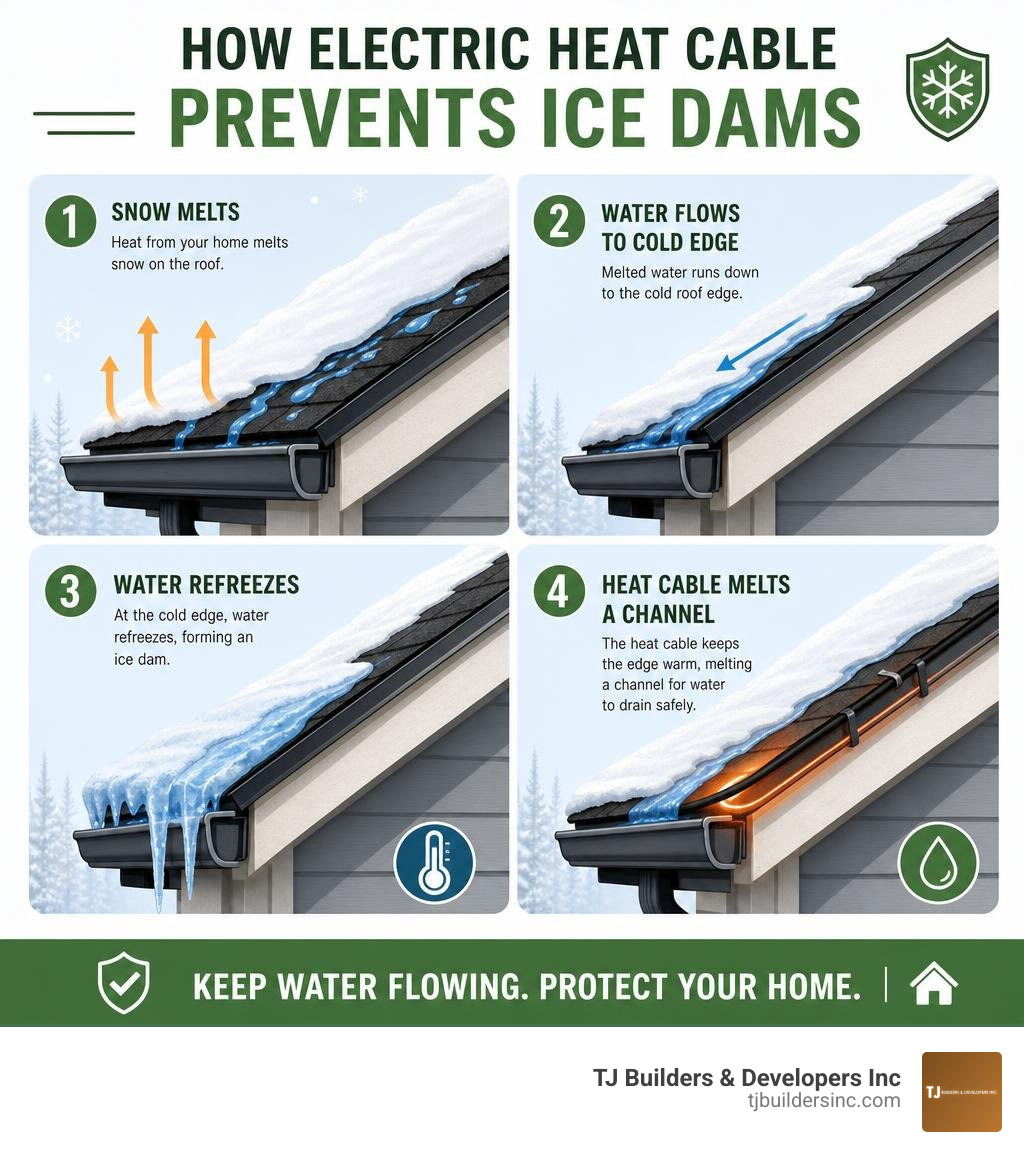
Every winter, Northern Illinois homeowners face the same threat: heavy snow accumulates on the roof, melts from the inside out, and then refreezes at the cold roof edge. The result is an ice dam — a ridge of ice that forces water back up under shingles and into your home. It’s a slow, invisible process that can cause thousands of dollars in damage before you even notice a problem.
The good news? Electric heat cable is one of the most effective and proven tools to stop ice dams before they start. Self-regulating heat cables have been in use since 1971 and are now the most widely used form of electric heat tracing in the world.
I’m Thomas Pruszynski, owner of TJ Builders & Developers Inc., and over more than 20 years of exterior renovation and restoration work across Northern Illinois, I’ve seen what ice dams do to roofs, gutters, and interior structures. Installing a properly designed electric heat cable system is one of the most impactful preventive steps a homeowner can take before winter arrives.
How Electric Heat Cable Technology Works to Prevent Ice Dams
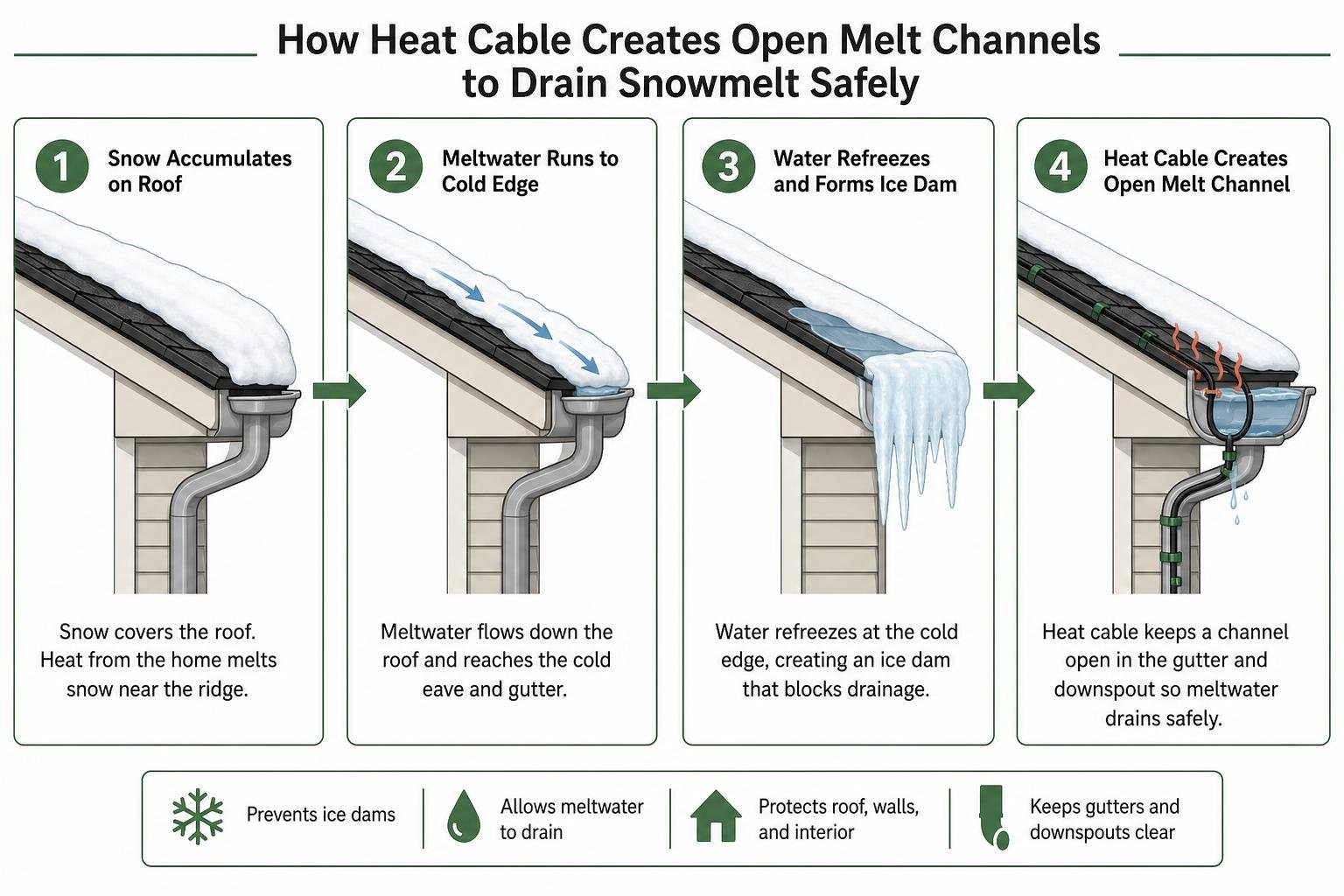
To understand how an electric heat cable prevents ice dam formation, it helps to take a look at the underlying thermodynamics of your roof during a midwestern winter. Heat escapes from your living space into the attic, warming the underside of the roof deck. Snow sitting directly over heated living quarters melts and runs down the roof slope. However, when that melted water reaches the cold overhang or eave—which extends past the heated footprint of your home—it encounters freezing temperatures and turns straight back into solid ice.
Over several freeze-thaw cycles, a massive wall of ice forms at the eave. Meltwater pooling behind this barrier has nowhere to go but up, creeping under your roof shingles, damaging structural sheathing, and leaking directly into interior ceiling spaces and wall cavities.
This is where an electric heat cable steps in. When mounted along the eaves, valleys, gutters, and downspouts, the heating core produces target thermal energy to maintain open drainage pathways. Rather than trying to melt every square inch of snow on your roof—which would consume excessive amounts of electricity—the cable creates clear melt channels. This allows liquid runoff to escape down off the roof through the gutters and downspouts before it can freeze into a ridge.
Modern self-regulating cables rely on a specialized conductive polymer core extruded between two parallel bus wires. As ambient weather conditions get colder, the core microscopic carbon pathways contract and conduct more electrical current, increasing heat output. Conversely, when surrounding temperatures rise, the polymer matrix expands, reducing thermal pathways and cutting electrical consumption automatically. This uniform thermal distribution ensures constant relief against ice dams while preserving roof materials. For persistent heavy snow accumulation across local properties in Lakewood, Crystal Lake, and surrounding communities, pairing trace heating with seasonal Roof Snow Removal ensures long-term roof integrity.
Need Help With Your Home?
TJ Builders & Developers handles roofing, siding, gutters, windows, home additions, and fire damage restoration for homes and businesses in Lakewood, Crystal Lake, Schaumburg, and nearby McHenry County towns.
- Free, no-obligation estimates
- Licensed & insured
- 20+ years of local experience
Types of Electric Heat Cable and Primary Applications
Electric heat cables serve several critical home protection roles during freeze conditions. While roof and gutter de-icing is one of the most visible uses, these versatile cables are also applied across residential plumbing systems, driveways, and radiant interior floor warming.
Self-Regulating vs. Constant-Wattage Electric Heat Cable
When selecting an electric heat cable, the most fundamental decision is choosing between self-regulating technology and constant-wattage construction. Each type operates on distinctly different electrical principles:
Self-Regulating Electric Heat Cable:
- How it works: Features a conductive polymer matrix core that dynamically adjusts electrical resistance based on ambient surface temperatures.
- Wattage output: Varies dynamically. For example, systems like NeverFreeze pipe tracing cables output 5 to 8 watts per linear foot at 0°F, dialing back output as local temperatures rise.
- Safety & Versatility: Can be cut to length in the field and safely touch or overlap without risking immediate hot spot burnouts or electrical jacket meltdowns.
- Ideal applications: Roof eaves, valleys, complex gutter systems, downspouts, and unheated pipe runs. Advanced Self-regulating cable technology represents the global gold standard for residential trace heating.
Constant-Wattage Electric Heat Cable:
- How it works: Built with fixed metallic resistance heating wires wrapped in thermal insulation that output a constant power level whenever plugged in or switched on.
- Wattage output: Fixed continuous draw (e.g., standard pre-assembled kits drawing 5 to 7 Watts per foot at 120V).
- Safety & Versatility: Sold in fixed pre-assembled lengths with factory-sealed end terminations. Never cut or shorten a constant-wattage cable, as shortening reduces total electrical resistance, causing extreme overheating and severe fire hazards.
- Overlapping risks: Overwrapping or crossing constant-wattage heat cable onto itself traps generated thermal energy, melting cable jackets and creating immediate fire hazards.

Key Differences Between Pipe Tracing and Roof De-Icing Electric Heat Cable
Homeowners often wonder if a single heat cable kit can handle every freeze protection job around the house. In reality, pipe tracing cables and roof de-icing cables are tailored for different thermal demands, environmental exposures, and code compliance standards.
- Roof and Gutter De-Icing Cables: Designed specifically to handle heavy exposure to direct sunlight, ultraviolet (UV) radiation, water immersion, wind, and freezing weather. Standard 120V roof de-icing cables typical draw 5 Watts per linear foot and feature tough weather-resistant outer jackets to withstand severe winter exposure along roof edges. If severe weather has already caused localized shingle or gutter separation, combining heat cable installations with timely Ice Dam Removal prevents further roof damage.
- Pipe Heating Trace Cables: Engineered to protect interior and exterior water supply pipes from freezing down to extreme temperatures like -40°F. Pipe cables generally carry higher power densities—typically around 7 Watts per linear foot at 120V—and are designed to be installed flush along metal or Schedule 40 PVC water lines before being covered with pipe insulation.
- Radiant Underfloor Heating Cables: Built exclusively for indoor concrete or subfloor installations beneath tile, stone, or resilient flooring. These thin heating elements (often ~4.3mm diameter delivering roughly 10W/m) operate under strict Underfloor heating cable standards like UL 1673 or CSA C22.2 No. 130. They must never be deployed on exterior roofs or wrapped around outdoor water supply lines.
Sizing, Thermostats, and Safe System Design
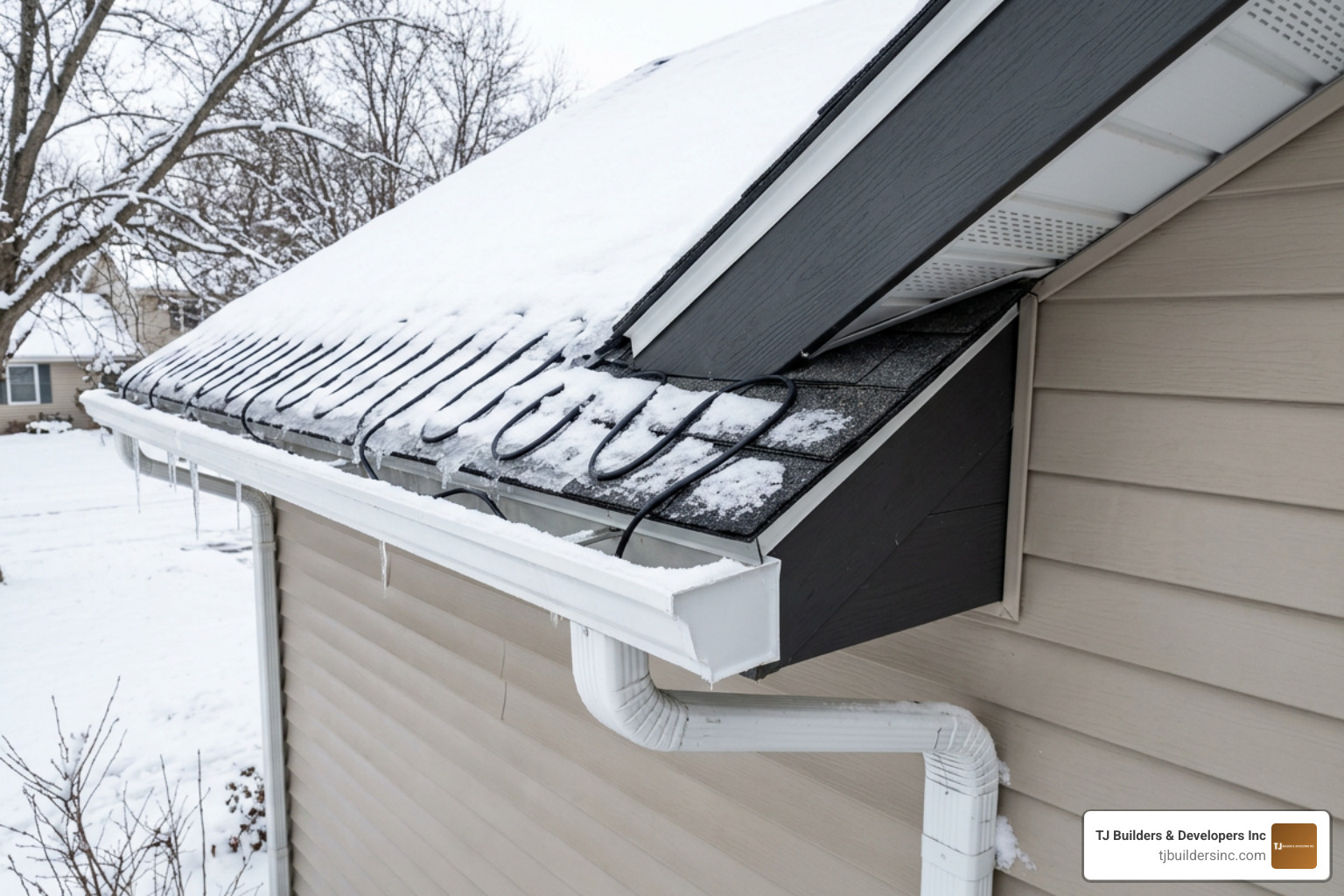
Designing an effective roof de-icing system requires accurate layout planning, wattage calculation, and intelligent thermostatic control. Improperly sized cables leave vulnerable gaps where ice dams can re-form, while unmonitored systems can waste excessive electricity.
To calculate the linear footage of electric heat cable required for roof eave de-icing, contractors follow an alternating triangular pattern (often called a “WWWW” or serpentine layout) along the roof edge. The calculation accounts for roof overhang depth, gutter length, downspout runs, and roof valleys:
| Roof Overhang Depth | Cable Multiplier Factor (Per Linear Foot of Eave) |
|---|---|
| 12 Inches (1 Foot) | Multiply eave length by 1.9 |
| 24 Inches (2 Feet) | Multiply eave length by 2.5 |
| 36 Inches (3 Feet) | Multiply eave length by 3.2 |
Additional Length Requirements: Add 1 foot of cable per linear foot of gutter, add 1 foot of cable per linear foot of downspout (double if routing back up inside downspouts), and add 6 extra feet for every roof valley where snow collects.
Thermostat Controllers and Energy Efficiency
Operating a heat cable without automated controls can lead to unnecessarily high energy bills. While self-regulating heat cables adjust output based on surface temperature, they do not completely shut off automatically when freezing conditions pass. A self-regulating cable idles at a lower current but continues to draw electricity unless disconnected or regulated by a smart controller.
- Integrated Mechanical Thermostats: Common on pre-assembled kits (such as Frost King kits rated for 120V, 7 Watts/ft up to a maximum 15 Amp circuit draw). These units automatically turn power ON when ambient temperature drops below 38°F (3°C) and shut OFF when temperatures warm above 45°F–50°F (10°C).
- Automated Air & Moisture Sensors: Advanced roof de-icing controllers pair ambient air temperature sensors with snow/moisture detectors. The heating cable activates only when ambient air falls below 38°F and liquid precipitation or melting snow is detected, maximizing overall energy efficiency.
- 120V vs. 240V Electrical Circuits: A common myth is that 240V heat cable systems use less energy than 120V systems. Voltage does not dictate energy usage—total consumed wattage dictates power costs. However, 240V circuits draw half the amperage of 120V systems for identical heating runs, allowing longer single-circuit runs on large commercial or residential roof lines without overloading breakers.
Insulation and Weather Protection Considerations
When heat cables are applied to pipe freeze protection projects, insulation plays a crucial role in maintaining performance. Wrapping pipe heat cable with a minimum 1/2-inch layer of fiberglass pipe wrap with a vapor barrier seal prevents heat from dissipating into cold crawl space air, concentrating energy on the pipe wall.
For exterior roof de-icing, the cable jacket itself must feature robust weatherproofing, cross-linked polyolefin insulation, and UV protection to withstand year-round outdoor exposure. Furthermore, thermal management works hand-in-hand with primary roofing underlayments; ensuring your roof deck is fortified with a rubberized self-adhering membrane like an Ice & Water Shield provides essential back-up protection under eaves.
Need Help With Your Home?
TJ Builders & Developers handles roofing, siding, gutters, windows, home additions, and fire damage restoration for homes and businesses in Lakewood, Crystal Lake, Schaumburg, and nearby McHenry County towns.
- Free, no-obligation estimates
- Licensed & insured
- 20+ years of local experience
Safety Guidelines, Fire Hazard Prevention, and Electrical Codes
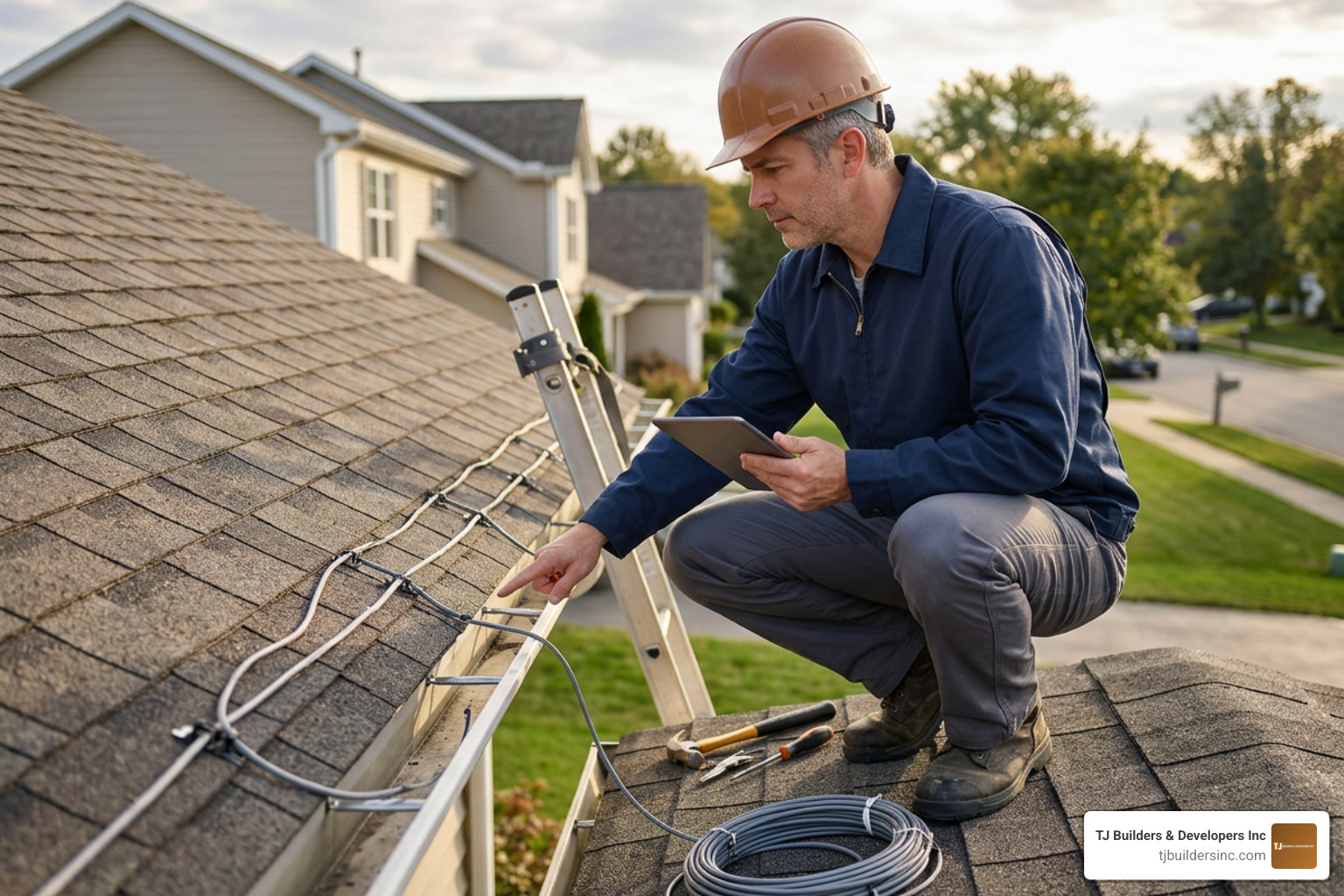
When working with high-voltage exterior electrical devices, strict safety adherence is non-negotiable. Modern heat cables are reliable and durable when properly installed, but poor wiring, improper mounting, or structural code violations create dangerous electrical and fire hazards.
National Electrical Code Restrictions and Installation Safety
The National Electrical Code (NEC) lays out clear guidelines regarding how and where trace heating equipment can be deployed:
- No Wall, Floor, or Ceiling Penetrations: NEC regulations strictly prohibit running pipe tracing or roof heating cables inside or behind wall cavities, floor assemblies, or finished ceilings. Heating cables must remain fully accessible for routine inspection and replacement.
- GFCI Electrical Circuit Protection: All heating cable installations must be powered through a Ground Fault Circuit Interrupter (GFCI) or Ground Fault Equipment Protector (GFEP) breaker (typically rated with a 30mA trip level). This immediate safety shut-off prevents electrical shocks and fire risks if cable insulation is damaged by ice movement, tree branches, or wildlife.
- End-to-End Safety Certifications: Always verify that heating cable products bear full system certifications from recognized laboratories—such as ETL, UL (e.g., UL 1673), or CSA (CAN/CSA-C22.2 No. 130). Avoid cheap unbranded imports where only the wall plug is UL listed while the actual heating cable remains uncertified.
- Gutter and Fastening Precautions: Secure cables using clips, roof spacers, and approved fasteners designed for roofing shingles or gutter guards. Never drive nails, staples, or dry-wall screws directly through heat cable insulation. Ensure a minimum clearance of 2 inches between downspout drip loops and gutter bottoms to allow debris flow without stressing the cable. If existing gutters are misaligned or sagging, arranging professional Gutter Repair & Realigning ensures meltwater flows away from your foundation.
Fire Hazards, Inspection, and Maintenance Practices
According to national fire safety data, heating equipment failures account for thousands of residential house fires every winter. With electric trace cables, fire risks almost always stem from incorrect installation, overlapping constant-wattage cable, or physical wire damage.
- Watch for Overheating Signs: If you detect a distinct burning rubber or burning plastic odor coming from electrical connections or roof lines, immediately shut off circuit power at the breaker. A burning rubber scent indicates thermal degradation of synthetic cable sheathing or overheating electrical wiring insulation.
- Never Reset Repeatedly Tripped Breakers: If your heating cable trips its circuit breaker more than once, do not force the breaker back on. A repeated trip indicates an active short circuit or ground fault that requires professional inspection by a licensed electrician.
- Annual Pre-Winter Maintenance: Conduct visual checks every autumn before cold weather hits. Look for frayed cable jackets, damaged end caps, loose shingle clips, or accumulated leaf debris sitting directly against the heat cable.
Frequently Asked Questions About Electric Heat Cable
Can electric heat cable be safely installed on plastic (PVC) pipes?
Yes, provided you choose an electric heat cable rated explicitly for plastic piping and follow strict installation procedures. Standard self-regulating heat cable (or automatic kits operating around 38°F) can be safely applied to primary supply water pipes made of metal (copper, stainless steel) or rigid Schedule 40 PVC with diameters between 3/8″ and 1½”.
Because plastic is a poorer thermal conductor than metal, heat dissipates more slowly. You should apply a layer of aluminum foil tape along the plastic pipe before laying down the cable to distribute heat evenly along the pipe wall. Always secure the heat cable using electrical tape rated for at least 176°F (80°C) or zip ties applied lightly—never use masking tape, wire, or duct tape, as adhesives break down under seasonal heat cycle variations. Do not install pipe heat cables on thin flexible vinyl tubing, mobile home supply lines, or pipes that carry liquids above 155°F.
Can you cut electric heat cable to length or overlap it?
Whether you can cut or overlap an electric heat cable depends entirely on the technology type:
- Self-Regulating Cable: Can be cut to length in the field because its parallel bus-wire design provides a uniform wattage output along any segment. However, cable end terminations and power connections must be completed using factory-approved termination kits installed by a qualified electrician to seal out moisture. Because of its temperature-limiting polymer matrix core, self-regulating cable can safely touch or cross over itself without melting or overheating.
- Constant-Wattage Cable: Cannot be cut to length and must never be overlapped. Shortening constant-wattage wire reduces electrical resistance, causing intense current draw and thermal failure. Overlapping constant-wattage cable traps heat at the crossover point, leading to burned jackets and severe fire risks.
How do you test if your heat cable is working properly?
Testing your heat cable before winter sets in ensures your system will perform when freeze warnings hit. You can perform a practical diagnostic test using simple household materials:
- The Ice Bag Diagnostic Test: For pre-assembled automatic heat cables equipped with a built-in thermostat block, plug the cable into a working GFCI outlet. Take a plastic bag filled with ice water and wrap it tightly around the thermostat block. Leave the ice bag in place for approximately 20 minutes to cool the sensor below its 38°F activation threshold. Feel the length of the cable; it should grow warm to the touch within 15 to 20 minutes.
- Indicator Light Verification: Many modern plugs feature built-in power status LEDs. Ensure the indicator light remains solid; a flickering light signals internal wiring damage or inadequate power supply.
- Professional Resistance & Megohmmeter Testing: For hardwired self-regulating roof systems or underfloor cables, a licensed electrician uses an ohmmeter to verify conductor core resistance and a megohmmeter (insulation resistance tester) set to 1000V. A passing reading (typically showing infinity or high megohms) confirms that the internal insulating sheath has no microscopic cracks, ground faults, or moisture intrusion.
Conclusion
Preventing ice dams before winter weather takes hold is essential for maintaining a dry, structurally sound home. Installing a certified, properly sized electric heat cable along roof edges, valleys, gutters, and downspouts provides a reliable, automated defense that keeps snowmelt flowing freely all season long.
At TJ Builders & Developers Inc., we take pride in delivering top-tier exterior home solutions across Lakewood, Crystal Lake, Schaumburg, Barrington, McHenry, and surrounding Northern Illinois communities. From expert roofing and gutter systems to fire restoration and storm protection, our team focuses on quality craftsmanship and long-term durability. Protect your home this winter—explore our specialized Professional Ice Dam Removal Services or contact us today to prepare your roof for winter weather.