When Does Wind Damage Require Roof Replacement?
Wind damage roof replacement may be needed when shingles are missing or creased across a large area, the roof deck is damaged, or a lasting repair is not possible. Stay off the roof. Photograph visible damage from the ground, protect active leaks, and arrange a professional inspection. Then check your insurance policy and report the damage promptly. Coverage depends on what caused the damage, your policy terms, and the scope of work needed.
A few missing shingles may call for a repair rather than a new roof. A roofer’s written findings can help you compare those options and review the insurance adjuster’s estimate.
I’m Thomas Pruszynski, owner of TJ Builders & Developers Inc in Lakewood, Illinois. Wind damage roof replacement is part of the roofing and exterior work our team has handled for more than 20 years; let’s start with the signs that call for a closer look.
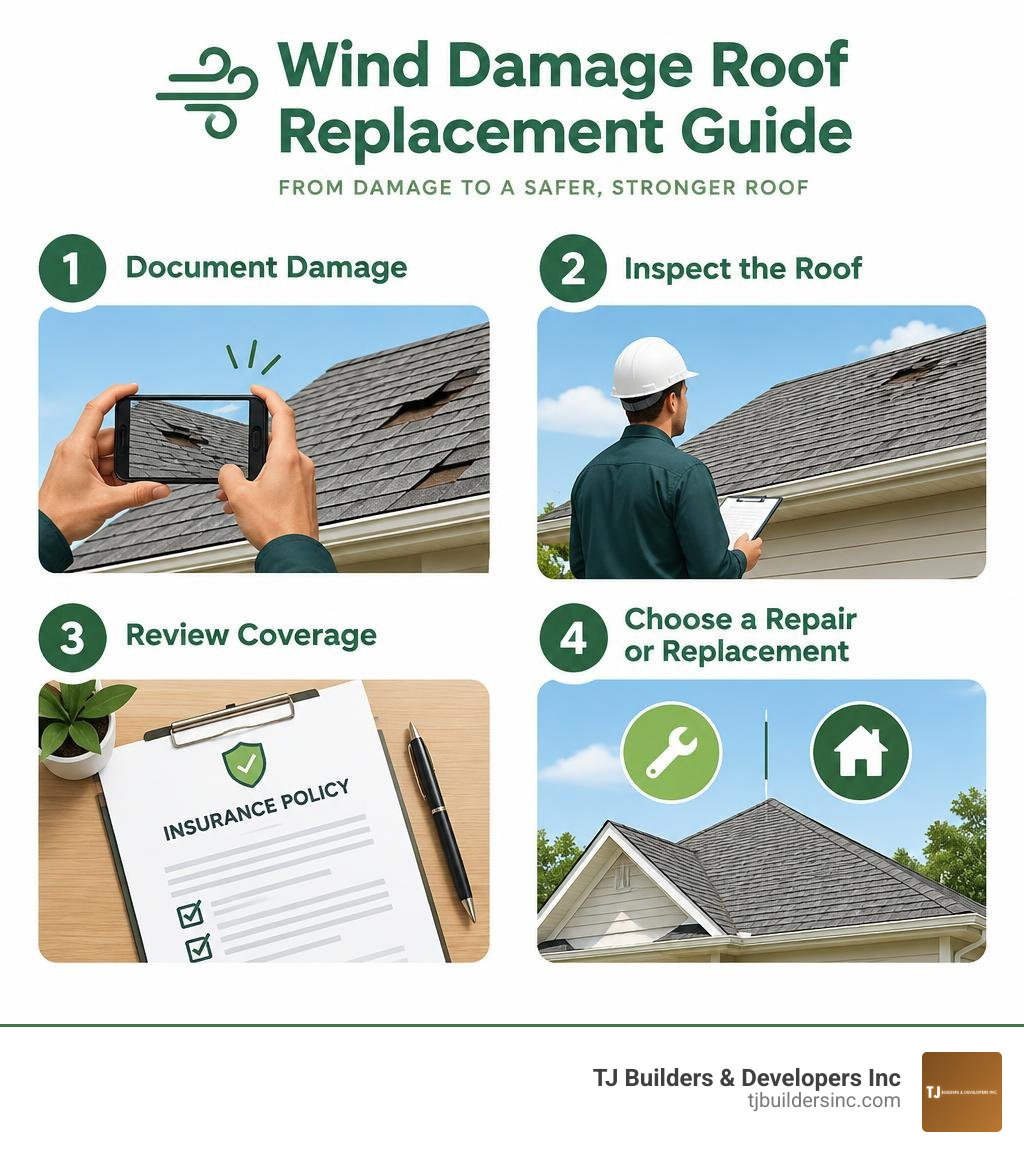
Wind damage roof replacement terms to learn:
Identifying Severe Wind Damage and Hidden Structural Compromise

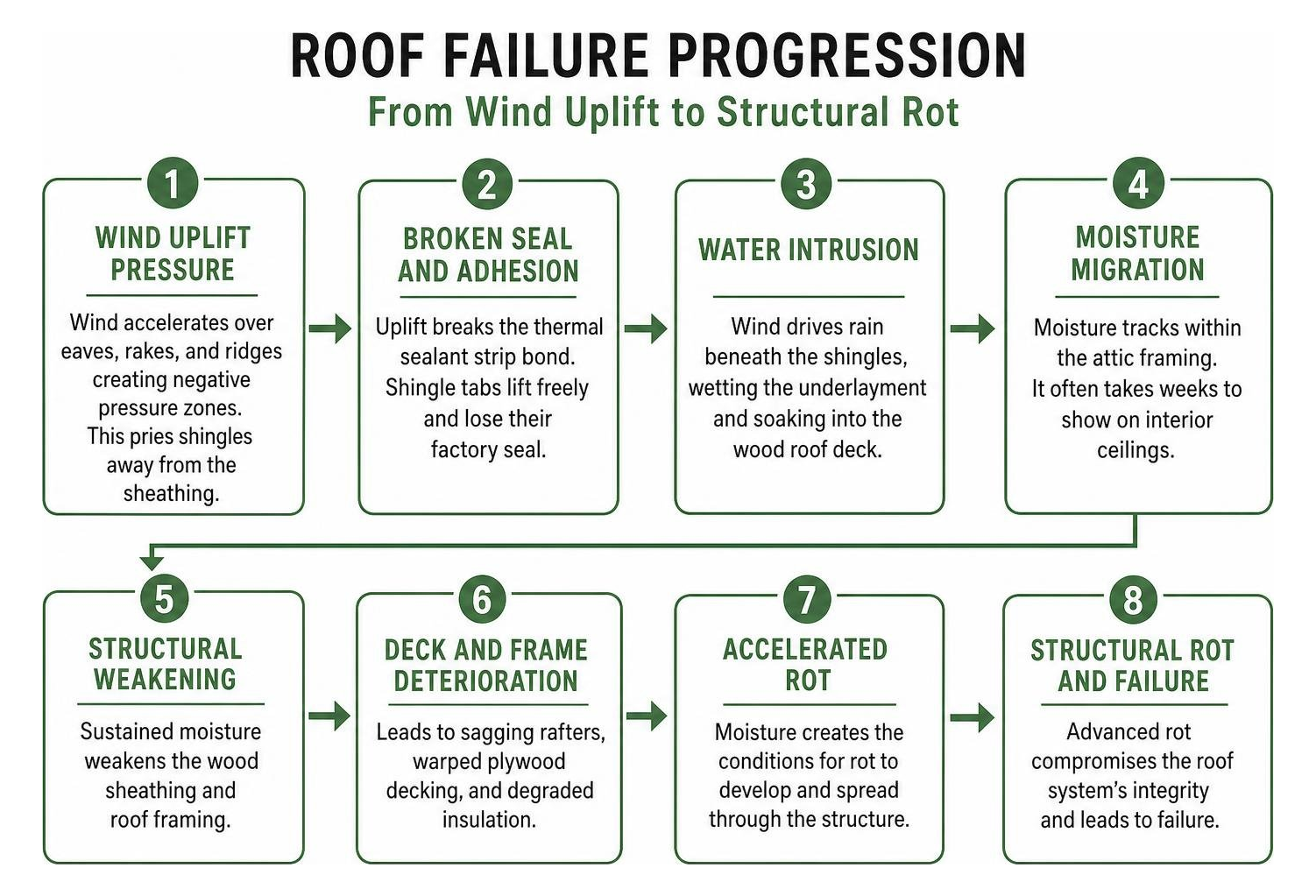
When high-velocity gusts sweep through Northern Illinois communities like Crystal Lake, Algonquin, and Schaumburg, wind interacts with a roof system through uplift pressure. Wind does not hit a structure uniformly. Instead, it strikes the vertical exterior walls, travels upward, and accelerates over the eaves, rakes, and ridges. This aerodynamic lift creates negative pressure zones that pry shingles away from the underlying sheathing.
Even when shingles appear intact from the ground, uplift forces frequently break the thermal sealant strip bond that glues individual courses together. Once this seal breaks, wind drives rain directly beneath the shingle surface, wetting the underlayment and soaking into the wood roof deck. Moisture tracking within the attic framing often takes weeks to manifest on finished interior ceilings, silently weakening the structure in the meantime. Addressing this early requires thorough storm hail damage restoration practices to identify compromised materials before rot sets in.
Building standards mandate that asphalt shingles meet strict manufacturing criteria, specifically ASTM D7158 or ASTM D3161 classifications for wind resistance. Shingles engineered to these standards can withstand design wind speeds up to 110 to 150 mph when properly installed. For an in-depth breakdown of standard system designs, the Asphalt Shingle Roofs guide by Building America Solution Center details how proper fastening schedules maintain envelope integrity during severe weather events.
Signs of Functional Wind Damage: Lifted Seals, Creases, and Torn Flashing
Insurance carriers distinguish between cosmetic flaws and functional damage. Functional wind damage compromises the water-shedding capacity or shortens the expected service life of the roof component.
- Creased and Folded Shingles: When uplift pressure breaks a shingle’s adhesive bond, subsequent gusts flap the tab upward. This repetitive mechanical bending fractures the fiberglass matting along the upper edge, creating a dark, horizontal crease where protective granules dislodge.
- Unsealed Shingle Tabs: Shingles that lift freely by hand have lost their factory seal. In cold weather, these tabs will not reseal on their own and will continue to admit wind-driven moisture.
- Perimeter and Edge Tearing: Eaves and rakes absorb the highest localized wind shear. Tearing along these boundaries exposes the roof deck directly to edge-lift failure.
- Displaced Step and Counter Flashing: High winds can pry flashing loose from sidewalls, headwalls, and chimneys, severing water-diverting channels around sensitive roof penetrations.
- Valley Metal Distortion: Metal valleys subjected to intense wind pressure can lift, buckling adjacent valley cuts and channeling rushing rainwater underneath the shingles.
Assessing Severe Shingle Failure and Wind Damage Roof Replacement Triggers
The National Weather Service classifies severe thunderstorms at a baseline of 58 mph winds or 1-inch hail. Gale-force winds range between 39 and 54 mph, while storm systems exceeding 74 mph bring hurricane-force pressure profiles. At these velocities, localized shingle failure frequently transitions into broader system compromise.
Fastener pull-through occurs when high upward pressure forces the asphalt matting to tear clean over the nail heads, leaving the fasteners embedded in the sheathing while the shingle tears free. Once multiple shingles pull through or tear across several slopes, sub-roof moisture migration accelerates. If neglected, sustained moisture leads to sagging rafters, warped plywood decking, and degraded insulation.
Need Help With Your Home?
TJ Builders & Developers handles roofing, siding, gutters, windows, home additions, and fire damage restoration for homes and businesses in Lakewood, Crystal Lake, Schaumburg, and nearby McHenry County towns.
- Free, no-obligation estimates
- Licensed & insured
- 20+ years of local experience
Criteria for a Full Wind Damage Roof Replacement vs. Repair
Choosing between targeted repairs and a complete replacement depends on the severity of the damage, the remaining service life of the roofing material, and local construction mandates. Reviewing our roof installation and replacement complete guide helps clarify how modern assemblies perform compared to weathered systems.
| Evaluation Metric | Targeted Spot Repair | Full Roof Replacement |
|---|---|---|
| Damage Scope | Isolated to fewer than 10-15% of shingles on a single slope | Exceeds 25% of an individual slope or spans multiple facets |
| Roof Age | Typically under 10 years; shingles remain pliable | 15+ years; shingles are brittle and prone to cracking during repairs |
| Decking Condition | Dry, solid plywood or OSB with no structural sagging | Soft, rotted, or delaminated decking across multiple areas |
| Material Match | Identical shingle profile and color actively manufactured | Discontinued shingle size, exposure, or color profile |
| Cost vs. Value | Repair cost remains well under 30% of replacement cost | Repair costs exceed 30-40% of total system replacement value |
The 25-Percent Slope Rule and Regional Building Codes
Municipal building codes across Northern Illinois—including local enforcement throughout McHenry, Lake, and Cook counties—frequently adopt International Residential Code (IRC) provisions regarding existing roof coverings. Under standard building codes, if more than 25 percent of a roof covering on a single slope or building plane is damaged or removed within a 12-month period, the entire affected slope or system must be replaced to meet modern code requirements.
Furthermore, building codes mandate modern ice barrier protections (ice and water shield) installed along eaves and valleys during a full tear-off. Attempting to slip individual replacement shingles into an aging assembly without replacing underlying underlayment often violates local building mandates. When an insurance carrier attempts to pay only for scattered patch repairs, having Ordinance and Law coverage within your policy bridges the financial gap, requiring the carrier to fund code-mandated system upgrades.
The Shingle Matching Rule, Discontinued Lines, and Line of Sight
Insurance carriers routinely attempt to resolve claims by paying to replace only the specific shingles that tore off. However, industry standards and line-of-sight matching regulations require a uniform appearance.
- Discontinued Shingle Profiles: Shingle manufacturers periodically redesign product dimensions, exposure widths, and metric measurements. Older shingles cannot be seamlessly interlocked with modern products without breaking surrounding tabs.
- Granule Weathering and Color Variance: Even if a shingle model is still produced, years of ultraviolet light exposure fade existing shingles. Introducing new, vibrant shingles creates an obvious patchwork pattern across a contiguous roof plane.
- ITEL Laboratory Testing: When shingle availability is disputed, a physical sample can be sent to ITEL Laboratories for precise product identification. If ITEL confirms the product is obsolete or discontinued, the carrier must address the inability to perform a uniform repair.
Navigating Insurance Claim Battles: ACV, RCV, and Deductible Traps
Filing a roof damage claim requires a clear understanding of your policy’s structural terms. Carriers frequently apply wear-and-tear exclusions or cite pre-existing granule loss to minimize payouts. Reviewing the plain-English guide to roof insurance coverage provides helpful perspective on how policy conditions operate during storm restoration.
Actual Cash Value vs. Replacement Cost Value Policies
The single most critical factor in your claim payout is whether your coverage is structured as Actual Cash Value (ACV) or Replacement Cost Value (RCV).
- Actual Cash Value (ACV): ACV policies pay only the depreciated value of your roof at the time of loss. For example, if a full replacement costs $14,000 on a 15-year-old roof with an estimated 60% depreciation schedule, the carrier will deduct $8,400 for age and use. The initial payout is only $5,600, minus your deductible, leaving you to cover the remaining balance out of pocket.
- Replacement Cost Value (RCV): RCV policies cover the complete cost to install a new roof of like kind and quality, split into two payments. The carrier issues the ACV payment first. Once the work is completed and an itemized invoice is submitted, the carrier releases the withheld depreciation (recoverable depreciation) to settle the remaining balance, minus your deductible.
Understanding Percentage-Based Wind and Hail Deductibles
Many modern homeowner policies carry a separate wind and hail deductible calculated as a percentage of the dwelling coverage (Coverage A) rather than a flat dollar amount.
If your home is insured for a dwelling value of $300,000:
- A flat standard deductible might be $1,000.
- A 1% wind deductible requires an out-of-pocket payment of $3,000.
- A 2% wind deductible requires an out-of-pocket payment of $6,000.
Because wind/hail claims involve multi-party insurance drafts made out to both the homeowner and the mortgage holder, claim checks must pass through an escrow endorsement process. Understanding these figures early prevents unexpected delays when scheduling construction.
Need Help With Your Home?
TJ Builders & Developers handles roofing, siding, gutters, windows, home additions, and fire damage restoration for homes and businesses in Lakewood, Crystal Lake, Schaumburg, and nearby McHenry County towns.
- Free, no-obligation estimates
- Licensed & insured
- 20+ years of local experience
Step-by-Step Claim Roadmap and Overcoming Denials
When dealing with severe weather losses, following a clear timeline ensures your documentation withstands insurance review. If you discover blown-off shingles or unexpected leaks, our emergency roof repair and leak detection team can help secure your property right away.
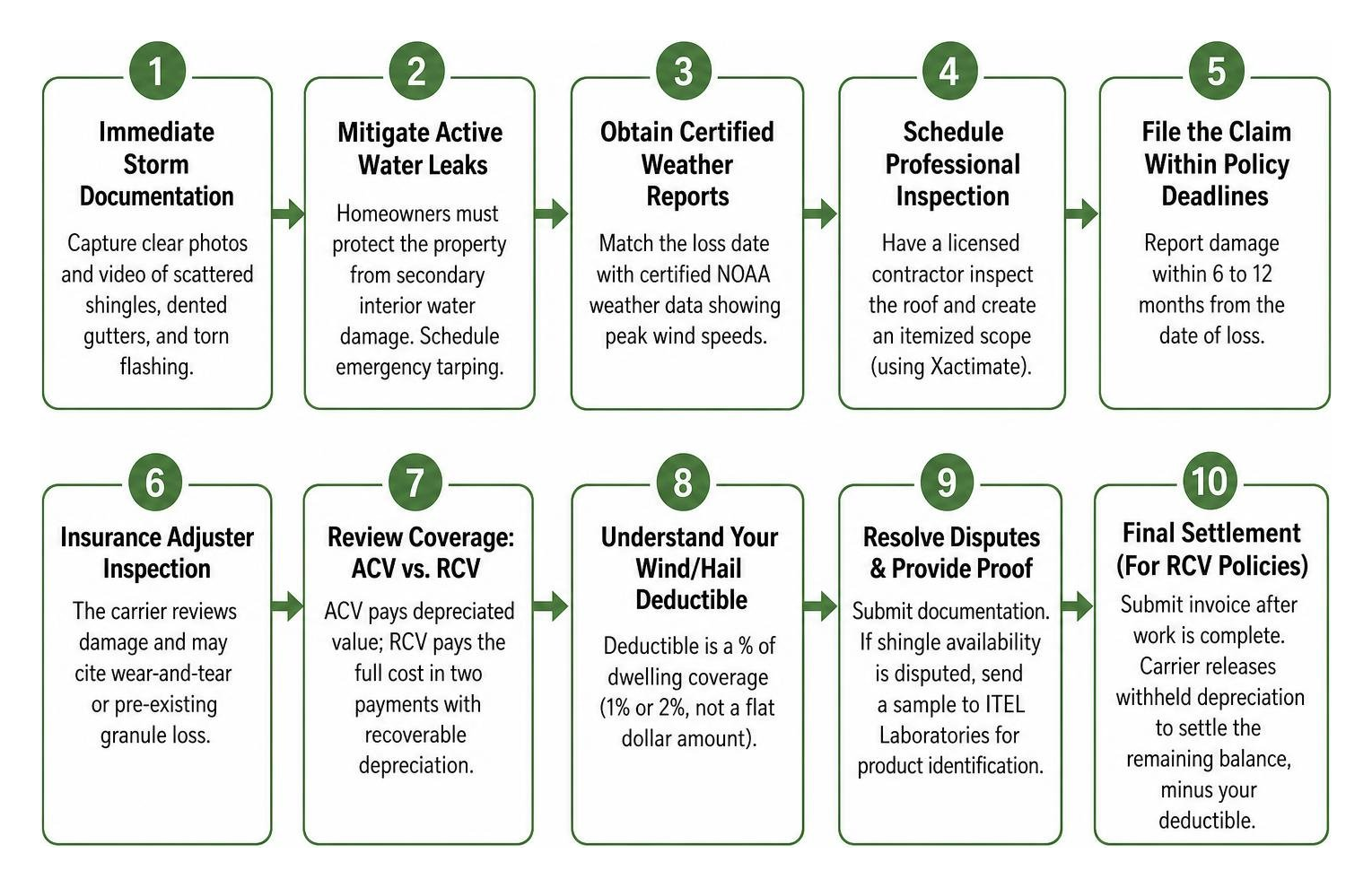
- Immediate Storm Documentation: Capture clear photos and video footage of scattered shingles on the ground, dented gutters, and torn flashing. Do not climb the roof yourself; leave elevated inspections to professionals.
- Mitigate Active Water Leaks: Homeowners have an explicit policy duty to protect the property from secondary interior water damage. Schedule fast emergency roof repair for temporary protective tarping.
- Obtain Certified Weather Reports: Match the loss date with certified NOAA meteorological data indicating peak wind speeds in your immediate area to eliminate carrier disputes regarding pre-existing wear.
- Schedule an Independent Professional Inspection: Have a licensed contractor complete a full roof assessment and generate an itemized scope using standard industry estimation software (such as Xactimate).
- File the Claim Within Policy Deadlines: Standard policies require reporting damage within 6 to 12 months from the date of loss. File promptly with your carrier’s claims department.
- Attend the On-Site Adjuster Meeting: Ensure your contractor is present during the adjuster’s inspection to point out lifted seals, mat fractures, and code requirements on-site.
Immediate Storm Documentation and Emergency Protection
Insurance policies include a standard clause requiring the policyholder to prevent further damage. If wind rips shingles off and allows rain into the attic, failing to tarp the opening can result in the carrier denying coverage for ruined drywall, flooring, or insulation.
Save all receipts from emergency repairs. These mitigation expenses are categorized under “reasonable repairs” within Coverage A and are reimbursed by the insurer independently of the main repair settlement.
Steps to Turn a Partial Repair Offer into a Wind Damage Roof Replacement
If an insurance adjuster approves only a partial repair that leaves your roof mismatched or structurally unsound, you have procedural options to appeal the decision:
- Conduct Shingle Brittleness (Tarp/Bend) Tests: During a joint inspection, our team checks whether surrounding weathered shingles can be lifted high enough to drive nails without cracking adjacent tabs. If surrounding shingles fracture during the attempt, repair is considered impossible.
- Partner with Qualified Professionals: Understanding the benefits of hiring insurance approved roofers ensures your repair scope adheres to manufacturer guidelines and building code standards.
- Submit a Formal Scope Supplement: We provide the insurance carrier with a detailed, line-by-line supplement including high-resolution photographic evidence, manufacturer repair limitations, and local municipal building code requirements.
- Invoke the Policy Appraisal Clause: If negotiations stall over the financial value of the loss, most standard policies permit invoking the appraisal clause. In this process, an independent appraiser from each side (and a neutral umpire, if needed) determines the binding cost of the scope.
Frequently Asked Questions About Roof Insurance Claims
How long do I have to file a roof damage insurance claim after a windstorm?
Most standard homeowner policies require you to notify the carrier of a storm loss within 365 days (one year) of the event, though some policies specify a 180-day window. Waiting too long allows normal seasonal weathering to obscure fresh wind tears, giving adjusters an opening to classify the issue as gradual maintenance neglect.
Will insurance pay for a full roof replacement if only one side is damaged?
Insurance carriers may initially approve replacement for only the damaged slope. However, full roof replacement can be warranted if the existing shingles are discontinued, if local building codes prohibit mixing non-matching components, or if repairs would violate uniform appearance standards across contiguous lines of sight.
What should I do if the insurance adjuster undervalues the wind damage?
Do not sign a final release or cash an initial settlement check marked “paid in full” if the scope is inadequate. Request a reinspection with a different adjuster, submit an independent roofer’s itemized estimate, and provide manufacturer documentation showing why spot repairs are technically unfeasible.
Conclusion
Recovering from severe wind damage requires balancing immediate property protection, sound technical installation standards, and structured insurance claim navigation. Choosing heavy-duty, wind-rated roofing systems installed with proper fastening schedules and continuous underlayment protects your home against future storms for decades to come.
TJ Builders & Developers Inc provides professional roofing and exterior restoration across Lakewood, Crystal Lake, Algonquin, Schaumburg, and surrounding Northern Illinois communities. To evaluate your roof following severe weather, schedule a comprehensive assessment through our professional roofing services.