Why an Allura Trim Board Is Worth Considering
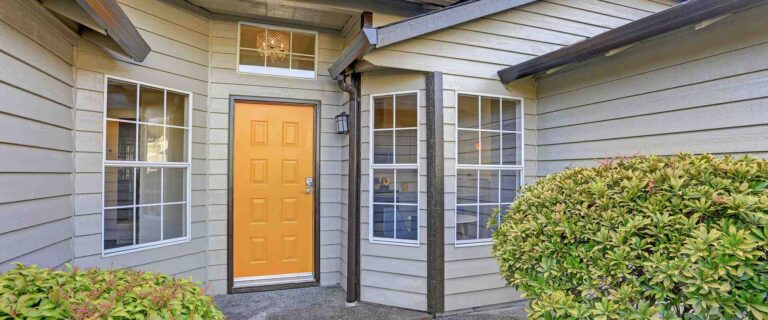
An Allura trim board is a fiber cement board made for exterior window and door surrounds, corners, fascia, and other crisp finishing details. It is a strong option when you want trim that resists rot, termites, moisture, and fire better than ordinary wood, without the expansion and contraction common with PVC.
Allura trim is available in primed, paint-ready boards and Spectrum factory-finished options. Most boards come in 12-foot lengths, with 4/4, 5/4, and select 8/4 profiles for projects that need more visual depth. The material is also reversible, with a smooth face on one side and a cedar-textured face on the other.
For homeowners comparing exterior trim materials, the main tradeoff is simple: fiber cement costs and weighs more than basic wood trim upfront, but its durability, Class A fire rating, and lower risk of rot can make it a practical long-term choice. Proper flashing, clearances, corrosion-resistant fasteners, and sealant details still matter because no trim board can fix a window or wall that lets water behind it.
I am Thomas Pruszynski, owner of TJ Builders & Developers Inc. For more than 20 years, I have helped Northern Illinois homeowners protect and improve their exteriors, including selecting and installing durable trim systems such as Allura trim board as part of complete siding, window, and water-management work.
Basic allura trim board glossary:
What Is Allura Fiber Cement Trim and Key Performance Benefits
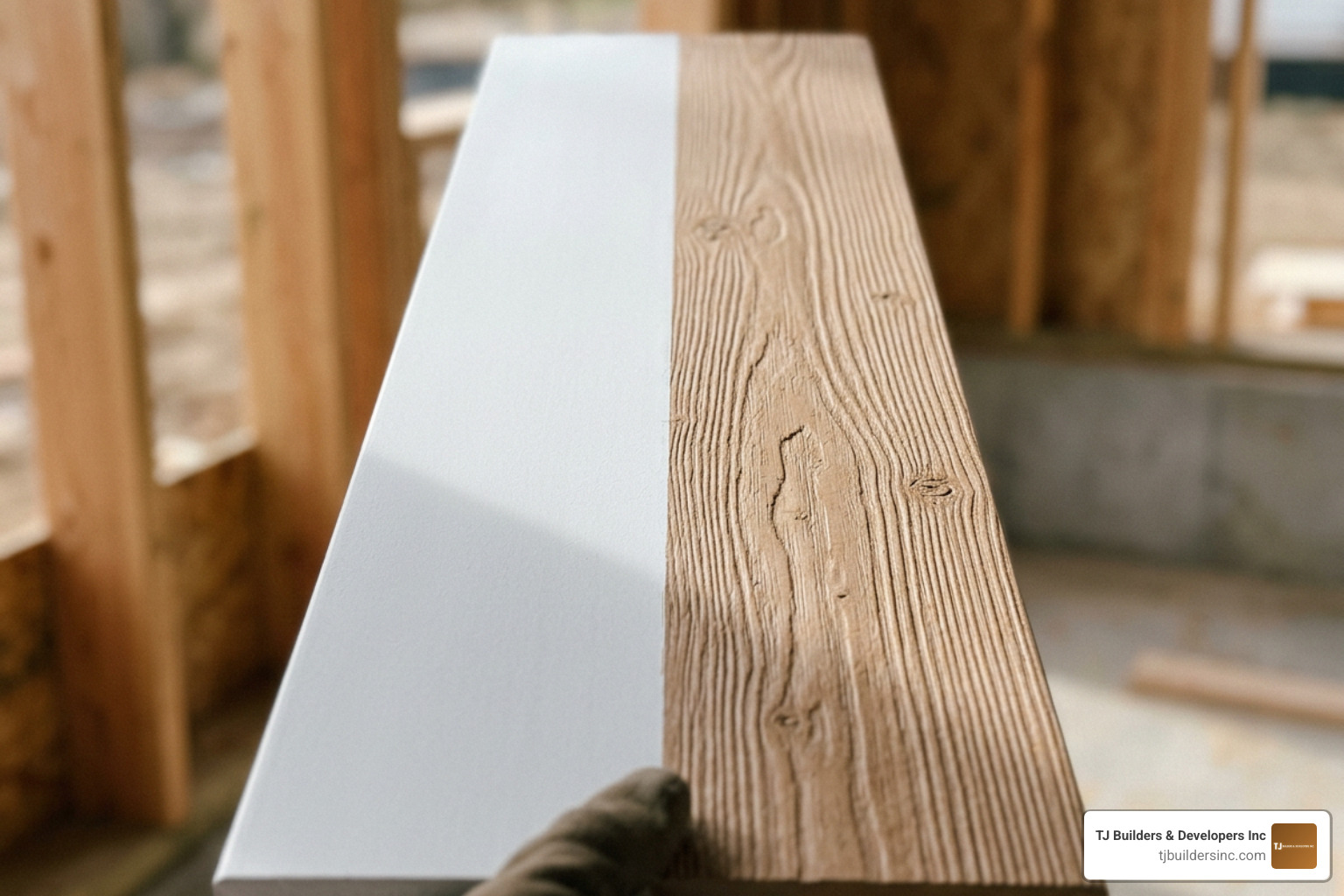
When upgrading a home exterior, the architectural trim establishes visual definition around windows, doorways, band boards, and corners. Engineered by combining high-grade Portland cement, wood fiber, and specialized additives under intense pressure, Fiber Cement Board Trim | Allura USA delivers a balance of structural resilience and traditional craftsmanship. Understanding all about fiber cement vs alternatives helps explain why this composite mixture performs reliably across varying weather conditions.
Durability and Fire Safety Ratings
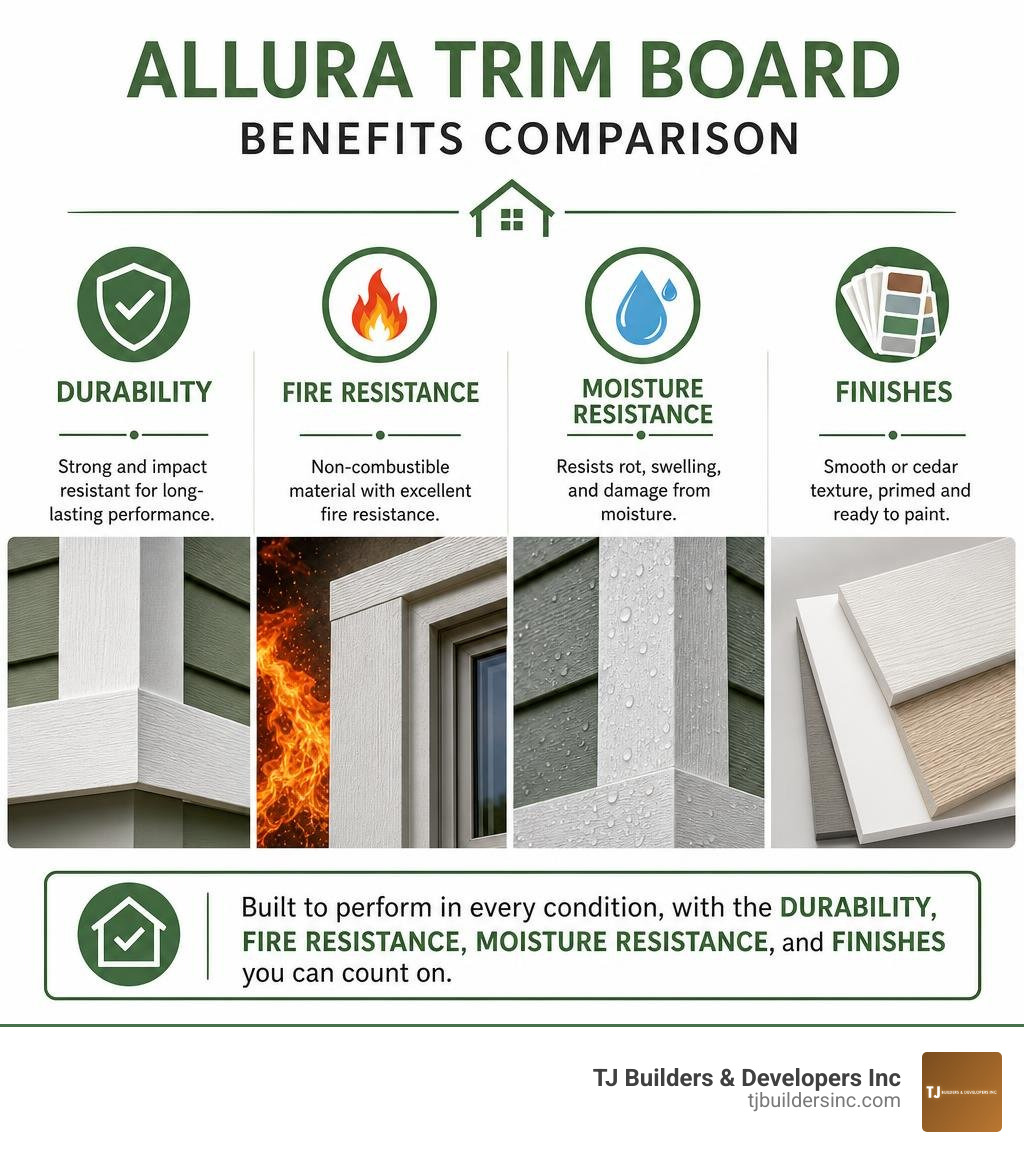
Exterior cladding materials face extreme environmental stressors, from freeze-thaw cycles to severe seasonal storms. Allura trim complies with ASTM C1186 standards for flat non-asbestos fiber cement sheets and is tested under ASTM C1185 for flexural strength, moisture movement, water absorption, and dimensional stability.
Safety remains a core performance metric. Allura fiber cement products carry a Class A fire rating under ASTM E84 testing, demonstrating a Flame Spread Index of 0 and a Smoke Developed Index of 5. The material is non-combustible per ASTM E136 and is listed under CalFire Wildland Urban Interface (WUI) compliance standards (8170-2180:0503). These properties provide resistance against airborne embers, hail impacts, wood-boring pests, and moisture-induced rot.
Reversible Surface Textures: Smooth and Cedar Grain
Architectural versatility is engineered into each profile. Allura trim features a reversible profile with precision machined square edges:
- Traditional Cedar Texture: Emulates the authentic depth, relief, and grain pattern of natural milled timber.
- Smooth Surface: Provides crisp, modern lines suited for contemporary facades, transitional styles, or clean farmhouse designs.
This dual-sided manufacturing allows installers to maintain consistent stock while matching specific design profiles across home elevations.
Need Help With Your Home?
TJ Builders & Developers handles roofing, siding, gutters, windows, home additions, and fire damage restoration for homes and businesses in Lakewood, Crystal Lake, Schaumburg, and nearby McHenry County towns.
- Free, no-obligation estimates
- Licensed & insured
- 20+ years of local experience
Sizing and Profiles: Choosing the Right Allura Trim Board for Your Project
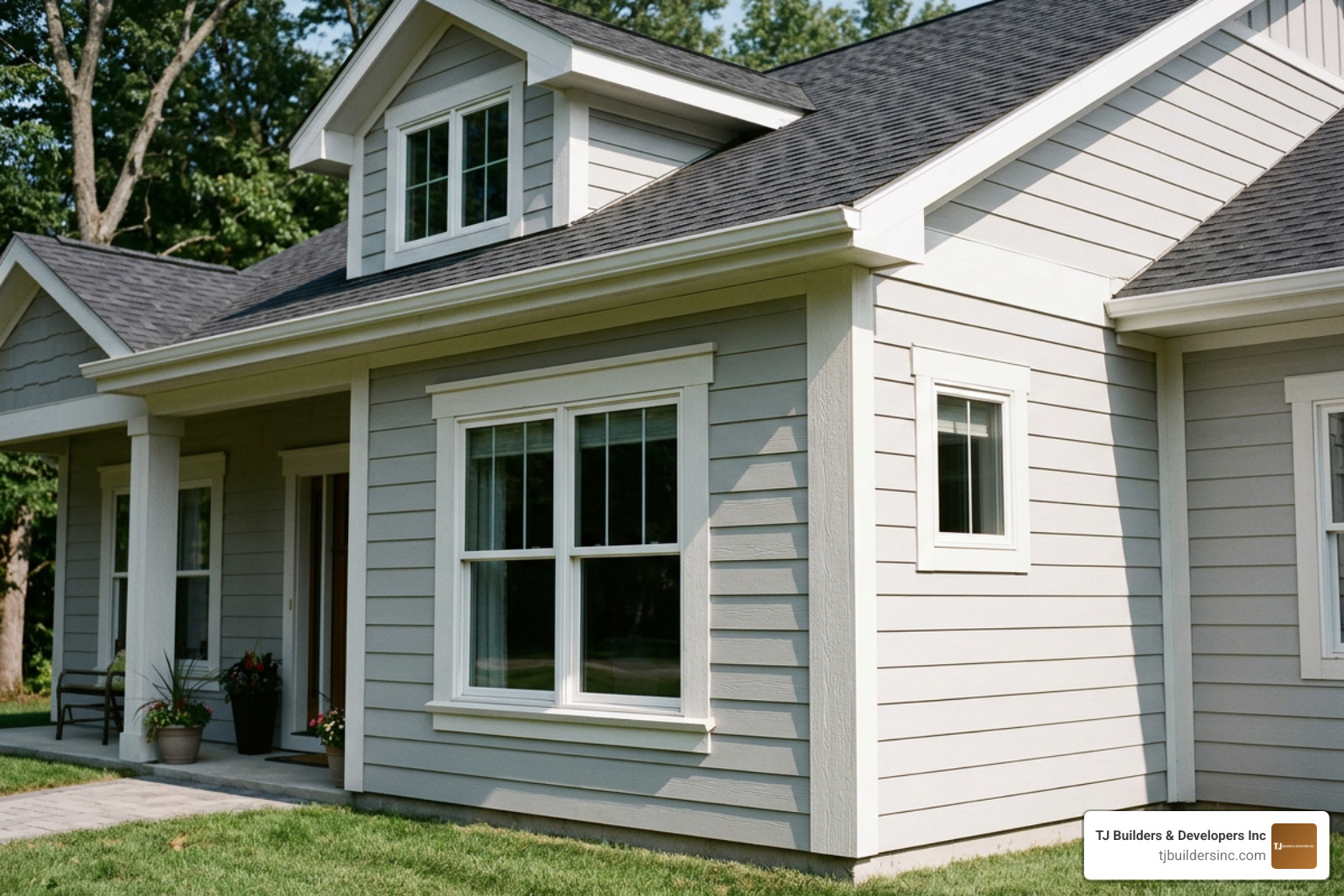
Selecting appropriate dimensional profiles ensures the trim provides proper architectural depth relative to the primary siding panels. Allura trim boards are manufactured in standard 12-foot lengths across multiple nominal thicknesses. The table below outlines nominal profiles against their actual physical dimensions based on the Lap Vertical Trim Smooth Stucco Reversable Specification Sheet.
| Nominal Thickness | Actual Thickness | Available Nominal Widths | Actual Widths | Common Applications |
|---|---|---|---|---|
| 4/4 Trim | 3/4 in. (19 mm) | 2″, 3″ (Batten), 4″, 5″, 6″, 8″, 10″, 12″ | 1-3/4″, 2-1/2″, 3-1/2″, 4-1/2″, 5-1/2″, 7-1/4″, 9-1/4″, 11-1/4″ | Window/door surrounds, board & batten accents, fascia |
| 5/4 Trim | 1 in. (25 mm) | 3″, 4″, 5″, 6″, 8″, 10″, 12″ | 2-1/2″, 3-1/2″, 4-1/2″, 5-1/2″, 7-1/4″, 9-1/4″, 11-1/4″ | Outside corners, thick window casings, architectural frieze |
| 8/4 Trim | 1-1/2 in. (38 mm) | 4″, 6″ | 3-1/2″, 5-1/2″ | Heavy corner posts, structural visual projections |
For standard installations, products such as the Allura Reversible Trim 3/4 in. x 4 in. x 12 ft. Primed Fiber Cement Trim Board serve as a baseline profile for window and door casing applications.
Primed vs Spectrum Pre-Finished Allura Trim Board Finishes
Allura trim boards are supplied in two primary finish formats:
- Factory-Primed: Sealed on all sides with a specialized primer formulated for field top-coating. Once installed, surfaces can be finished with premium 100% acrylic latex exterior paint.
- Spectrum Factory-Finished: Pre-coated in a factory-controlled environment using curated Sherwin-Williams exterior palettes (such as Snow White, Black Fox, Sandy Clay, and Bronze). This system includes a 15-year coating warranty and utilizes color-matched sealants and dedicated touch-up formulations for cut ends.
Installation Best Practices and Moisture Management
Long-term performance relies on continuous water management. Trim serves as an architectural detail, not an impermeable moisture barrier. When water breaches exterior trim lines, it can travel behind cladding via capillary action, compromising structural sheathing and framing. Homeowners seeking guidance on maintaining building envelope integrity can review the ultimate guide to finding exterior home repair near me for insights on addressing exterior vulnerabilities.
Fastening Specifications for Allura Trim Board Installation
Proper mechanical attachment requires specific fasteners and penetration depths. Fastener schedules must comply with structural building codes (including CERus-1012, Florida Building Code FL20742-R6, and Miami-Dade NOA approvals). Key requirements include:
- Fastener Selection: Corrosion-resistant, hot-dipped galvanized or stainless steel siding nails, ring-shank nails, or approved trim screws.
- Framing Penetration: Nails must penetrate structural wood framing by a minimum of 1 inch (25 mm), while screws require 3/4-inch (19 mm) embedment. For steel framing, self-tapping screws must penetrate at least 1/4 inch (6.4 mm) or three full threads.
- Fastening Pattern: Standard runs require fasteners placed 1 inch from side edges and 2 inches from end joints, spaced no more than 16 inches apart on center.
- Outside Corners: According to the B01.A Technical Bulletin, thicker 8/4 outside corners require fasteners positioned 1 inch from the inside edge and 1-3/4 inches from the outside edge, spaced a maximum of 8 inches on center in an alternating pattern to avoid fastener collisions.
For complex architectural framing, consulting resources like dont get trimmed out how to pick the best exterior trim contractor helps ensure trade professionals follow correct manufacturer specifications.
Window Trim and Flashing Integration to Prevent Water Damage
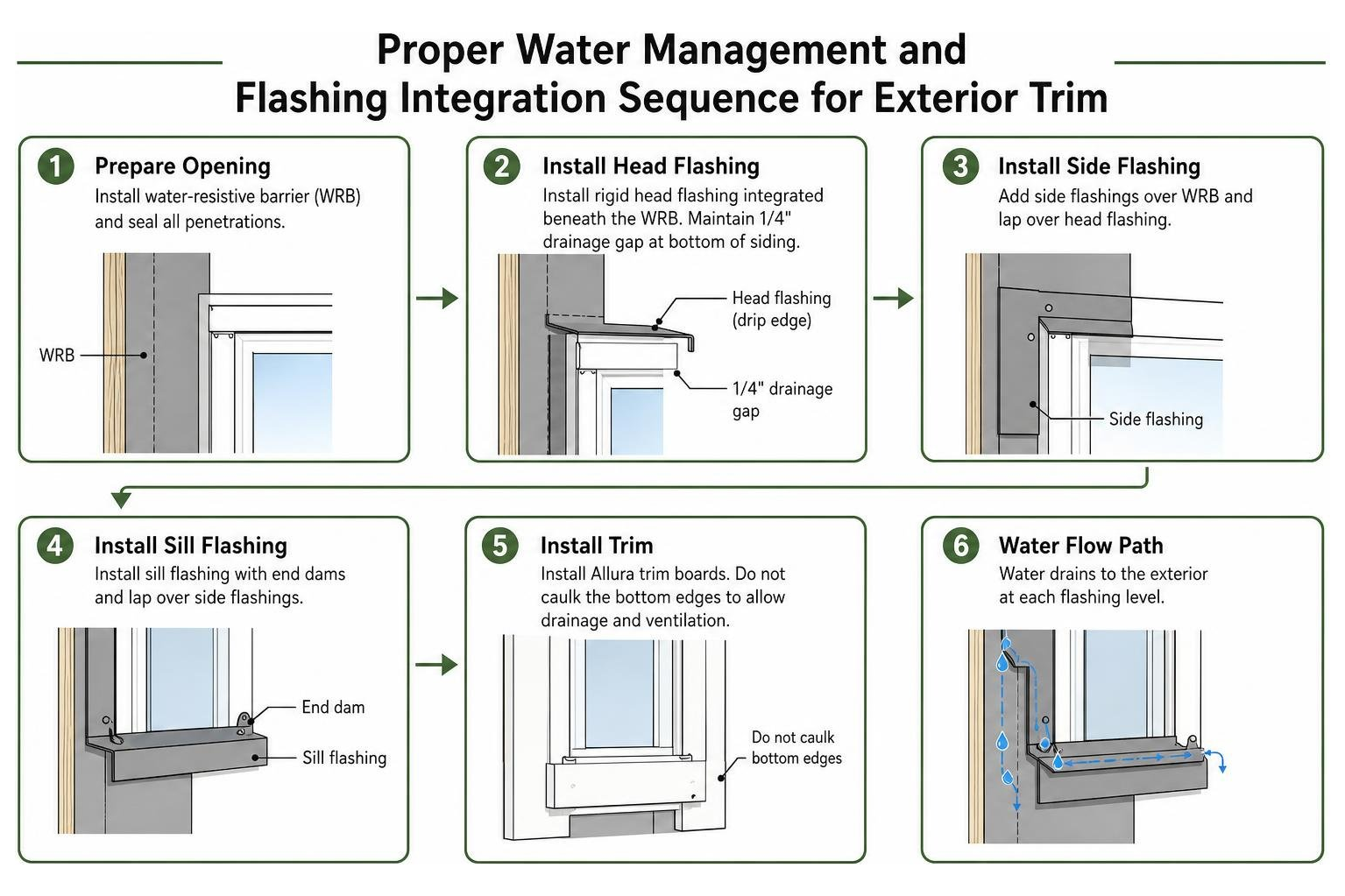
Moisture mitigation around window openings requires strict adherence to water drainage principles:
- Head Flashing (Drip Edge): Rigid, corrosion-resistant metal head flashing must be installed above horizontal window trim, integrated beneath the weather-resistive barrier (WRB). A 1/4-inch drainage gap should be maintained between the bottom of the siding and the horizontal trim.
- Sill and Base Clearances: Maintain a minimum 2-inch clearance above horizontal hard surfaces (rooflines, decks, patios) and 6 inches above finished grade to prevent capillary moisture uptake.
- Sealant Application: Apply high-performance elastomeric sealants (such as OSI QUAD MAX or Bostik DUO-SIL Ultra) at butt joints and material transitions, leaving critical drainage weeping zones uncaulked.
- End Sealing: All field cuts must be sealed immediately using manufacturer-approved touch-up paint or primer before final fastening.
Material Comparisons: Fiber Cement Trim vs Wood and PVC
Choosing the correct exterior trim involves evaluating performance across longevity, thermal behavior, and maintenance requirements:
- Natural Wood (Cedar/Pine): While traditional, natural lumber is vulnerable to fungal decay, insect boring, moisture warping, and paint failure caused by internal wood movement. It requires regular repainting and surface sealing.
- Cellular PVC: PVC offers high moisture resistance but exhibits significant thermal expansion and contraction across seasonal temperature swings. If dark colors are applied without specialized heat-reflective formulations, PVC trim can bow or pull fasteners loose.
- Fiber Cement (Allura): Combines non-combustibility, dimensional stability, and pest resistance. It experiences negligible thermal movement compared to plastics and holds paint coatings significantly longer than natural timber.
Need Help With Your Home?
TJ Builders & Developers handles roofing, siding, gutters, windows, home additions, and fire damage restoration for homes and businesses in Lakewood, Crystal Lake, Schaumburg, and nearby McHenry County towns.
- Free, no-obligation estimates
- Licensed & insured
- 20+ years of local experience
Warranty Coverage and Ongoing Maintenance Standards
Allura fiber cement trim is supported by a 15-Year Transferrable Limited Product Warranty. According to the official Allura Trim Warranty, coverage protects against manufacturing defects, failure to meet ASTM C1186 physical standards, hail damage, and termite attacks.
Key warranty conditions and ongoing maintenance best practices include:
- Storage and Handling: Uninstalled boards must be kept dry and covered on flat pallets to prevent efflorescence (salt residue migration) and moisture absorption prior to nailing.
- Periodic Cleaning: Surfaces should be washed periodically using low-pressure garden hoses and mild detergent. Abrasive chemical cleaners or high-pressure power washing can damage factory coatings.
- Caulk Maintenance: Inspect joint sealants every two to three years around high-exposure window and corner assemblies, replacing deteriorated caulk lines to maintain moisture protection.
Frequently Asked Questions About Fiber Cement Exterior Trim
How long does Allura trim board last compared to traditional wood?
When properly installed, flashed, and maintained, fiber cement trim provides decades of service life. Unlike wood trim, which often requires scraping and repainting every 3 to 5 years and remains susceptible to rot, fiber cement maintains structural integrity without decaying or attracting boring insects.
Can Allura trim boards be cut and painted on-site?
Yes. Factory-primed Allura boards are designed to be cut and top-coated on-site with 100% acrylic latex paint. During cutting, professional contractors use dust-reducing circular saws equipped with polycrystalline diamond (PCD) fiber cement blades and HEPA vacuum collection to maintain OSHA respirable crystalline silica safety compliance.
Where can you buy Allura trim boards and what is the typical availability?
Allura products are distributed through professional building material suppliers, regional lumberyards, and commercial distributor networks. Materials can be ordered in full-unit packaging bundles or individual job-lot piece counts tailored to specific architectural blueprints.
Conclusion
Upgrading exterior trim is an investment in your home’s long-term protection and architectural character. Utilizing engineered fiber cement trim ensures clean corner lines, durable window framing, and robust defense against harsh regional weather without constant maintenance demands.
At TJ Builders & Developers Inc, we bring decades of exterior remodeling expertise to homeowners throughout Northern Illinois—including Lakewood, Crystal Lake, Algonquin, Huntley, McHenry, and Schaumburg. Whether coordinating complete home additions, window replacements, or comprehensive siding installation replacement, our team applies meticulous installation standards to safeguard your residence for years to come.