Finding Commercial Roofing Services in Illinois
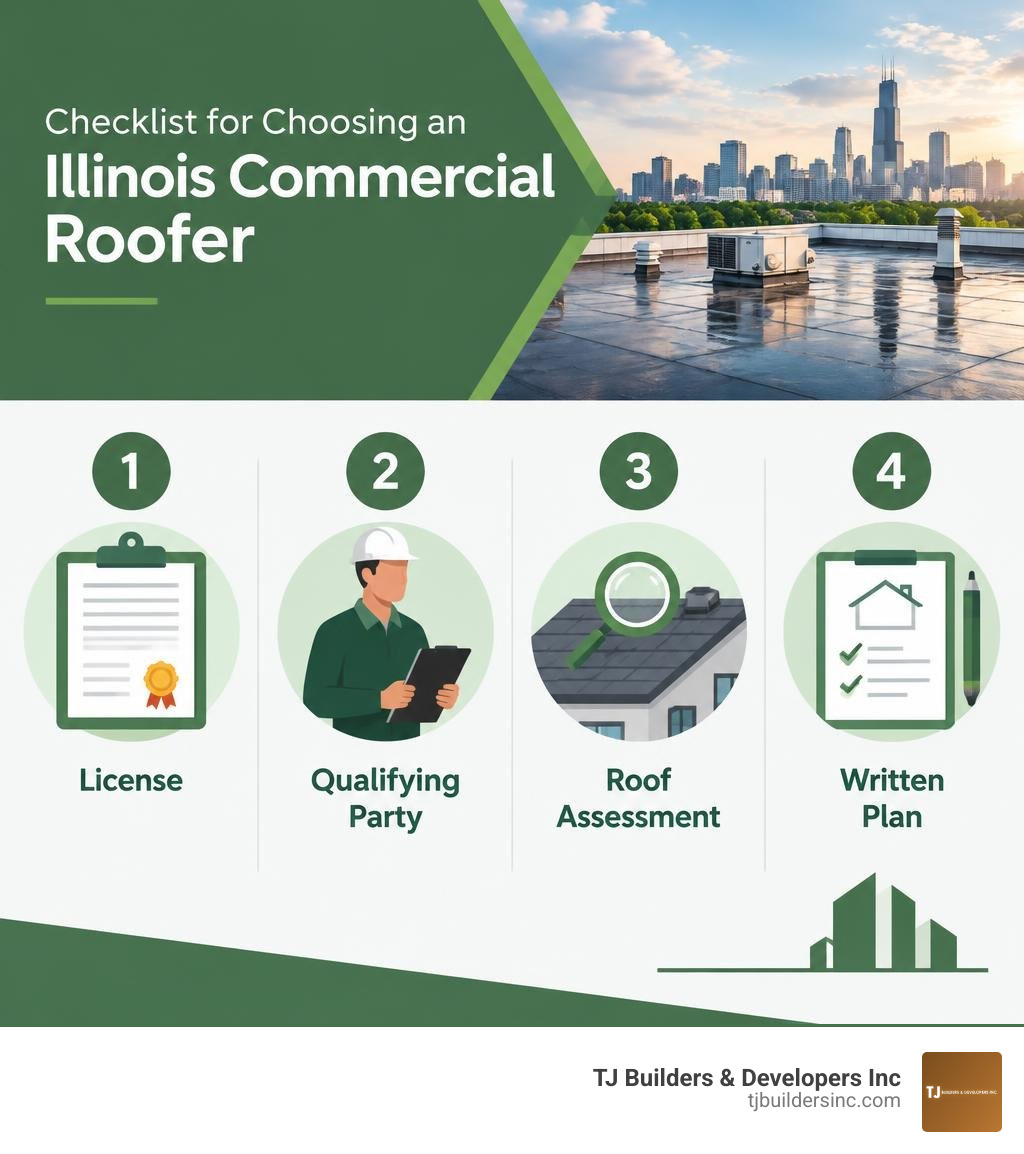
Start with the contractor’s credentials and your roof’s needs. Verify an active Illinois roofing contractor license through the Illinois Department of Financial and Professional Regulation (IDFPR), and ask who serves as the firm’s qualifying party. Then look for experience with your roof type and request a written plan for inspecting leaks, drainage, and any needed repairs or replacement.
A leak can interrupt work and damage the space below. In Northern Illinois, a clear inspection and timely repairs can help protect the building before water damage spreads. According to state regulations, commercial roofing contractors must hold an active license backed by insurance and bonding.
I’m Thomas Pruszynski, owner of TJ Builders & Developers Inc. My more than 20 years of exterior construction work for Northern Illinois homes and businesses informs this guide to commercial roofing services in Illinois, helping property owners make sound decisions starting with licensing and roof condition.
Helpful roofing resources:
Key Standards for Commercial Roofing Services Illinois Businesses Rely On
Operating a commercial facility across Northern Illinois requires vigilance against demanding weather conditions. From heavy winter snowfall in Woodstock and McHenry to intense summer heat waves across Schaumburg and Crystal Lake, your building envelope faces severe environmental stress year-round. When water breaches a commercial roofing system, the resulting downtime, ruined inventory, and structural decay can disrupt your entire operation. Ensuring long-term property protection starts with understanding the strict technical and regulatory standards governing professional contractors in our state.

IDFPR Licensing Requirements for Commercial Roofing Services Illinois Contractors
In Illinois, commercial roofing is heavily regulated to protect property owners against substandard workmanship. The Illinois Department of Financial and Professional Regulation (IDFPR) oversees all commercial and residential roofing contractors. Unlike general handymen, legitimate roofing professionals must hold an active state license backed by mandatory insurance, workers’ compensation coverage, and surety bonds.
State law distinguishes between commercial and residential classifications:
- Residential (Limited): Authorizes work on residential properties consisting of eight units or fewer.
- Commercial/Industrial (Unlimited): Authorizes work on any structure, including large commercial warehouses, manufacturing plants, retail centers, multi-family complexes, and institutional facilities.
Hiring a contractor who holds the unlimited license ensures they have proven their technical capability for large-scale, complex roofing assemblies. Facilities demanding integrated exterior maintenance often benefit from versatile teams capable of delivering comprehensive residential commercial roofing services to ensure all structural envelopes remain secure.
Qualifying Party Designation and Examination Standards
Under IDFPR regulations, an enterprise cannot simply purchase a commercial license. Every licensed business entity must operate under the technical supervision of an officially designated Qualifying Party.
The Qualifying Party is an individual who has demonstrated rigorous trade expertise by sitting for and passing the state-administered Roofing Contractor Qualifying Party Examination. This comprehensive exam covers:
- Illinois building codes, state safety mandates, and environmental rules.
- Advanced roofing installation techniques across steep-slope and low-slope roof assemblies.
- Moisture control, flashing engineering, thermal insulation, and positive drainage management.
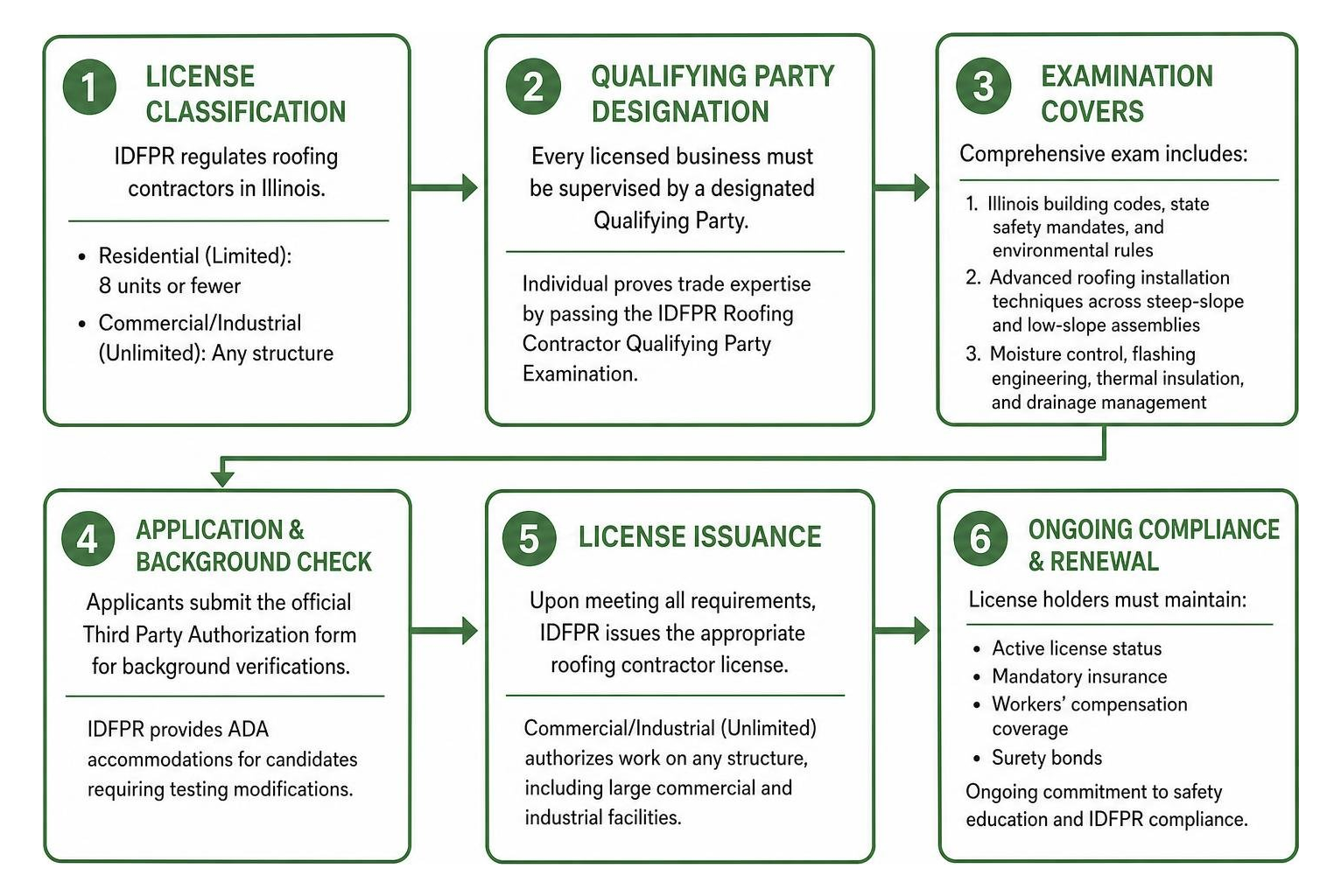
To maintain absolute integrity in the application process, the state requires all applicants to submit the official Third Party Authorization form for background verifications. IDFPR also provides reasonable accommodation options under the Americans with Disabilities Act (ADA) for candidates requiring testing modifications, ensuring that qualified professionals can prove their knowledge without systemic barriers.
Need Help With Your Home?
TJ Builders & Developers handles roofing, siding, gutters, windows, home additions, and fire damage restoration for homes and businesses in Lakewood, Crystal Lake, Schaumburg, and nearby McHenry County towns.
- Free, no-obligation estimates
- Licensed & insured
- 20+ years of local experience
License Maintenance, Renewals, and IDFPR Compliance Procedures
Holding a license is an ongoing commitment to regulatory compliance and ongoing safety education. To safeguard facility investments, commercial building managers should know the operational rules contractors must satisfy behind the scenes.
License Renewal, Reactivation, and Record Updates
Illinois roofing licenses operate on a biennial renewal cycle. To maintain an active, unencumbered status:
- Contractors must file their renewal applications before the state deadline, confirming active general liability insurance and current bonding.
- If a license lapses, the contractor must complete formal reactivation procedures, which may include paying back fees and verifying continuous compliance during the inactive period.
- Contractors must proactively submit official name changes and address updates to the IDFPR within required statutory timeframes to prevent lapses in formal communication.
- When expanding operations or working with institutional municipal projects, a contractor can formally request an official License Certification directly from the state to provide verified proof of active standing.
Qualifying Party Transitions and Disciplinary Relief Procedures
A business entity’s license validity depends directly on maintaining its Qualifying Party. If the designated individual resigns, retires, or leaves the company:

- 60-Day Notification Mandate: The company must officially notify IDFPR within 60 days of the termination or departure of the Qualifying Party.
- Replacement Protocol: The contractor must submit a formal application designating a new Qualifying Party who has passed the state examination to avoid license suspension.
When regulatory discrepancies occur, the state maintains a formal administrative review process. Contractors facing administrative citations may petition IDFPR for restoration or schedule a formal hearing through the division’s administrative legal channels. Primary oversight operates through central administrative centers:
- Chicago Office: James R. Thompson Center / IDFPR Division of Professional Regulation, Chicago, IL.
- Springfield Office: IDFPR Division of Professional Regulation, 320 W. Washington Street, Springfield, IL.
Keeping these administrative requirements up to date ensures that property owners in communities like Barrington Hills, Algonquin, and Huntley work with fully vetted, compliant roofing professionals.
Selecting the Right Commercial Roofing Solutions for Northern Illinois Facilities
Low-slope and flat roofing systems require custom engineering to survive the freeze-thaw cycles of the Midwest. Selecting the proper membrane technology safeguards structural decks against pooling water, UV degradation, and membrane punctures.
Core Commercial Roofing Services Illinois Property Managers Need
Industrial properties, retail centers, and multi-family structures require tailored solutions depending on roof deck slope, mechanical rooftop equipment, and foot traffic:
- TPO (Thermoplastic Polyolefin): A popular single-ply membrane choice. TPO features heat-welded seams that create a continuous, monolithic barrier. Its bright white surface reflects solar radiation, helping maintain balanced indoor temperatures during humid Illinois summers.
- EPDM (Ethylene Propylene Diene Monomer): Known for flexibility, this synthetic rubber membrane expands and contracts during extreme winter temperature swings in Cary, Fox River Grove, and Johnsburg without cracking.
- Modified Bitumen: Incorporating multi-layer redundant protection, asphalt-based modified bitumen systems deliver impact resistance for roofs supporting heavy HVAC service traffic.
When planning long-term building investments, exploring engineered commercial flat roofing solutions allows building owners to balance thermal efficiency with physical strength. Understanding the complete variables that dictate your overall commercial roof replacement cost—such as insulation thickness, tear-off logistics, and perimeter drainage sizing—helps you plan your capital expenditures accurately. For complete information on whole-building exterior protection, our complete roof installation replacement guide covers everything from initial tear-off to final structural detailing.
Preventing Structural Leak Damage with Routine Maintenance and Repair
Water intrusion rarely starts as a catastrophic opening. Instead, tiny tears in expansion joints, cracked perimeter flashings, or blocked interior drains allow moisture to slowly seep into the insulation board. Once saturated, wet insulation loses thermal resistance and accelerates deck corrosion.
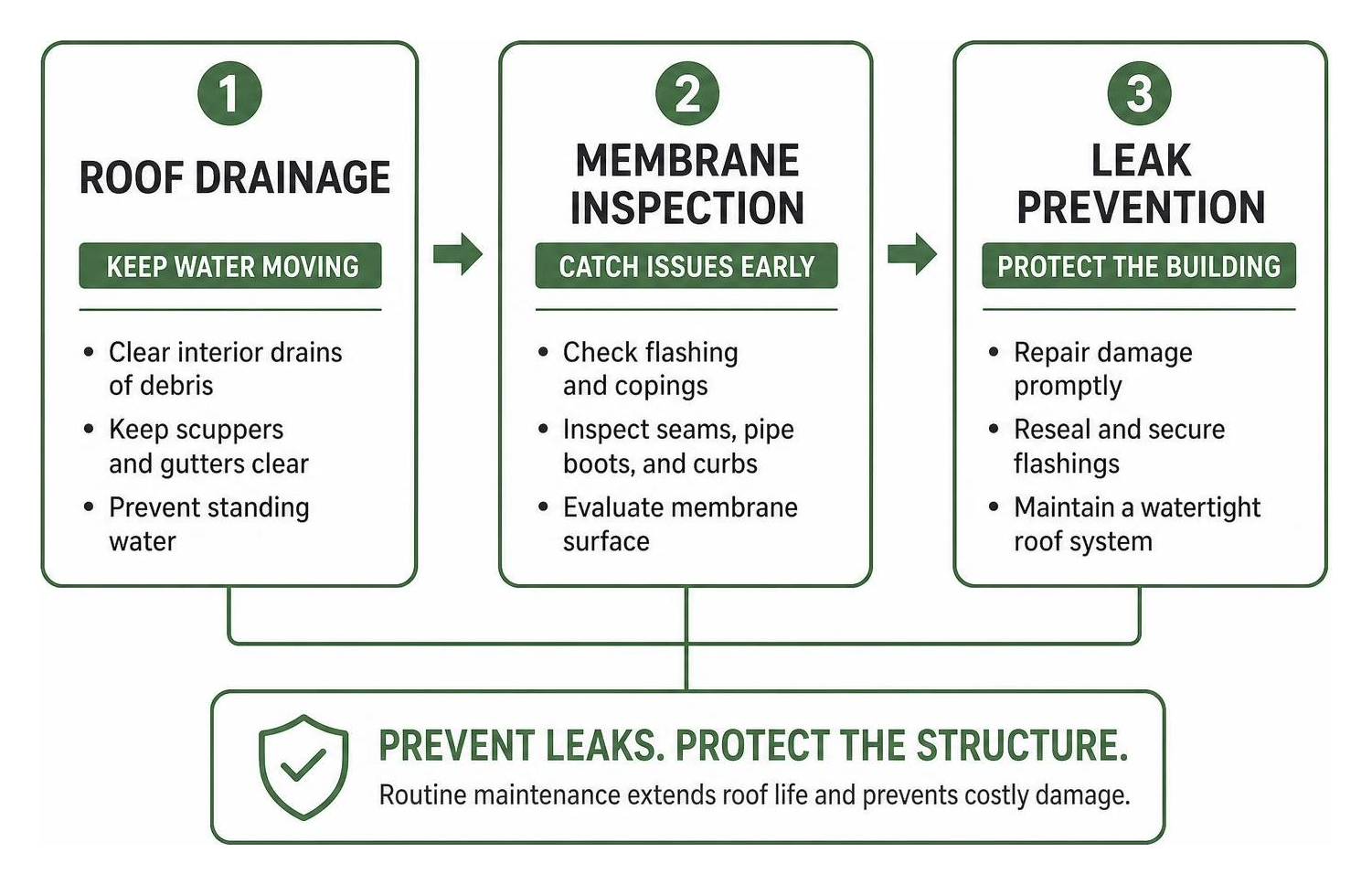
Proactive commercial maintenance should focus on:
- Drain and Scupper Clearances: Removing organic debris to stop standing water around interior drains and exterior scuppers.
- Flashing Integrity Inspections: Checking parapet wall coping caps, mechanical curbs, and pipe boots for cracked sealant or loose fasteners.
- Surface Membrane Evaluations: Locating punctures, open lap seams, or blistering early.
When sudden severe weather causes unexpected roof breaches, securing dependable commercial roof repairs near me prevents structural rot, interior asset loss, and electrical hazards. Dedicated roof repair procedures should always prioritize lasting perimeter sealing over temporary patch jobs.
Need Help With Your Home?
TJ Builders & Developers handles roofing, siding, gutters, windows, home additions, and fire damage restoration for homes and businesses in Lakewood, Crystal Lake, Schaumburg, and nearby McHenry County towns.
- Free, no-obligation estimates
- Licensed & insured
- 20+ years of local experience
Frequently Asked Questions About Commercial Roofing in Illinois
How can property owners verify an Illinois commercial roofing license?
You can confirm any contractor’s licensing credentials online using the official IDFPR License Lookup tool. Enter the company name or license number to verify that their unlimited roofing license is active, in good standing, and backed by a designated Qualifying Party.
What happens if a commercial roofing contractor loses their Qualifying Party?
If a commercial roofing contractor loses their Qualifying Party due to resignation, retirement, or death, state law allows a 60-day window to notify IDFPR and designate an examined, qualified replacement. If the contractor fails to provide a replacement Qualifying Party within this period, their operating license is subject to administrative suspension.
Where are the IDFPR offices located for licensing support?
Licensing inquiries, official record updates, and compliance filings are processed through two primary IDFPR administrative offices:
- Chicago Office: James R. Thompson Center / IDFPR Division of Professional Regulation, Chicago, Illinois.
- Springfield Office: IDFPR Division of Professional Regulation, 320 West Washington Street, 3rd Floor, Springfield, Illinois.
Conclusion
Protecting your commercial facility against water intrusion requires regular maintenance, proper material selection, and verified contractor credentials. Working with a state-licensed, insured contractor who complies with IDFPR standards ensures that every roof replacement, drain installation, and membrane repair meets Illinois building codes.
Whether you oversee an industrial facility in Schaumburg, a retail storefront in Crystal Lake, or a commercial complex in Lakewood, taking a proactive approach to roof maintenance protects your building’s structural integrity for decades to come.
To keep your building dry, safe, and code-compliant, turn to our experienced team for reliable roofing and exterior building solutions designed to handle Northern Illinois weather.