The Critical Role of Professional Fire Restoration Roofing Services
Fire restoration roofing services are specialized repair and reconstruction solutions that address the full scope of damage a fire causes to your roof — from charred structural framing and melted underlayment to smoke contamination and water intrusion from firefighting efforts.
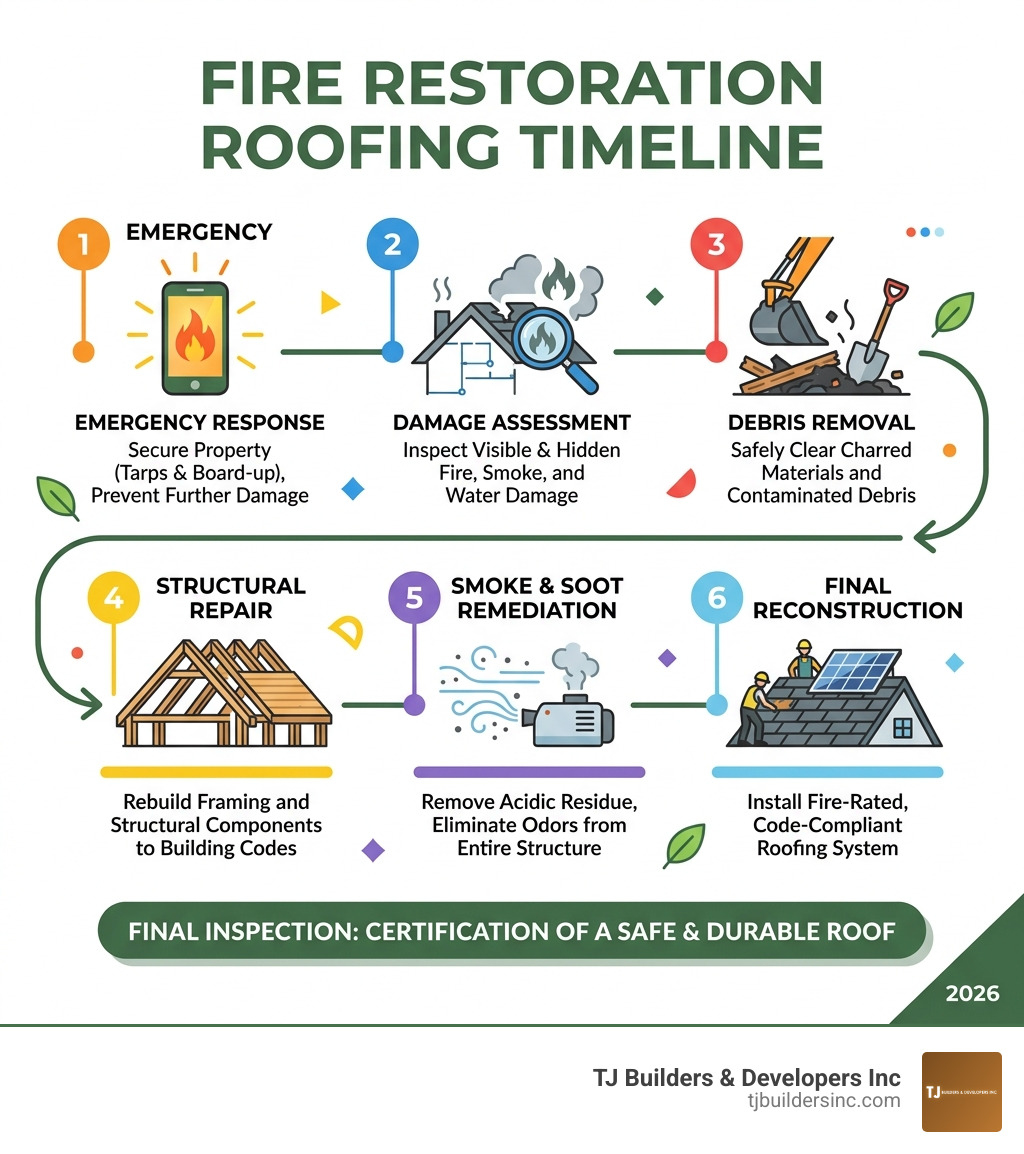
Here’s what fire restoration roofing typically involves:
- Emergency response — securing the property with tarps and board-up to prevent further damage
- Damage assessment — inspecting both visible and hidden fire, smoke, and water damage
- Debris removal — clearing charred materials safely
- Structural repair or replacement — rebuilding rafters, decking, and framing to current building codes
- Smoke and soot remediation — removing acidic residue and eliminating odors
- Final roof reconstruction — installing fire-rated, code-compliant roofing materials
A fire doesn’t just burn what you can see. Heat compromises structural integrity in ways that aren’t always obvious, smoke contaminates porous materials like shingles and underlayment, and the water used to fight the fire can saturate insulation and weaken decking within hours. Every layer of your roofing system can be affected — often all at once.
That’s what makes fire damage uniquely complex. It’s not a standard repair job. It requires a contractor who understands how heat, smoke, and water interact with roofing materials, how to document damage properly for insurance, and how to rebuild safely to code.
I’m Thomas Pruszynski, and over my 20+ years at TJ Builders & Developers, I’ve helped homeowners across Northern Illinois navigate the full process of fire restoration roofing services — from the first emergency call to the final inspection. The sections below will walk you through everything you need to know.
When a fire strikes, the immediate instinct is to look at the interior damage. However, the roof is the most critical component for the long-term safety of your home. Professional fire restoration roofing services are not just about aesthetics; they are about restoring the structural spine of your property.

Fire damage is traumatic and destructive, often leaving homeowners in our local communities like Crystal Lake and Algonquin feeling overwhelmed. Attempting to manage a fire-damaged roof without expert help is dangerous. Intense heat can weaken the chemical bonds in roofing materials, and structural members may be compromised even if they aren’t completely burned through.
We focus on Fire Damage Restoration that prioritizes your family’s safety. A professional Expert Fire Damage Roof Restoration ensures that every truss, rafter, and beam is inspected for load-bearing capacity. Without this, you risk a structural collapse months after the fire has been extinguished.
Identifying Visible and Hidden Fire Damage
Visible damage is easy to spot—charred rafters, missing shingles, and sagging rooflines are clear calls for help. However, the hidden damage is often more insidious. At TJ Builders & Developers Inc, we use specialized assessment techniques to find what the naked eye might miss.
- Charred Materials: We look for charring patterns on structural members. Even shallow charring can reduce the strength of a beam.
- Sagging Rooflines: This indicates that the heat was intense enough to warp the wood or metal supports.
- Soot Staining: Acidic soot can settle into the nooks and crannies of your attic and exterior, leading to permanent discoloration and material degradation.
- Smoke Odor: If you can smell smoke in your attic, it means the porous wood has absorbed carbon particles.
If the damage is localized, a targeted Roof Repair might be possible, but only after a rigorous safety inspection ensures the surrounding structure is sound.
The Dangers of Delayed Restoration
Time is your enemy after a fire. Once the fire department leaves, the clock starts ticking on secondary damage.
- Acidic Soot: Soot is highly acidic. When it sits on metal flashing, gutters, or even certain shingle types, it accelerates corrosion and pitting.
- Mold Growth: This is a major concern in Northern Illinois. Because firefighting efforts involve thousands of gallons of water, your roof deck and insulation become a breeding ground for mold. According to the Federal Emergency Management Agency (FEMA), mold can develop within 24 to 72 hours after water exposure.
- Structural Collapse: A weakened roof is vulnerable to the weight of snow and wind. In areas like Woodstock and McHenry, our heavy winters make it vital to address structural weaknesses immediately.
By integrating Storm Hail Damage Restoration principles, we ensure that your roof is not just “fire-fixed” but also “weather-ready” for our local climate.
Assessing the Impact: How Fire and Smoke Damage Roofing Systems
Fire doesn’t just burn; it transforms the materials it touches. The intense heat of a house fire can reach temperatures that fundamentally change the chemical composition of your roof.
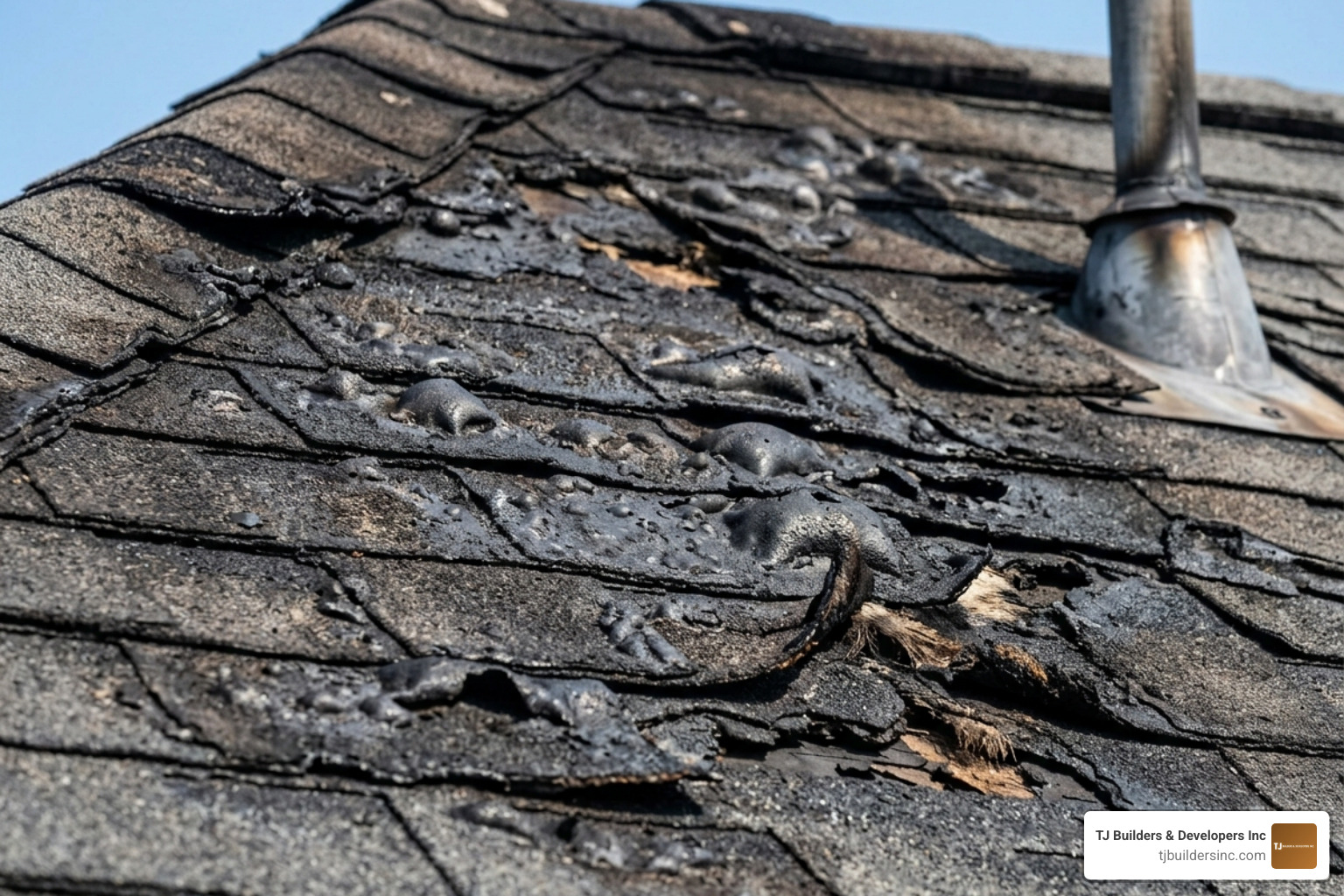
When we evaluate roofing systems after a fire, we often find that asphalt shingles have become incredibly brittle. The oils that make them flexible and water-resistant evaporate under high heat. We also frequently see melted underlayment—the secondary water barrier—which can fuse to the roof deck, making it impossible to repair without a full teardown.
Smoke and Soot Contamination on Exteriors
Smoke is more than just a bad smell. It is a cocktail of chemicals, including carbon, oils, and resins from everything that burned inside the home. These particles are microscopic and highly porous shingles will “trap” them.
Standard cleaning rarely works for smoke-damaged roofing. We utilize Professional Smoke Remediation techniques, such as thermal fogging or ozone treatment, to neutralize odors at the molecular level. If the smoke damage is too deep, the materials must be replaced to ensure your home doesn’t smell like a campfire every time the sun warms the roof.
Secondary Damage from Firefighting Efforts
It is a painful irony that the water used to save your home can also destroy it. High-pressure hoses can rip shingles off and force water under the underlayment.
- Saturated Insulation: Wet insulation loses its R-value and becomes heavy, putting additional stress on your ceiling and rafters.
- Weakened Decking: Plywood and OSB (Oriented Strand Board) can delaminate when soaked, leading to “soft spots” in the roof.
- Moisture Detection: We use moisture meters and infrared cameras to find hidden pockets of water behind fascia boards and in the soffits.
In many cases, the moisture damage is so extensive that reroofing is the only way to guarantee a dry, mold-free home.
Need Help With Your Home?
TJ Builders & Developers handles roofing, siding, gutters, windows, home additions, and fire damage restoration for homes and businesses in Lakewood, Crystal Lake, Schaumburg, and nearby McHenry County towns.
- Free, no-obligation estimates
- Licensed & insured
- 20+ years of local experience
The Comprehensive Process of Fire Restoration Roofing Services
Restoring a roof after a fire is a multi-stage marathon, not a sprint. It requires precision and a deep understanding of building science.
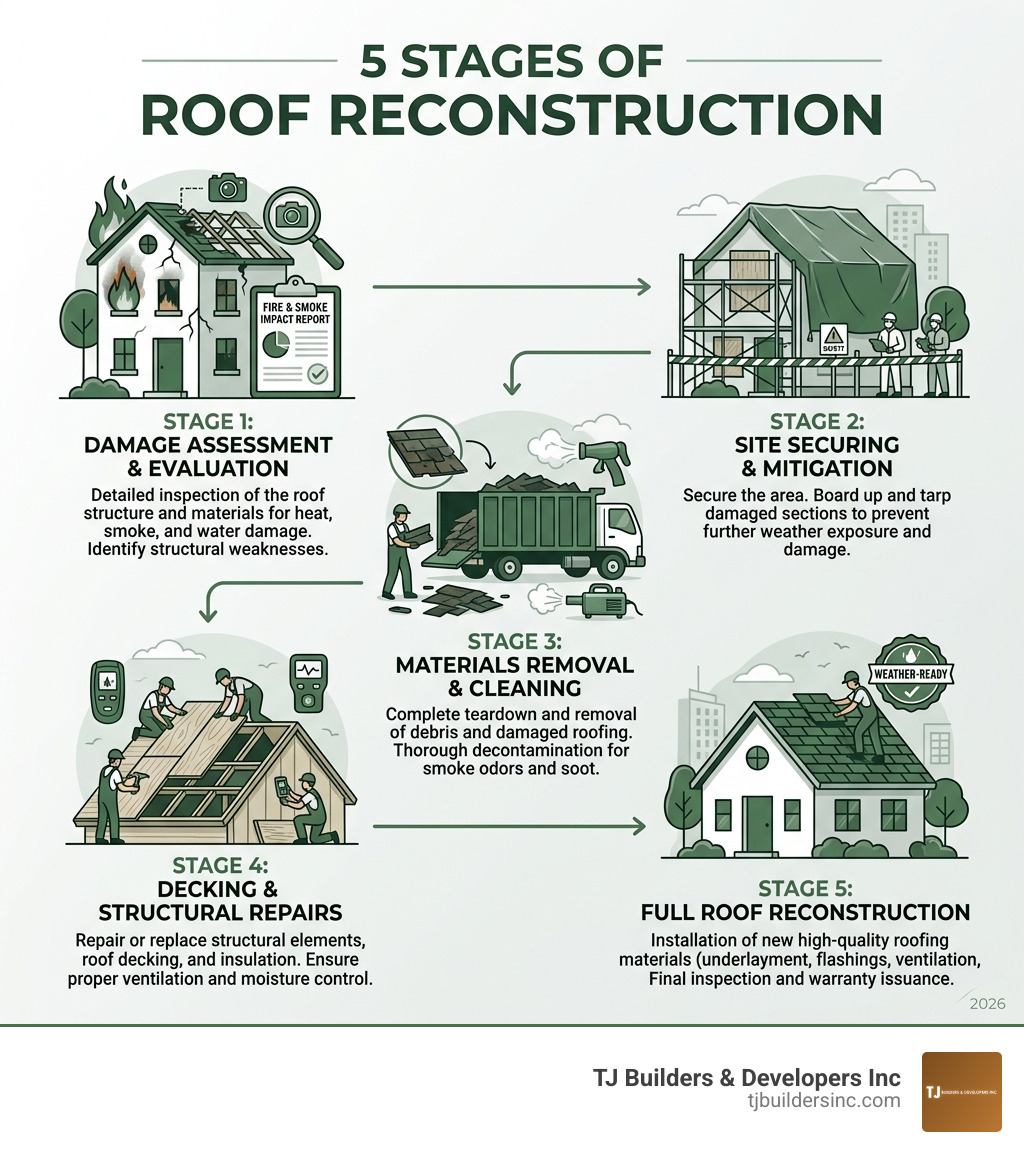
Our process begins with an immediate site visit to the Village of Lakewood, Cary, or wherever you are located in our service area. We follow the Fire Damage Restoration Gilbert Guide 2025 standards for safety and thoroughness, ensuring no step is skipped.
Emergency Mitigation and Securing the Property
Before we can rebuild, we must protect what’s left. Our 24/7 emergency services include:
- Roof Tarping: We use heavy-duty, industrial-grade tarps to cover holes and exposed areas. This prevents rain from causing further interior damage.
- Emergency Board-Up: If the fire damaged windows or gables near the roofline, we secure these openings to prevent unauthorized entry and pest intrusion.
- Weatherproofing: We ensure the property is stable enough to withstand Northern Illinois winds while the insurance claim is processed.
Structural Reconstruction and Code-Compliant Fire Restoration Roofing Services
This is where the heavy lifting happens. Fire restoration is often the perfect time to bring an older home up to modern safety standards.
We don’t just “patch” charred wood. If a rafter has lost more than a certain percentage of its mass to charring, it must be replaced or “sistered” (reinforced) according to local building codes in Schaumburg or Barrington. We follow the Roof Installation Replacement Complete Guide to ensure every new component—from the ridge board to the eave—is installed with precision.
We use fire-rated materials that provide an extra layer of protection for the future. This includes Class A fire-rated shingles and fire-resistant underlayments that can help slow the spread of a fire should another disaster occur.
Choosing a Qualified Partner for Fire Restoration Roofing Services
Not every roofing company is equipped to handle fire damage. You need a partner who understands the emotional weight of the situation and the technical requirements of the job.
At TJ Builders & Developers Inc, we pride ourselves on:
- GAF Certification: As a GAF certified contractor, we use industry-leading materials that offer superior fire resistance and long-term durability.
- Local Expertise: We know the specific building codes for Huntley, Woodstock, and the surrounding suburbs.
- Insurance Advocacy: We act as your advocate, meeting with adjusters on-site to ensure they see every bit of hidden damage. We provide the detailed documentation they need to approve your claim.
- Workmanship Warranties: We stand behind our work with comprehensive guarantees, giving you peace of mind that your home is secure once again.
- One-Stop Solution: We handle everything. From the roof and siding to windows and interior structural repairs, we are your TJ Builders & Developers Inc Restoration Services partner.
Navigating Insurance and Timelines for Restoration
The insurance process for fire damage is notoriously complex. Unlike a hail claim, which is usually straightforward, fire claims involve structural, cosmetic, and “loss of use” components.
Repair vs. Full Replacement Criteria
| Feature | Repair Criteria | Full Replacement Criteria |
|---|---|---|
| Structural Integrity | Localized damage to non-load-bearing areas. | Charred rafters, warped trusses, or sagging roofline. |
| Smoke/Soot | Minimal staining on non-porous surfaces. | Deep smoke penetration in shingles or attic wood. |
| Material Age | Roof is mid-life and materials are still available. | Roof is near end-of-life or materials are discontinued. |
| Code Compliance | Repairs meet current local codes. | Upgrades required by law exceed 50% of the roof area. |
| Water Damage | Minor moisture in a small, accessible area. | Saturated insulation and widespread deck delamination. |
Understanding the Restoration Timeline
One of the most common questions we get from homeowners in Lake in the Hills and Schaumburg is, “How long will this take?” While every project is unique, here is a general breakdown:
- Insurance Processing (2-4 Weeks): This involves the adjuster’s visit, damage reports, and claim approval. We work to speed this up by providing professional estimates quickly.
- Permit Acquisition (1-2 Weeks): Local municipalities like Hoffman Estates or Crystal Lake require specific permits for structural fire repairs.
- Material Procurement (1-2 Weeks): We source high-quality, fire-rated materials.
- Construction Phase (1-4 Weeks): Minor repairs may take a few days, while full structural reconstruction can take several weeks.
Building Code Upgrades and Compliance
When we rebuild, we don’t just aim for “pre-fire condition”—we aim for better. Building codes, such as those established by the International Code Council (ICC), have evolved in Northern Illinois. If your home was built in the 1980s, the current codes for ventilation, ice and water shielding, and fire-resistant technology are much stricter.
Most homeowners’ policies include “Law and Ordinance” coverage, which helps pay for these mandatory upgrades. We ensure your new roof meets all local regulations in Lakewood and surrounding suburbs, potentially even improving your home’s energy efficiency in the process.
Need Help With Your Home?
TJ Builders & Developers handles roofing, siding, gutters, windows, home additions, and fire damage restoration for homes and businesses in Lakewood, Crystal Lake, Schaumburg, and nearby McHenry County towns.
- Free, no-obligation estimates
- Licensed & insured
- 20+ years of local experience
Frequently Asked Questions about Fire Roof Restoration
Can a fire-damaged roof be repaired or is replacement required?
This depends on the severity and location of the fire. If the fire was external (like a neighbor’s house fire) and only caused minor shingle melting, a repair might suffice. However, if the fire was internal and charred the structural framing or if smoke has deeply penetrated the materials, a full replacement is usually necessary to ensure safety and eliminate odors.
How long does the smoke odor last after a roof fire?
Without professional remediation, smoke odor can last for years. Porous wood in the attic acts like a sponge for smoke particles. We use specialized cleaning agents and equipment like ozone generators to neutralize these odors. If the odor persists, it usually means contaminated materials like insulation or charred wood still need to be removed.
Does homeowners insurance cover the full cost of roof reconstruction?
Most standard policies cover fire damage. However, whether they cover the full cost depends on your policy type (Replacement Cost Value vs. Actual Cash Value). We assist you in documenting the damage and working with your adjuster to maximize your benefits, especially regarding building code upgrades.
Conclusion
Recovering from a fire is one of the most challenging experiences a homeowner can face. At TJ Builders & Developers Inc, we believe that your roof should be the last thing you have to worry about. As Lakewood restoration experts, we bring over two decades of experience to every project, ensuring professional workmanship and a compassionate approach to your recovery.
Whether you are in Crystal Lake, Schaumburg, or anywhere in Northern Illinois, we are here to help you rebuild. From emergency board-ups to final, code-compliant reconstruction, our team is dedicated to restoring your home’s safety and your peace of mind.
If you are facing the aftermath of a fire, don’t wait for secondary damage to take hold. Contact us today to start your journey back to a safe, secure home.