Why Your Attic Is Quietly Cooking Your Roof — And What to Do About It
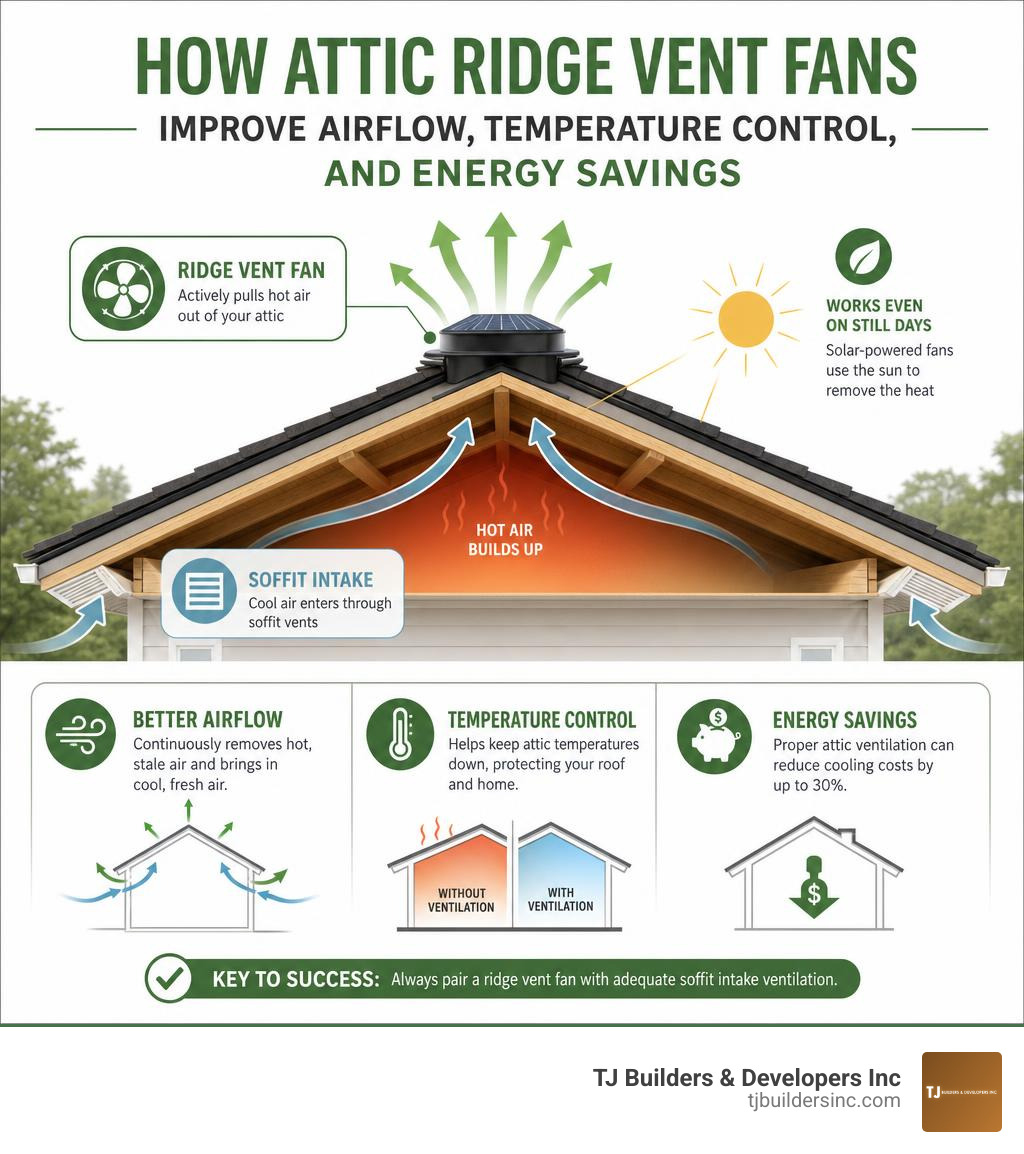
An attic ridge vent fan is one of the most effective tools for keeping your attic cool, protecting your roof, and reducing your home’s energy costs. Here’s a quick overview of what it does and why it matters:
- What it is: A powered fan installed at or near the roof ridge that actively pulls hot air out of your attic
- How it helps: Keeps attic temperatures from reaching dangerous levels — unventilated attics can exceed 160°F in summer
- Energy impact: Proper attic ventilation can reduce cooling costs by up to 30%
- Best option: Solar-powered ridge vent fans work even on windless days, using the sun — the very source of the heat — to remove it
- Key requirement: Effective only when paired with adequate soffit intake ventilation
Your attic takes a beating every summer. Without proper airflow, heat builds up fast — and that heat doesn’t just make your upstairs rooms uncomfortable. It slowly degrades your shingles, drives up your energy bills, and creates the moisture conditions that lead to mold and rot.
Passive ridge vents help, but they rely on wind and convection. On a hot, still day — exactly when you need ventilation the most — they can fall short.
That’s the problem a ridge vent fan solves.
I’m Thomas Pruszynski from TJ Builders & Developers, and over more than 20 years of working on roofing and exterior restoration projects across Northern Illinois, I’ve seen how the right attic ridge vent fan setup can extend a roof’s life and meaningfully lower a homeowner’s energy costs. In the sections below, I’ll walk you through everything you need to know to get it right.
Easy attic ridge vent fan word list:
Understanding Attic Ventilation: Passive vs. Active Systems
To understand why an attic ridge vent fan is such a game-changer, we first need to look at how attic ventilation works. At its core, attic ventilation is all about balance. You need a system that brings cool, fresh air in at the lowest point of the roof and exhausts hot, moist air out at the highest point.
This balancing act relies on two main types of ventilation: passive and active.
- Passive Ventilation: This system relies entirely on natural forces like wind and thermal convection (the scientific fact that hot air rises). Cool air enters through your soffit vents (the vents under your roof’s eaves), warms up inside the attic, and escapes through exhaust vents at the top of the roof.
- Active Ventilation: This system uses mechanical power—either electricity from your home’s grid or solar energy—to physically pull air through the attic space, ensuring a continuous, controlled flow of fresh air regardless of outdoor wind conditions.
For most homes in Northern Illinois, passive systems are the starting point. The most common passive setup is a combination of soffit intake vents and a ridge vent. If you want to dive deep into how passive ridge systems keep your roof deck dry, check out our comprehensive resource on dry ridge ventilation.
While passive setups are great in theory, they have a major vulnerability: they are completely at the mercy of the weather.
The Limitations of Passive Ridge Vents
A standard passive ridge vent is simply a continuous slot cut along the peak of your roof, covered by a vented cap shingle. It works beautifully when a steady breeze is blowing across your roof line, creating a low-pressure zone that draws hot air out.
However, think about those sweltering July afternoons in Crystal Lake or McHenry. The air is thick, humid, and completely still. On these windless days, passive ridge vents have to rely solely on convection. Because the temperature difference between the attic air and the outdoor air isn’t always enough to force rapid movement, heat builds up.
Without active mechanical assistance, your attic can quickly transform into a giant oven, reaching temperatures north of 160°F. This stagnant heat radiates downward through your ceiling, forcing your air conditioning system to run constantly. If you want to explore active solar options that solve this exact issue, products like the 10-Watt Solar – 9010TR – Air Vent, Inc. provide continuous daytime ventilation without drawing a single watt of electricity from your home.
Need Help With Your Home?
TJ Builders & Developers handles roofing, siding, gutters, windows, home additions, and fire damage restoration for homes and businesses in Lakewood, Crystal Lake, Schaumburg, and nearby McHenry County towns.
- Free, no-obligation estimates
- Licensed & insured
- 20+ years of local experience
Why You Need an Attic Ridge Vent Fan to Protect Your Roof
Many homeowners view attic cooling purely as a matter of indoor comfort. While keeping your upstairs bedrooms cool is a huge plus, the real victim of an unventilated attic is your roof itself.
Excessive heat cooks your roof shingles from the inside out. When attic temperatures soar, the wood decking beneath your shingles becomes incredibly hot. This heat transfers directly to the asphalt shingles, causing them to dry out, curl, blister, and lose their protective mineral granules prematurely. A roof designed to last 30 years can easily fail in 15 to 20 years if subjected to extreme heat season after season.
Moisture is the other silent killer. In our humid Northern Illinois summers, warm, moist air gets trapped in stagnant attics. When temperatures drop slightly at night, this moisture condenses on the underside of your roof deck, creating the perfect breeding ground for mold, mildew, and wood rot.

Upgrading to an active ventilation system is one of the smartest protective measures you can take. If you are weighing different options, our guide on how to best roof ventilation Lakewood offers a great breakdown of the various fans available.
How an Attic Ridge Vent Fan Works
An attic ridge vent fan combines the high-level placement of a ridge vent with the mechanical power of an exhaust fan. Because hot air naturally gathers at the absolute peak of your roof, putting a fan at this exact location is the most efficient way to exhaust it.
When the fan turns on, it creates a powerful active exhaust zone. By rapidly pushing hot air out of the ridge, it creates a low-pressure area inside the attic. This pressure drop immediately draws fresh, cooler outdoor air in through your soffit vents. This continuous cycle of air replenishment keeps the attic space close to the ambient outdoor temperature, preventing heat and moisture from settling.
For a rugged, roof-mounted solar option that handles this cycle automatically, the Galvanized Steel 15 Watt Solar Powered Static Roof Vent Mount Attic Fan is an excellent example of a durable, rust-resistant active vent designed to stand up to harsh weather.
Impact on Attic Temperature and Energy Costs
The financial impact of installing an attic ridge vent fan is immediate. When your attic is kept within 5 to 10 degrees of the outdoor temperature, your home’s air conditioning system doesn’t have to fight a massive thermal block directly above the ceiling.
Industry statistics show that active attic fans can save homeowners up to 30% on A/C cooling costs. Instead of your cooling system struggling to cool down rooms while hot attic air radiates heat through the ceiling drywall and ductwork, a smart attic fan lowers the attic temperature by 30°F to 50°F.
To maximize these savings, many homeowners opt for high-performance units like the 1500 CFM Shingle Match Weathered Wood Power Roof, which moves a high volume of air while blending in seamlessly with your roof’s shingles.
Solar-Powered vs. Hardwired Ridge Vent Fans
If you’ve decided to add active power to your roof’s ventilation, your next decision is choosing how to power the unit. The two primary options are solar-powered fans and hardwired (electric) fans. Both have distinct advantages depending on your budget, roof layout, and energy goals.
| Feature | Solar-Powered Attic Fans | Hardwired (Electric) Attic Fans |
|---|---|---|
| Power Source | Renewable Solar Energy | Home Electrical Grid (110V) |
| Operating Cost | $0.00 | Moderate (depends on run time) |
| Installation Complexity | Low (no electrical wiring needed) | High (requires licensed electrician) |
| Runtime | Daylight hours (or hybrid battery/adapter) | 24/7 (controlled by thermostat/humidistat) |
| Motor Type | High-efficiency Brushless DC | Standard AC Motor |
| CFM Output | Moderate to High (up to 1,200+ CFM) | Very High (1,500+ CFM) |
Sizing Your Attic Ridge Vent Fan
An improperly sized attic fan is highly inefficient. If the fan is too small, it won’t move enough air to cool the space. If it is too large, it can create excessive negative pressure, pulling conditioned air out of your living space through recessed lights or attic hatches.
To size your fan correctly, you need to calculate the Cubic Feet per Minute (CFM) rating required for your attic’s volume. A basic industry rule of thumb is to provide at least 15 complete air exchanges per hour.
To calculate your needs:
- Calculate the square footage of your attic floor (Length x Width).
- Multiply that number by 0.7 to get the baseline CFM requirement.
- If you have a dark roof or a steep slope, add 15% to 20% to that baseline.
For example, a 1,500-square-foot attic would require a fan rated for at least 1,050 CFM. If you are looking for a heavy-duty, smart-controlled option that handles large spaces, the 40-Watt Solar Fan | Galvanized Black Steel | Remington Solar features a built-in thermostat and humidistat, allowing it to activate automatically only when needed.
Benefits of Solar-Powered Ventilation
Solar-powered ventilation has exploded in popularity over the last few years, and for good reason. Because solar fans run on DC power generated by their own integrated solar panels, they require zero electrical wiring during installation. This simplifies the process and eliminates ongoing operating costs.
Furthermore, solar fans naturally align with your home’s cooling needs. They run at peak speed during the brightest, hottest parts of the day—exactly when your attic requires the most ventilation.
Modern high-efficiency solar models, such as the 55W Solar Attic Fan with Smart Power Adapter & 65ft Remote, even offer hybrid capabilities. These systems run on free solar power during the day and can seamlessly switch to household electricity at night if the attic remains warm, giving you the best of both worlds.
Combining Ridge Vents and Attic Fans: Best Practices
One of the most common questions we get at TJ Builders & Developers is: “Can I install a powered attic fan if I already have a passive ridge vent?”
The short answer is yes, but you must be very careful with how they are configured.
If you simply install a high-powered exhaust fan directly next to a passive ridge vent, you will create a short-circuit in your ventilation system. Instead of pulling cool air up from the soffits at the bottom of your roof, the powerful fan will draw air from the easiest, closest source—which is the passive ridge vent right next to it.
This creates a localized loop where air is pulled in through the ridge vent and immediately pushed back out by the fan. The rest of your attic space remains stagnant, hot, and completely unventilated. To avoid this, it is essential to understand the layout of your roof. You can read more about balancing different systems in our guide to the best roof ventilation systems.
Proper Placement and Distance Rules
To prevent short-circuiting, we follow strict placement and distance rules when combining active and passive systems:
- The 5-to-10-Foot Rule: Always install your powered attic fan at least 5 to 10 feet away from any passive ridge vents. This physical distance forces the fan to draw air from the lower soffit vents rather than the ridge.
- Mounting Depth: Position the fan about 1/3 lower than the absolute peak height of your attic. This placement ensures it pulls stagnant air from the core of the attic space.
- Balance Your Intake: Your fan can only exhaust as much air as your intake vents allow. Ensure your soffit vents are completely clear of insulation. The ideal ratio is 1 square foot of vent area for every 150 square feet of attic space, split evenly between intake and exhaust.
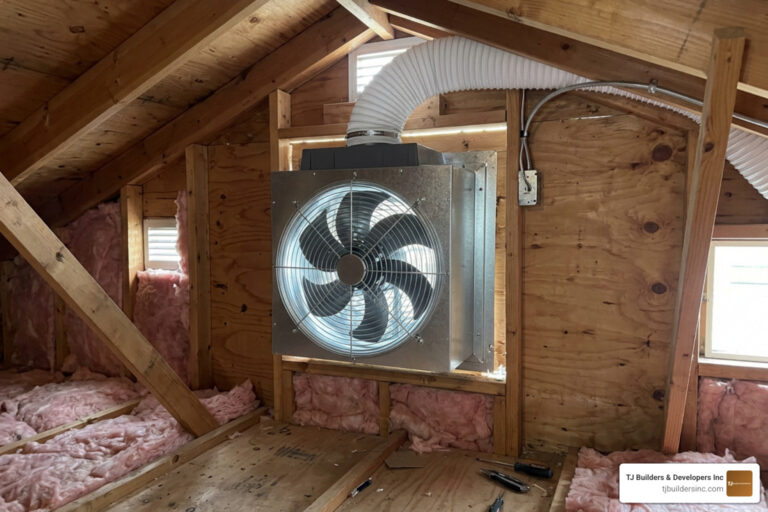
If your home’s architecture makes roof-mounted fans tricky, a gable-mounted option like the Whisper-Quiet Attic Gable Vent Fan | CentricAir can be mounted on the side wall of your attic, keeping it well away from the center ridge line while still providing powerful, quiet ventilation.
Need Help With Your Home?
TJ Builders & Developers handles roofing, siding, gutters, windows, home additions, and fire damage restoration for homes and businesses in Lakewood, Crystal Lake, Schaumburg, and nearby McHenry County towns.
- Free, no-obligation estimates
- Licensed & insured
- 20+ years of local experience
Professional Installation and Maintenance Requirements
While some home improvement projects are great for weekends, installing an attic ridge vent fan is a job best left to professionals. Cutting into your roof deck, ensuring a watertight seal, and navigating steep slopes require specialized safety equipment and expertise.
At TJ Builders & Developers, we ensure that every roof penetration is sealed with professional-grade flashing and heavy-duty underlayment to prevent leaks during our intense Northern Illinois winter snowstorms and spring downpours. A single improperly flashed vent can lead to water damage that ruins your attic insulation and drywall.

If you are planning an upgrade, read our detailed breakdown of what to expect during a professional best roof ventilation Lakewood.
Maintenance and Warranty Considerations
Once installed, modern attic fans are remarkably low-maintenance, but they aren’t completely “set-it-and-forget-it.” To keep your system running efficiently, we recommend a few simple maintenance practices:
- Annual Inspections: Have your vents checked every spring to ensure no leaves, bird nests, or debris are blocking the fan blades or solar panels.
- Check the Shingles: Ensure the shingles surrounding the fan flashing remain secure and flat.
- Monitor the Motor: Standard AC fan motors typically last about 10 years, while high-end brushless DC solar motors can last significantly longer. Listen for any unusual squeaking or buzzing sounds, which indicate the bearings may be wearing out.
It is also vital to consider your roof’s warranty. Improperly installing a roof vent or fan can void your shingle manufacturer’s warranty. Working with a licensed, certified contractor ensures your manufacturer warranties remain fully intact. For tips on choosing a trustworthy local expert, check out our guide on best roof ventilation Lakewood.
Frequently Asked Questions about Attic Ventilation
Can you combine a ridge vent fan with existing passive ridge vents?
Yes, but they must be physically separated. If you place a powered fan too close to a passive ridge vent, it will “short-circuit” the system—pulling outdoor air backward through the ridge vent instead of drawing hot air up from your soffit vents. Keep the fan at least 5 to 10 feet away from the ridge vent, or have a professional seal a portion of the ridge vent to maintain proper directional airflow.
How does a ridge vent fan prevent winter moisture and ice dams?
In the winter, heat escaping from your living space can warm up your roof deck, melting the snow on top. As that melted snow runs down to the cold eaves, it refreezes, creating dangerous ice dams that back up under your shingles. By actively venting warm air out of the attic during winter, an attic fan keeps the roof deck at a uniform, cold temperature, preventing ice dams and eliminating winter condensation that causes mold.
What is the ideal CFM rating for a standard residential attic?
The ideal rating depends on your attic’s square footage. As a general rule, you want 0.7 CFM of airflow per square foot of attic floor space. For example, a 1,500-square-foot attic requires a fan rated for at least 1,050 CFM. If you have a dark shingle roof or a particularly steep pitch, you should increase that rating by 15% to ensure adequate cooling power.
Conclusion
An attic ridge vent fan is one of the most reliable upgrades you can make to protect your home’s roof structure, control indoor humidity, and lower your summer cooling bills. By turning a passive, weather-dependent system into an active cooling powerhouse, you ensure your home stays comfortable and protected all year long.
At TJ Builders & Developers Inc, we have spent decades helping homeowners in Lakewood, IL, and surrounding communities like Crystal Lake, Schaumburg, and McHenry protect their most valuable assets. We specialize in high-quality roofing, siding, and exterior restoration services, focusing on reliable workmanship and long-term durability.
If you are ready to cool down your home and extend the life of your roof, we are here to help. Contact us today to schedule a consultation with our experienced team.