Why Dry Ridge Ventilation Is One of the Smartest Upgrades for Your Roof
Dry ridge ventilation is a mortar-free system that mechanically fixes ridge tiles to the roof peak while allowing a continuous flow of air to escape from the roof void — protecting your home from moisture, mold, and structural decay.
Here’s what you need to know at a glance:
| Feature | Dry Ridge Ventilation |
|---|---|
| Fixing method | Mechanical (screws, clamps, batten straps) |
| Mortar required | No |
| Ventilation provided | ~5,000mm²/m (equivalent to a continuous 5mm gap) |
| Typical roof pitch range | 15° to 55° |
| Key standards (UK) | BS 5534, BS 8612 |
| Maintenance | Very low — “fit and forget” |
| Lifespan | Up to 15–20 years |
| Main benefit | Prevents condensation, mold, and rot in the attic |
Most homeowners don’t think about their roof ridge until something goes wrong. But a poorly ventilated or insecurely fixed ridge is one of the leading causes of moisture buildup, rotting timbers, and premature roof failure — problems that are far more expensive to fix than to prevent.
Traditional mortar-bedded ridges crack over time. They trap moisture. They fail in freeze-thaw conditions. And they offer zero ventilation to the roof space below.
Dry ridge systems solve all of that — and they do it without the mess, the wait time, or the ongoing maintenance headaches.
I’m Thomas Pruszynski from TJ Builders & Developers Inc, and over more than 20 years of residential exterior work across Northern Illinois, I’ve seen how the right dry ridge ventilation setup can mean the difference between a roof that lasts decades and one that quietly deteriorates from the inside out. In this guide, I’ll walk you through everything you need to make a confident, informed decision for your home.
Understanding the Mechanics of a Dry Ridge System
To understand why dry ridge ventilation is so effective, we first have to look at how it’s put together. Unlike the old-school method of using a sand-and-cement “glue” (mortar) to stick tiles to the top of your roof, a dry-fix system uses engineering and mechanical strength.
In a dry ridge setup, we don’t rely on chemistry to hold your roof together; we rely on stainless steel screws, high-grade plastic unions, and weather-resistant membranes. This approach creates a “breathable” peak that remains completely watertight. It’s like wearing a high-performance rain jacket for your house—it keeps the rain out but lets the “sweat” (vapor) escape.
At TJ Builders & Developers Inc, we believe that understanding the “why” behind your roof’s components helps you appreciate the value of professional workmanship. You can learn more about our full range of exterior solutions on our Services page.
How dry ridge ventilation works
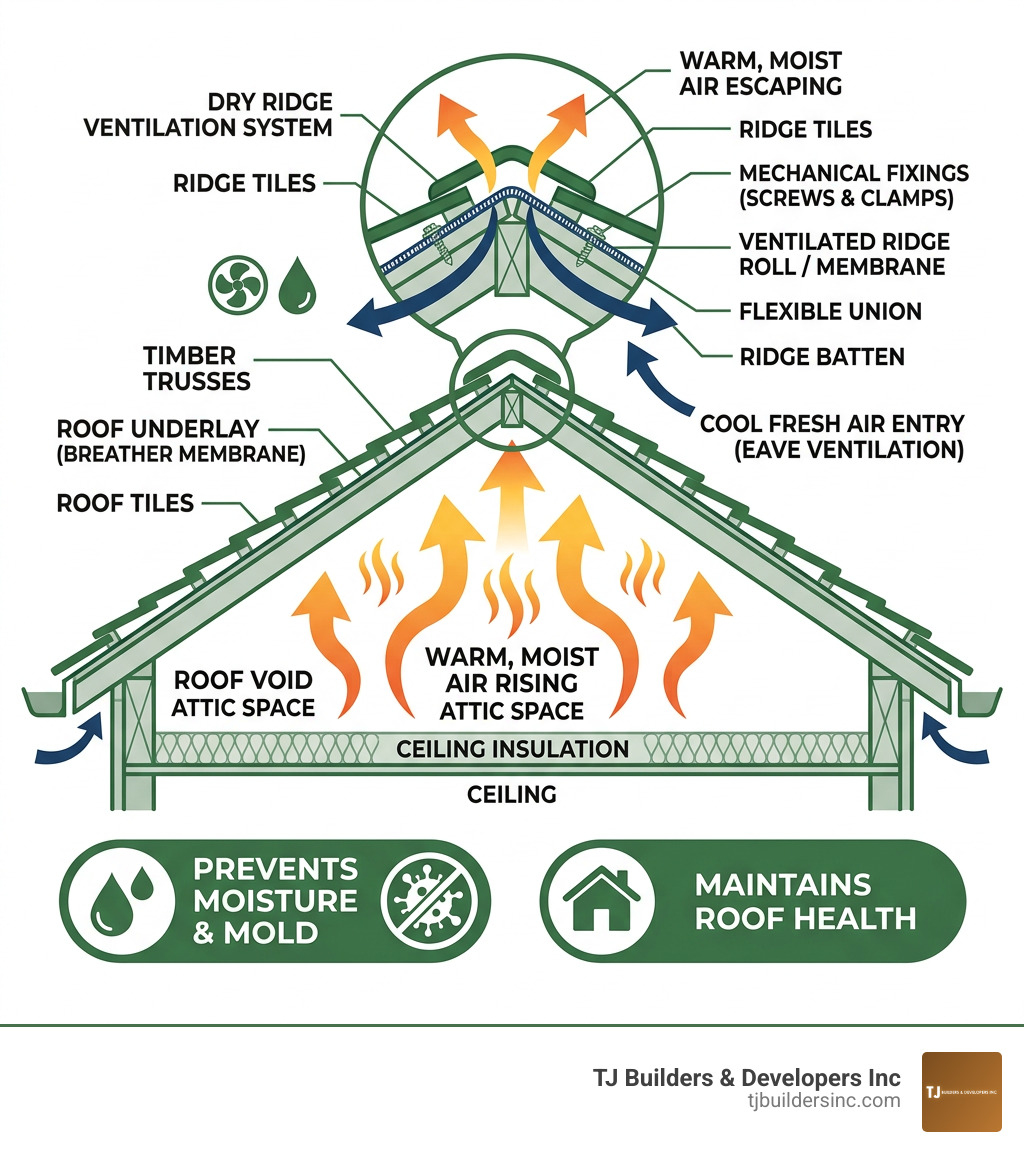
The magic of dry ridge ventilation lies in passive airflow. Physics tells us that hot air rises. In a standard attic, heat from your home and the sun accumulates at the highest point—the ridge. If that heat and the moisture it carries have nowhere to go, they sit against your roof deck and rafters.
A dry ridge system uses a specialized “ridge roll” or membrane. This material is perforated or woven in a way that allows air to pass through while blocking wind-driven rain and pests. Most high-quality systems, like those from Manthorpe or Marley, provide roughly 5,000mm² of ventilation per linear meter. To put that in perspective, it’s like having a continuous 5mm gap running the entire length of your roof peak.
As wind blows over the ridge, it creates a venturi effect, effectively sucking the warm, moist air out of your attic and pulling fresh, cool air in through your soffit vents. This constant cycle keeps your roof structure dry and at a stable temperature.
Components of a modern dry-fix system
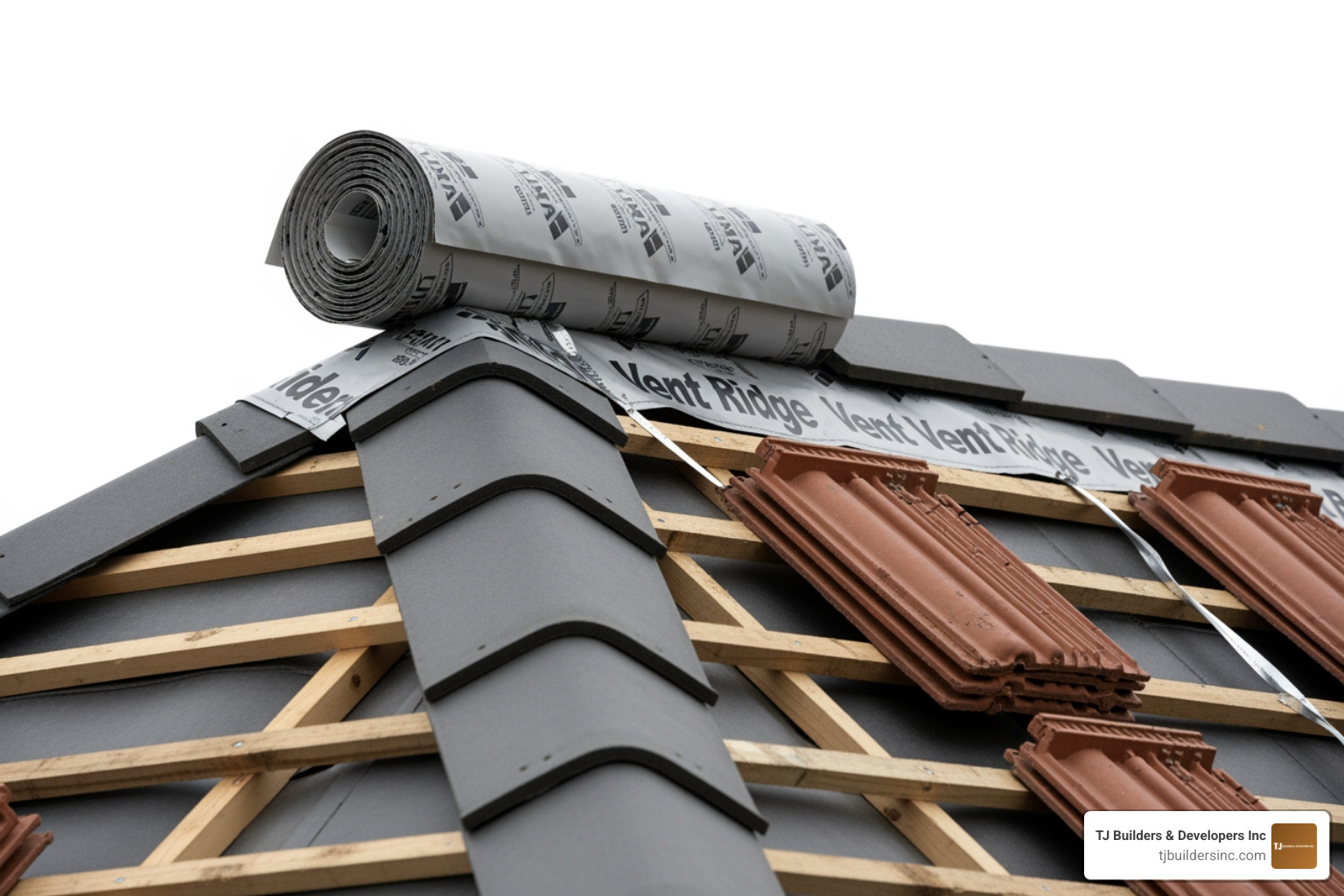
When we install a dry ridge ventilation system in areas like Crystal Lake or Schaumburg, we use a kit of specialized parts designed to work in harmony:
- Ridge Batten Straps: These are galvanized or stainless steel brackets that secure a timber batten to the apex of the rafters. This batten acts as the “spine” that everything else anchors to.
- Ridge Roll: This is the long, flexible membrane mentioned earlier. It usually has adhesive butyl strips on the edges that “dress down” onto the roof tiles, creating a watertight seal that still breathes.
- Ridge Unions: These are plastic or rubber gaskets that sit between each ridge tile. They act as a bridge, ensuring the tiles are spaced correctly and providing a drainage channel for any water that might get under the tile edge.
- Clamping Plates and Screws: Instead of mortar, we use long, stainless steel screws and clamping plates to bolt the ridge tiles directly into the ridge batten. This mechanical bond is incredibly strong and won’t crack or wash away.
Need Help With Your Home?
TJ Builders & Developers handles roofing, siding, gutters, windows, home additions, and fire damage restoration for homes and businesses in Lakewood, Crystal Lake, Schaumburg, and nearby McHenry County towns.
- Free, no-obligation estimates
- Licensed & insured
- 20+ years of local experience
Key Benefits of dry ridge ventilation for Your Home
Why should you choose this over the traditional way? If you’ve ever lived in an older home in the Chicago suburbs, you’ve probably seen “ridge drift” or chunks of mortar sitting in your gutters. Dry ridge ventilation eliminates those issues entirely.
One of the biggest advantages is its ability to handle thermal expansion. Your roof isn’t a static object; it expands and contracts as the Illinois sun beats down on it in July and the sub-zero winds hit it in January. Mortar is rigid; it doesn’t move. When the roof shifts, the mortar cracks. A dry ridge system is flexible. It “breathes” with the house, maintaining its integrity through every season.
Furthermore, these systems offer superior wind uplift resistance. Because every tile is screwed down, it is significantly harder for a storm to peel tiles off your ridge. This is a massive safety benefit for homes in open areas like South Barrington or Bartlett.
For more details on how we ensure your roof stays put during a storm, check out our guide on Asphalt Roof Installation.
How dry ridge ventilation prevents mold and rot
Moisture is the undisputed enemy of your roof. Every day, an average household produces gallons of water vapor through cooking, showering, and even breathing. This vapor rises into the attic. If the attic is sealed tight (as it often is with traditional mortar ridges), that moisture hits the cold underside of the roof deck and turns back into liquid—condensation.
Over time, this condensation leads to:
- Mold Growth: Which can trigger allergies and ruin insulation.
- Wood Rot: Softening your rafters and roof deck.
- Rusted Nails: Which can lead to shingle slippage.
By using dry ridge ventilation, you give that moisture an immediate exit ramp. It’s the most effective way to ensure your attic stays “bone dry,” preserving the structural integrity of your home for the long haul.
The role of dry ridge ventilation in attic health
A healthy attic requires balance. You need “intake” (usually from soffit vents under the eaves) and “exhaust” (at the ridge). If you only have intake, the air just sits there. If you only have exhaust, you create a vacuum that can actually pull conditioned air out of your living space.
Dry ridge ventilation acts as the perfect exhaust. When paired with proper insulation and intake vents, it lowers energy bills by keeping the attic cooler in the summer, which means your AC doesn’t have to work as hard. In the winter, it prevents “hot spots” on the roof that lead to ice dams—a common and destructive problem in the Chicago suburbs.
If you suspect your current ventilation isn’t up to par, our Roof Repair experts can help diagnose the issue before it causes permanent damage.
Comparing Dry Ridge vs. Traditional Mortar Bedding
For decades, mortar was the only way to finish a roof. It looks traditional, and when it’s fresh, it looks great. But as professional contractors in Northern Illinois, we have to look at the long-term performance.
| Feature | Dry Ridge System | Mortar Bedding |
|---|---|---|
| Installation Speed | Fast (approx. 2.5 hours per 10m) | Slow (approx. 6 hours per 10m) |
| Weather Constraints | Can be installed in frost/rain | Cannot be installed below 40°F (4°C) |
| Maintenance | Virtually zero | Requires repointing every few years |
| Flexibility | High (moves with the building) | Zero (cracks with movement) |
| Ventilation | Built-in | None (unless separate vents added) |
Why mortar fails in Northern Illinois climates
The climate in Lakewood, Palatine, and Elk Grove Village is particularly brutal on mortar. We experience extreme freeze-thaw cycles. Water seeps into the tiny, microscopic pores of the mortar. When it freezes, it expands, turning those tiny pores into cracks. The next time it thaws, more water gets in, and the cycle repeats until the mortar literally crumbles.
Additionally, many homes experience slight vibrations from nearby traffic or structural settling. These micro-movements are enough to snap the bond between mortar and tile. Once that bond is broken, the ridge tile is just sitting there by gravity—waiting for a strong wind to turn it into a projectile.
When traditional mortar is still appropriate
We aren’t saying mortar is “evil.” There are times, particularly in heritage properties or historical districts in the Chicago area, where architectural conservation is required. If you live in a landmarked home, you may be legally required to use mortar to maintain the authentic 19th-century look.
In these cases, modern standards (like BS 5534) actually recommend a “best of both worlds” approach: bedding the tiles in mortar for aesthetics but still using mechanical screws to ensure they don’t fall off. If you’re considering a full replacement for a historic home, you can find more information on our Reroofing page.
Need Help With Your Home?
TJ Builders & Developers handles roofing, siding, gutters, windows, home additions, and fire damage restoration for homes and businesses in Lakewood, Crystal Lake, Schaumburg, and nearby McHenry County towns.
- Free, no-obligation estimates
- Licensed & insured
- 20+ years of local experience
Compliance and Professional Installation Standards
While we are based in Illinois, we often look to international benchmarks like the British Standards (BS 5534 and BS 8612) because they are some of the most rigorous in the world regarding dry-fix systems. These standards essentially state that mortar alone is no longer considered a sufficient fixing method for ridges and hips due to the increasing frequency of extreme weather.
In the US, we follow local building codes that increasingly emphasize the importance of “net free ventilating area” (NFVA). A professional dry ridge ventilation installation ensures your home meets or exceeds these requirements, providing peace of mind for home inspections and insurance purposes.
Compatibility with roof tiles and pitches
One of the best things about dry ridge ventilation is its versatility. Most systems are “universal,” meaning they work with:
- Concrete Tiles: Both flat and profiled.
- Clay Tiles: Including traditional pantiles.
- Slate: Using specialized low-profile kits.
- Asphalt Shingles: Though shingles often use a specific “ridge vent” product, the dry-fix principle remains the same.
The systems we install are typically rated for roof pitches between 15° and 55°. Whether you have a shallow ranch-style roof or a steep Victorian gable, there is a dry ridge solution that fits. You can explore different material options on our Asphalt Shingle Options page.
Step-by-step professional installation process
While it might look simple, a lot goes into a professional installation to ensure it stays watertight for 20+ years. Here is how our team at TJ Builders & Developers Inc handles it:
- Preparation: We ensure the top course of tiles is laid correctly and the underlay is cut back slightly at the apex to allow air to flow out.
- Batten Support: We fix ridge batten brackets to the rafters and secure a new timber batten. This must be at the perfect height so the ridge tiles sit snugly.
- The Roll-Out: We lay the ridge roll over the batten. It’s stapled or nailed into place. We then peel the adhesive backing and “dress” the edges into the contours of your roof tiles. This creates the primary weather seal.
- Setting the Tiles: We place the ridge tiles on top, inserting a ridge union at every joint.
- Mechanical Fixing: A stainless steel screw is driven through a clamping plate, through the union, and deep into the timber batten.
- Finishing: We install ridge end caps at the gables to prevent birds or squirrels from nesting under your new ridge.
Frequently Asked Questions about Ridge Ventilation
What is the typical cost of a dry ridge system?
Cost is always a factor for homeowners in Rolling Meadows or Mount Prospect. On average, a professional dry ridge ventilation installation costs between £50 and £60 per meter (which translates to roughly $65 to $80 per linear meter in local terms).
For a standard semi-detached home with about 5 meters of ridge, you might look at a total cost of around $300-$400 for the ridge itself during a larger project. While this is slightly more expensive upfront than a bucket of mortar, the long-term ROI is much higher because you won’t be paying a mason to repoint your roof every five years. You can read more about overall project budgeting in our Roof Installation & Replacement Complete Guide.
How long does a dry ridge system last?
When installed correctly with high-quality components (like stainless steel fixings and UV-stabilized plastics), a dry ridge system should last as long as the roof tiles themselves—typically 20 to 30 years. Unlike mortar, which begins to degrade the moment it’s applied, the materials used in dry-fix kits are designed to withstand decades of sun exposure and temperature swings.
Can dry ridge systems be installed in any weather?
This is a huge advantage for Illinois homeowners. Mortar cannot be laid in the rain, and it certainly shouldn’t be laid in freezing temperatures (below 40°F), as the water in the mix will freeze and ruin the bond. Dry ridge ventilation can be installed in almost any weather. As long as it’s safe for our crew to be on the roof, we can secure your ridge. This means no “waiting for a dry spell” while your roof sits unfinished.
Conclusion
Your roof is the first line of defense for your home, and the ridge is the most vulnerable part of that defense. Moving away from traditional mortar and embracing dry ridge ventilation isn’t just a modern trend—it’s a commitment to the longevity, safety, and health of your property.
By choosing a dry-fix system, you’re opting for a roof that breathes, moves, and stands up to the toughest Northern Illinois storms without cracking or leaking. It’s a “set it and forget it” solution that protects your attic from mold and your rafters from rot.
At TJ Builders & Developers Inc, we pride ourselves on providing the highest standard of workmanship for families in Lakewood, Crystal Lake, and throughout the Chicago suburbs. We don’t just “fix roofs”; we build systems that protect your biggest investment.
If you’re ready to upgrade your roof’s ventilation or need a professional assessment of your ridge line, we’re here to help. Contact TJ Builders & Developers Inc for expert roofing services today, and let’s ensure your home stays dry for decades to come.