What Is Liquid Rubber Waterproofing — and Why Homeowners Are Using It
Liquid rubber waterproofing is a flexible, high-performance coating that cures into a seamless, watertight membrane — protecting critical residential surfaces like roofs, foundations, and exterior walls from water damage.
Key Benefits for Residential Protection:
- It starts as a liquid and cures into a durable, monolithic rubber membrane
- Engineered for roofs, foundations, concrete, metal, and wood
- Provides superior adhesion and can often be applied in a high-build single coat
- Non-toxic and VOC-free — safe for residential environments
- Handles extreme Illinois temperatures (-40°F to 250°F) and standing water
- Tensile strength of 1,520 psi with up to 900% elongation for structural movement
When a leak appears — on a flat roof, a basement wall, or around a foundation — it requires immediate professional attention. Left unchecked, water intrusion can compromise structural integrity, encourage mold growth, and lead to extensive property damage. Liquid rubber products have become a cornerstone of modern restoration, offering a reliable, long-lasting barrier that protects the home’s structural components.
The concept is advanced: apply a liquid coating that cures into a continuous rubber barrier with no seams to crack or fail. This technology provides a professional-grade solution for maintaining the longevity of residential exteriors.
I’m Thomas Pruszynski, and through more than 20 years of hands-on work at TJ Builders & Developers, I’ve seen liquid rubber waterproofing used effectively across a wide range of residential exterior and restoration projects. In this guide, I’ll walk you through the professional standards for its application.
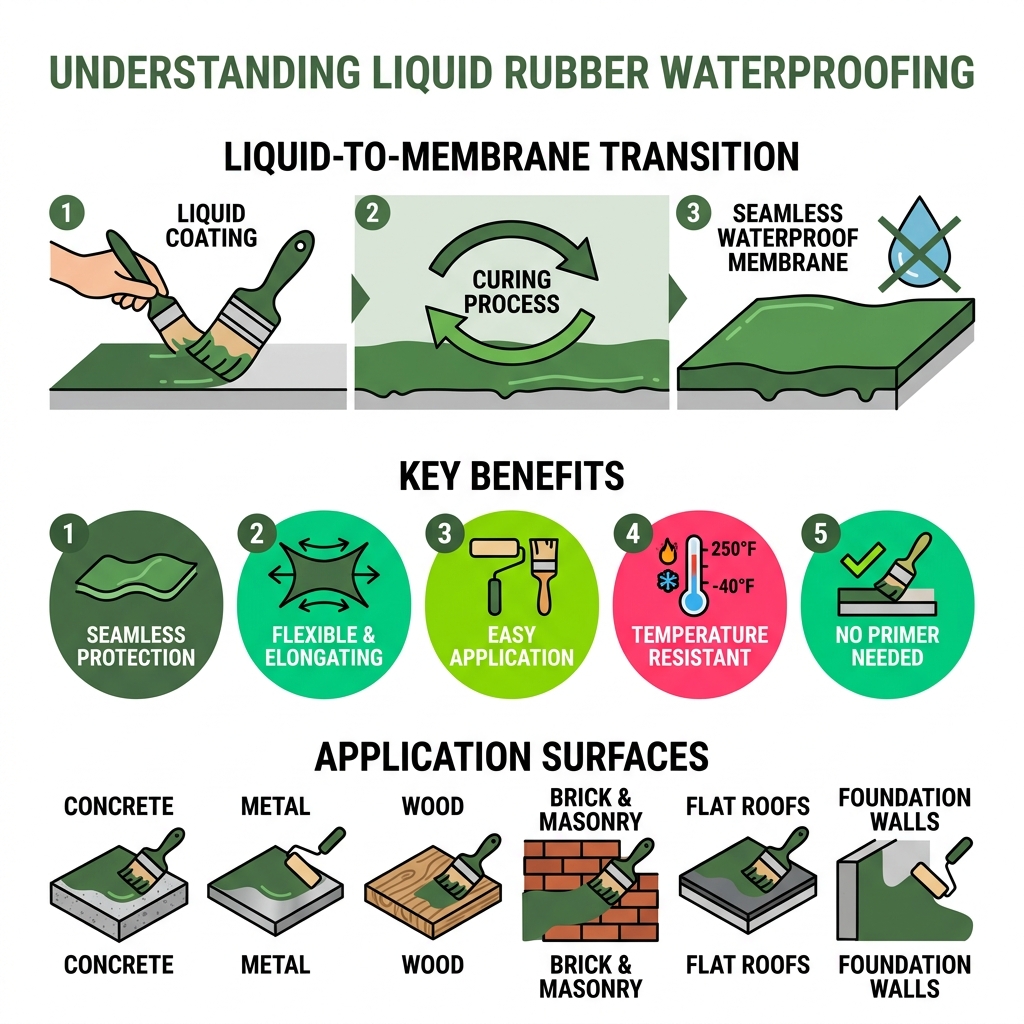
Basic liquid rubber waterproofing vocab:
Understanding Liquid Rubber Waterproofing and How It Works
At its core, liquid rubber waterproofing is an advanced elastomeric technology designed to solve the age-old problem of seams. In traditional roofing or foundation protection, water usually finds its way in through joints, laps, or mechanical fasteners. Liquid rubber eliminates these vulnerabilities by creating a monolithic (single-piece) Liquid Rubber Waterproofing Membrane that conforms to any shape or substrate.
The “magic” happens during the curing process. When applied, the liquid begins to cross-link chemically. This results in a membrane that isn’t just sitting on top of the surface but is often molecularly bonded to it. This “molecular welding” capability ensures that the coating won’t peel or delaminate even under intense hydrostatic pressure or thermal movement.
The Science of Flexibility and Strength
One of the most impressive statistics in our industry is the elongation rate of these products. Many liquid rubber formulations offer up to 900% elongation. To put that in perspective, if your foundation or roof shifts slightly due to the freeze-thaw cycles we experience here in the Chicago suburbs, the rubber stretches rather than snaps.
With a 25-year history of success in industrial and commercial sectors, this technology has been refined to be incredibly user-friendly. Most modern residential versions are non-toxic and VOC-free, meaning you don’t need a hazmat suit to apply them in a basement or a confined crawl space. They boast a tensile strength of approximately 1,520 psi, providing a “tough as a truck tire” finish that remains flexible for decades.
Types of Liquid Rubber Waterproofing Products
Not all “liquid rubber” is created equal. Depending on your specific project in Lakewood or Crystal Lake, you’ll want to choose the right formulation:
- Butyl Rubber: Often used for Roof Repair, these are solvent-based systems that offer incredible UV resistance and ponding water tolerance. They are the heavy hitters for flat roofs.
- Bitumen-Based Sealants: These are often used for Foundation Waterproofing Sealant. They typically go on brown and dry to a deep black. They are excellent for below-grade applications where UV exposure isn’t a factor.
- Waterproof Sealants: A versatile, all-purpose version found in 1-gallon or 5-gallon pails, like the Liquid Rubber Waterproof Sealant. These are great for gutters, planter boxes, and general home repairs.
- Adhesive Caulk: For gaps between 1/8” and 1/2”, a Liquid Rubber Sealant & Adhesive is used to fill voids before the main membrane is applied.
- UV-Stable Topcoats: Some specialized products, like those used for Storm Hail Damage Restoration, require a specific topcoat if they aren’t inherently UV-stable, ensuring the sun doesn’t degrade the rubber over time.

Need Help With Your Home?
TJ Builders & Developers handles roofing, siding, gutters, windows, home additions, and fire damage restoration for homes and businesses in Lakewood, Crystal Lake, Schaumburg, and nearby McHenry County towns.
- Free, no-obligation estimates
- Licensed & insured
- 20+ years of local experience
Key Applications for Residential Protection
In our work across the Chicago suburbs, we utilize liquid rubber for everything from leak mitigation to comprehensive preventative maintenance. Because it adheres to concrete, wood, and metal, the applications are essential for long-term property protection.
Roofing and Gutters
For homes with a Flat Roof Installation, liquid rubber is a game-changer. It can be applied over existing EPDM, TPO, or metal roofs to extend their lifespan significantly. It is particularly effective for Emergency Roof Repair & Leak Detection because it withstands ponding water 365 days a year and provides an immediate seal against the elements.
Foundations and Basements
Keeping water out of the basement is a top priority for Illinois homeowners. Applying a Foundation Waterproofing Sealant to exterior concrete walls creates a barrier that stops water vapor and liquid intrusion. This is a critical step in professional basement waterproofing to ensure no moisture migrates into the structural wall studs.
Outdoor Structures
Professional application of liquid rubber is also vital for:
- Planter Boxes: Preventing wood rot and soil moisture from compromising the structure.
- Retaining Walls: Protecting the structural integrity of concrete or stone against hydrostatic pressure.
- Fence Posts: Coating the portion of the post that goes into the ground to prevent rot and ensure stability.
Professional Standards for Liquid Rubber Waterproofing Application
While the material is versatile, the secret to a 20-year lifespan lies in professional-grade preparation and application. When we tackle a Reroofing project or seal a foundation, we adhere to the following industry standards.
1. Surface Preparation
The substrate must be clean, dry, and structurally sound.
- Cleaning: Professional-grade cleaners are used to remove oils, algae, or dirt that could compromise the bond.
- Coating Removal: Any flaking paint or failing previous coatings must be mechanically removed. We often rough sand surfaces to improve the “mechanical tooth” of the bond.
- Structural Repair: We use an Adhesive Sealant or specialized caulk to fill any cracks larger than 1/8 inch before the membrane is applied.
2. Primer Requirements
Determining if a primer is needed is a critical professional assessment.
- Self-Priming: On many clean concrete and metal surfaces, high-quality liquid rubbers bond directly.
- Specialized Primers: For specific roofing materials like EPDM and TPO, or for interior masonry where hydrostatic pressure is a concern, a specialized primer is required to prevent delamination.
3. Application Standards
Professional application involves using high-quality brushes, rollers, or heavy-duty airless sprayers for large-scale residential projects.
- Build and Thickness: We focus on building the membrane to a minimum of 20 mil thickness (roughly the thickness of a credit card) to ensure durability.
- Coverage Rates: To achieve the necessary dry film thickness, we strictly follow the rule of 50 sq. feet per gallon.
4. Environmental Conditions
In Northern Illinois areas like Schaumburg or Palatine, timing is everything. Application must occur when temperatures are consistently above 50°F to ensure proper chemical cross-linking and curing.
Durability, Safety, and Performance Standards
When comparing liquid rubber waterproofing to traditional acrylic or silicone sealants, the performance gap is significant.
| Feature | Liquid Rubber | Acrylic Sealant | Silicone |
|---|---|---|---|
| Elongation | 500% – 900% | 100% – 200% | 200% – 400% |
| Ponding Water | Excellent | Poor (re-emulsifies) | Good |
| VOC Content | Zero/Low | Low | Moderate |
| Lifespan | 15 – 25 Years | 3 – 5 Years | 10 – 15 Years |
Temperature and UV Resistance
Liquid rubber is built to survive the Illinois climate. It remains flexible in the dead of winter (down to -40°F) and won’t degrade in the scorching summer sun (up to 250°F). Because it is UV-stable, it doesn’t become brittle or chalky like many cheaper hardware store coatings.
Safety and Environmental Impact
For families in Barrington or Bartlett, safety is a major concern. Most leading liquid rubber products are non-toxic, solvent-free, and VOC-free. This means they are safe for use around pets and plants, and they won’t off-gas harmful chemicals into your home if used for Basement Waterproofing.
Need Help With Your Home?
TJ Builders & Developers handles roofing, siding, gutters, windows, home additions, and fire damage restoration for homes and businesses in Lakewood, Crystal Lake, Schaumburg, and nearby McHenry County towns.
- Free, no-obligation estimates
- Licensed & insured
- 20+ years of local experience
Professional Insights: Frequently Asked Questions
Does liquid rubber require a primer before application?
It depends on the substrate and the environmental conditions. For most residential wood and concrete, it is often self-priming. However, for specific roofing materials like TPO or EPDM, or for masonry where hydrostatic pressure is high, a professional contractor will always use a primer to ensure a permanent, warrantied bond.
Can liquid rubber be applied over existing paint or rust?
Yes, provided the surface is properly prepared. Loose, flaking paint must be removed, and heavy rust must be wire-brushed. For light rust, specialized versions of liquid rubber containing rust inhibitors can be used. A professional assessment ensures the new coating is sticking to a stable surface, preventing future peeling.
How long does it take for liquid rubber to fully cure?
In ideal conditions (70°F), it will be dry to the touch in a few hours and fully cured within 24 hours. In the variable Illinois climate, this process can take longer. Professional installers monitor weather forecasts to avoid application if rain is expected within 24 hours, ensuring the membrane’s integrity is not compromised during the curing phase.
Common Mistakes to Avoid
- Applying Too Thin: If you stretch a gallon too far, the membrane won’t be thick enough to handle structural movement. Stick to the 50 sq. ft. per gallon rule.
- Trapping Moisture: Never apply liquid rubber over a saturated surface. The moisture will try to escape as vapor, creating blisters in your new membrane.
- Ignoring Seams: For high-movement areas like roof seams or wall joints, always use a reinforcing geo-textile or seam tape embedded in the liquid rubber.
Conclusion
Whether you are dealing with Hail Damage Roof repairs or seeking to ensure your new foundation remains dry, liquid rubber waterproofing offers a professional-grade solution for modern homes. Its combination of extreme flexibility, chemical bonding, and environmental safety makes it one of the most effective tools in the residential restoration toolkit.
At TJ Builders & Developers Inc, we pride ourselves on delivering reliable workmanship and high-performance solutions to our neighbors in Lakewood, Crystal Lake, and throughout the Chicago suburbs. While the material is impressive, complex structural issues or large-scale Roof Installation & Replacement require a professional touch to ensure long-term warranty protection, safety, and structural integrity.
If you’re ready to protect your home from the unpredictable Illinois weather, consider how professional liquid rubber application can secure your property. For an expert assessment of your home’s exterior, reach out to us — we’re here to help you build and protect a home that lasts.