
What Does a New Rubber Roof Actually Cost?
New rubber roof cost is one of the most searched roofing questions — and for good reason. A leaking or failing flat roof can spiral into serious water damage fast. Here’s a quick answer before we dive deeper:
| Project Type | Typical UK Cost | Typical US Cost |
|---|---|---|
| Single garage (15m²) | £900 – £1,350 | – |
| Double garage (27.5m²) | £2,200 – £3,000 | – |
| Average home (1,500 sq ft) | – | $8,700 – $19,000 |
| Average home (2,500 sq ft) | – | $14,165 – $18,825 |
| Per square metre (UK) | £70 – £90/m² | – |
| Per square foot (US) | – | $4.25 – $14/sq ft |
Key cost drivers at a glance:
- Roof size — the bigger the roof, the higher the total
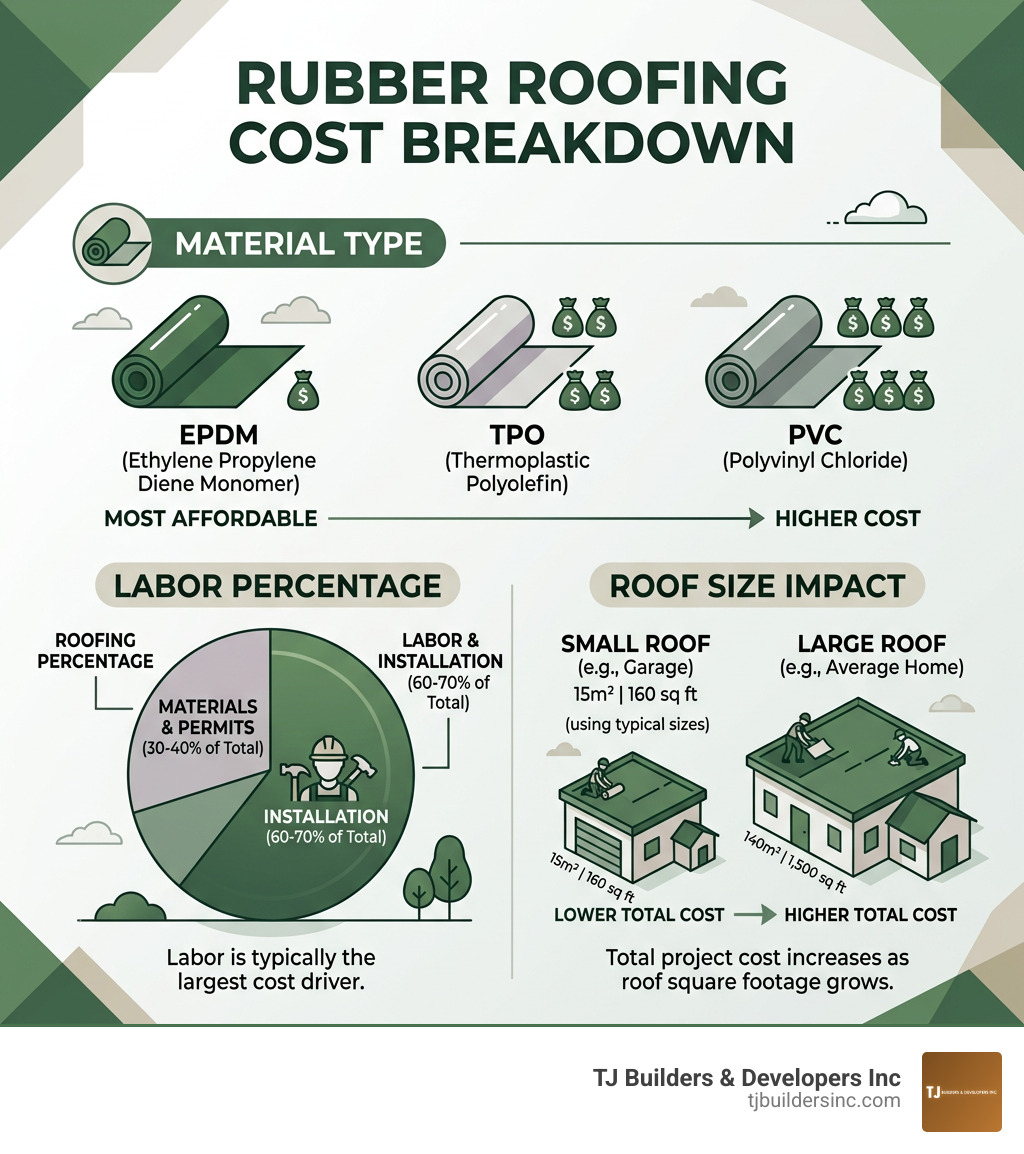
- Material type — EPDM is the most affordable; PVC costs more
- Labor — accounts for roughly 60–70% of total installation cost
- Accessibility — hard-to-reach roofs cost more
- Location — urban areas like Chicago suburbs run 15–30% higher than rural rates
Rubber roofing is primarily used on flat or low-slope roofs, and it’s one of the most durable waterproofing solutions available — with EPDM membranes lasting 50 years or more when properly installed.
I’m Thomas Pruszynski of TJ Builders & Developers Inc, and with over 20 years of hands-on experience in residential exterior construction and restoration across Northern Illinois, I’ve helped countless homeowners navigate the real new rubber roof cost — from first quote to final inspection. In this guide, I’ll walk you through everything you need to budget and plan your project with confidence.
Understanding the New Rubber Roof Cost Factors
When we sit down with a homeowner in Lakewood or Crystal Lake to discuss a new rubber roof cost, the conversation usually starts with the “sticker price,” but the real story is in the details. Rubber roofing isn’t just one product; it’s a system designed to protect your home from the unique challenges of the Northern Illinois climate.
Several variables dictate where your final estimate will land. First and foremost is the roof size. In the roofing world, we measure in “squares,” where one square equals 100 square feet. Naturally, a 2,000-square-foot home will require more material and more man-hours than a 500-square-foot garage.
Labor rates in the Chicago suburbs, including areas like Schaumburg and Elk Grove Village, tend to be higher than the national average, often accounting for 60% to 70% of the total project cost. This isn’t just for the physical act of laying the membrane; it includes the skill required for adhesive bonding, detailing around corners, and ensuring a watertight seal.
Material thickness also plays a role. Standard EPDM membranes often come in 45-mil or 60-mil thicknesses. While 45-mil is common, we often recommend 60-mil for residential properties in our region due to its superior puncture resistance against fallen branches or hail. You can find more details on how these factors integrate into a full project in our roof installation replacement complete guide.
Other factors include:
- Roof Pitch: While rubber is designed for flat or low-slope roofs, a slight pitch is necessary for drainage. If your roof is perfectly flat, we may need to install tapered insulation to create a slope, which adds to the cost.
- Accessibility: If our crew has to navigate tight alleys in Palatine or use specialized equipment to reach a third-story roof in Mount Prospect, the labor costs will adjust accordingly.
- Old Roof Removal: Stripping away multiple layers of old asphalt or felt is labor-intensive and involves waste disposal fees. Generally, removing an old roof adds between $1 and $3 per square foot to the new rubber roof cost.
| Component | Percentage of Total Cost |
|---|---|
| Labor & Overhead | 60% – 70% |
| Materials (Membrane, Adhesives, Trims) | 25% – 35% |
| Permits & Disposal | 5% |
Estimating Your New Rubber Roof Cost by Square Footage
To get a ballpark figure, you need to understand the “per square” pricing. For a professional installation in Illinois, you can expect to pay anywhere from $4.25 to $14 per square foot, depending on the material chosen and the complexity of the roof.
For a typical 1,500-square-foot residential roof, the average new rubber roof cost ranges from $8,700 to $19,000. If you are looking at a smaller project, such as a residential extension or a porch, the cost per square foot might be slightly higher because the fixed costs of getting a crew and equipment to the site remain the same.
We frequently handle garage roofing projects in Lakewood and surrounding areas. A standard single-car garage might run on the lower end of the spectrum, while a large double garage with complex drainage needs will hit the mid-to-high range. If you’re planning a project in our primary service area, check out our specialized roofing services in Lakewood IL for more localized insights.
Additional Expenses in a New Rubber Roof Cost Estimate
When budgeting, it’s the “hidden” extras that can sometimes catch homeowners off guard. We believe in transparency, so we always point out these potential additions:
- PolyISO Insulation: Most modern rubber roof installations require a layer of Polyisocyanurate (PolyISO) insulation board beneath the membrane. This provides a smooth substrate for the rubber to bond to and significantly improves your home’s energy efficiency.
- Scaffolding and Safety: For multi-story homes or commercial buildings in Barrington, scaffolding may be required to ensure our team can work safely and efficiently.
- Waste Removal: Disposing of old roofing materials requires a dumpster (skip) and specialized recycling or landfill fees.
- Roof Penetrations: Every skylight, chimney, vent pipe, or HVAC unit on your roof requires custom flashing and sealing. The more “holes” in your roof, the more labor is required to ensure they don’t leak.
- Drainage Systems: Often, a new roof is the perfect time to upgrade gutters or install internal drains to prevent water from pooling.
If your existing roof structure is sound but the surface is failing, we might discuss professional reroofing services, which can sometimes save on the cost of a full tear-off if local building codes allow for a second layer.
Comparing Rubber Membrane Types: EPDM, TPO, and PVC
“Rubber roofing” is a bit of a catch-all term. In reality, there are three main synthetic polymers used in single-ply membrane roofing: EPDM, TPO, and PVC. Each has its own price point and performance profile.
According to EPDM Roofing Association insights, these materials have been the gold standard for low-slope protection for decades. They offer excellent UV resistance and are designed to expand and contract with the extreme temperature swings we see in the Chicago suburbs — from -20°F winters to 100°F summers.
We adhere to strict flat roof installation standards regardless of the material chosen. Here is how they stack up:
EPDM Performance and Value
Ethylene Propylene Diene Terpolymer (EPDM) is the “original” rubber roof. It is a synthetic rubber membrane that is typically black, though white versions are available at a premium.
- Pros: It is the most cost-effective option for a new rubber roof cost. It is incredibly durable and easy to repair. Because it is black, it helps absorb heat during our long Illinois winters, which can help slightly with heating costs.
- Durability: Research on EPDM durability shows that these roofs can last over 50 years.
- Thickness: We generally recommend 60-mil for residential homes to provide better protection against the elements.
TPO and PVC for Modern Energy Savings
Thermoplastic Polyolefin (TPO) and Polyvinyl Chloride (PVC) are newer technologies compared to EPDM. They are typically white or light grey, making them “cool roofs.”
- TPO: This is a reinforced membrane that is heat-welded at the seams. It offers great solar reflectance, which can lower cooling costs in the summer by up to 20-30%. According to cool roofing data, TPO is the fastest-growing segment in the commercial and residential flat roofing market.
- PVC: This is the premium choice. It is highly resistant to chemicals, grease, and fire. PVC seams are also heat-welded, creating a permanent, monolithic seal that is virtually leak-proof. While the initial new rubber roof cost for PVC is higher, its lifespan and resistance to pooling water often make it the best long-term value for complex roofs.
Long-Term Value: Durability and Maintenance
One of the reasons we love installing rubber roofs is the sheer longevity they offer. While an asphalt shingle roof might last 20 to 25 years, a high-quality EPDM or PVC roof can easily reach a 50-year service life. This durability is a key factor in offsetting the initial new rubber roof cost.
Rubber membranes are naturally resistant to hail, fire, and extreme weather. They are also an eco-friendly choice; many membranes are made from recycled content and are themselves 100% recyclable at the end of their life. If a storm does roll through Crystal Lake and causes a small tear from a flying branch, professional roof repair is usually straightforward and inexpensive compared to other roofing types.
Maximizing Your Investment Through Inspections
To ensure your roof reaches that 50-year milestone, we recommend bi-annual checks — once in the spring after the snow melts and once in the fall before the first freeze. During these inspections, we look for:
- Seam Integrity: Ensuring the adhesives or welds are still tight.
- Drainage Clearance: Removing leaves or debris that could cause water to back up.
- UV Protection: Checking that any protective coatings are still intact.
When you look at asphalt roof installation comparisons, rubber often comes out ahead in terms of maintenance simplicity. You don’t have to worry about losing granules or shingles blowing off in high winds.
Warranty Coverage for Rubber Membranes
A significant portion of your new rubber roof cost goes toward the peace of mind provided by warranties. Most major manufacturers offer 20-year to 30-year protection on the membrane itself.
However, a warranty is only as good as the installation. Warranty details and standards often require that the roof be installed by a certified contractor to remain valid. At TJ Builders & Developers Inc, we provide our own workmanship guarantees on top of manufacturer warranties, ensuring that if a leak occurs due to an installation error, we’ll be there to fix it.
Professional Installation vs. The Risks of DIY
It can be tempting to look at a flat roof and think, “I could just roll that out myself.” We strongly advise against this. While you can buy DIY rubber roof kits, the risks far outweigh the potential savings.
Professional installation requires specialized tools — like heavy-duty rollers for EPDM or hot-air welders for TPO and PVC. More importantly, it requires an understanding of how these materials behave in the Northern Illinois climate. For example, the adhesives used for EPDM have strict temperature requirements. If you try to install a rubber roof on a chilly morning in South Barrington and the adhesive freezes, your roof will fail.
As a local company serving Lakewood, Crystal Lake, and the surrounding Chicago suburbs, we understand the local building codes and permit requirements. We ensure that your roof’s structural integrity is maintained and that every penetration is sealed according to industry best practices. Our team of roofers in Lakewood IL is trained to handle the complexities of residential and commercial flat roofing, providing expert services that a DIY approach simply cannot match.
Frequently Asked Questions about Rubber Roofing
Is rubber roofing suitable for pitched roofs?
While rubber is the king of flat roofs, it can be used on pitched roofs as well. However, it’s most commonly used on low-slopes (less than 2:12 pitch). For steep-sloped roofs, rubber shingles (made from recycled tires) are an option, though they come at a higher cost than standard membranes.
How long does a rubber roof installation typically take?
For an average residential project, such as a large garage or a home extension, the installation typically takes 1 to 3 days. This includes the time needed to remove the old roof, prep the deck, and lay the new membrane.
What is the ideal time of year to install a rubber roof?
In Illinois, the best time is during the dry, milder months of late spring through early fall. The adhesives and primers used in rubber roofing require temperatures above 40°F (and ideally above 50°F) to bond correctly. While we can perform emergency repairs in winter, a full installation is best scheduled when the weather is cooperative.
Conclusion
Investing in a rubber roof is about more than just the immediate new rubber roof cost; it’s about securing long-term protection for your property. Whether you choose EPDM for its proven track record or TPO for its energy-saving properties, a professionally installed rubber roof provides a weather-tight seal that can last for generations.
At TJ Builders & Developers Inc, we take pride in our workmanship and our commitment to the communities of Northern Illinois. From Bartlett to Palatine, we help homeowners increase their property value and protect their biggest investment with high-quality exterior solutions.
Ready to see how a rubber roof fits into your budget? Get a professional estimate for your roofing project today, and let’s build something that lasts.