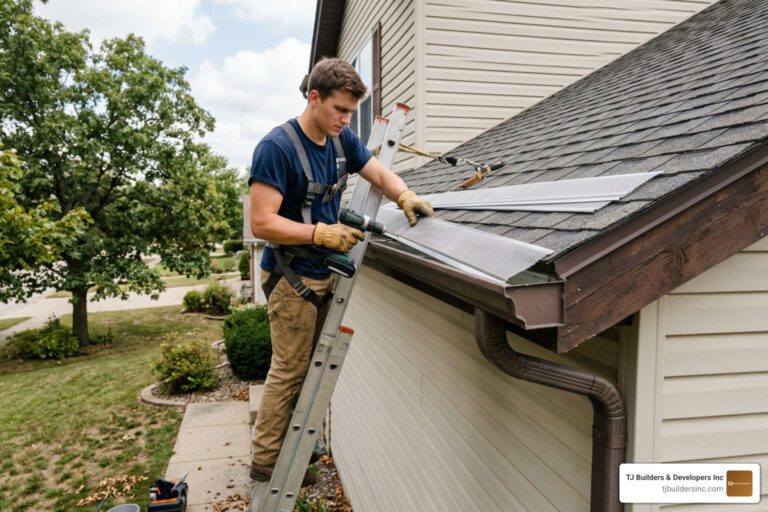
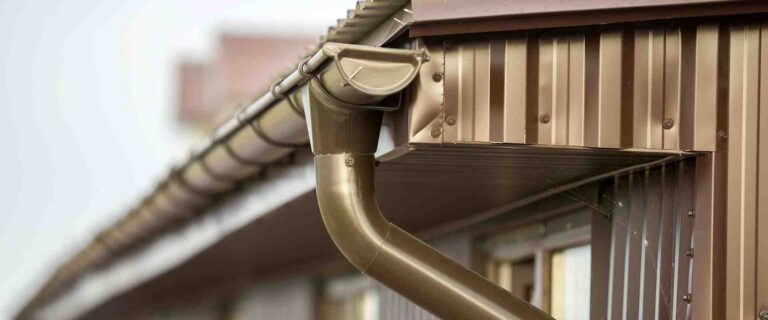
Why a Seamless Gutter is the Smartest Upgrade for Your Home
A seamless gutter is a continuous, custom-fabricated rain channel with no joints along its length — only at corners and downspouts. Unlike traditional sectional gutters pieced together from 10-foot lengths, seamless gutters are formed on-site from a single coil of metal to fit your exact roofline.
Here’s a quick overview of why homeowners across the country are choosing them:
| Feature | Seamless Gutter | Sectional Gutter |
|---|---|---|
| Leak risk | Very low (seams only at corners) | Higher (seam every 10 feet) |
| Maintenance | Minimal | Frequent resealing needed |
| Appearance | Clean, custom fit | Visible joints |
| Lifespan | 20-30+ years | Shorter without upkeep |
| Installation | Professional, on-site | DIY possible |
And those numbers matter. According to industry data, 75% of all gutters installed nationwide are seamless — and it’s easy to see why once you understand how they protect your home from water damage, foundation erosion, and costly repairs.
But not all seamless gutter installations are equal. The material, sizing, slope, and workmanship all determine how well your system performs — especially here in Northern Illinois, where heavy rain and harsh winters put gutters to the test.
I’m Thomas Pruszynski from TJ Builders & Developers Inc, and with over 20 years of experience installing seamless gutter systems on homes across the region, I’ve seen what separates a high-performing system from one that fails after a single hard season. In this guide, I’ll walk you through everything you need to know to make the right choice for your home.
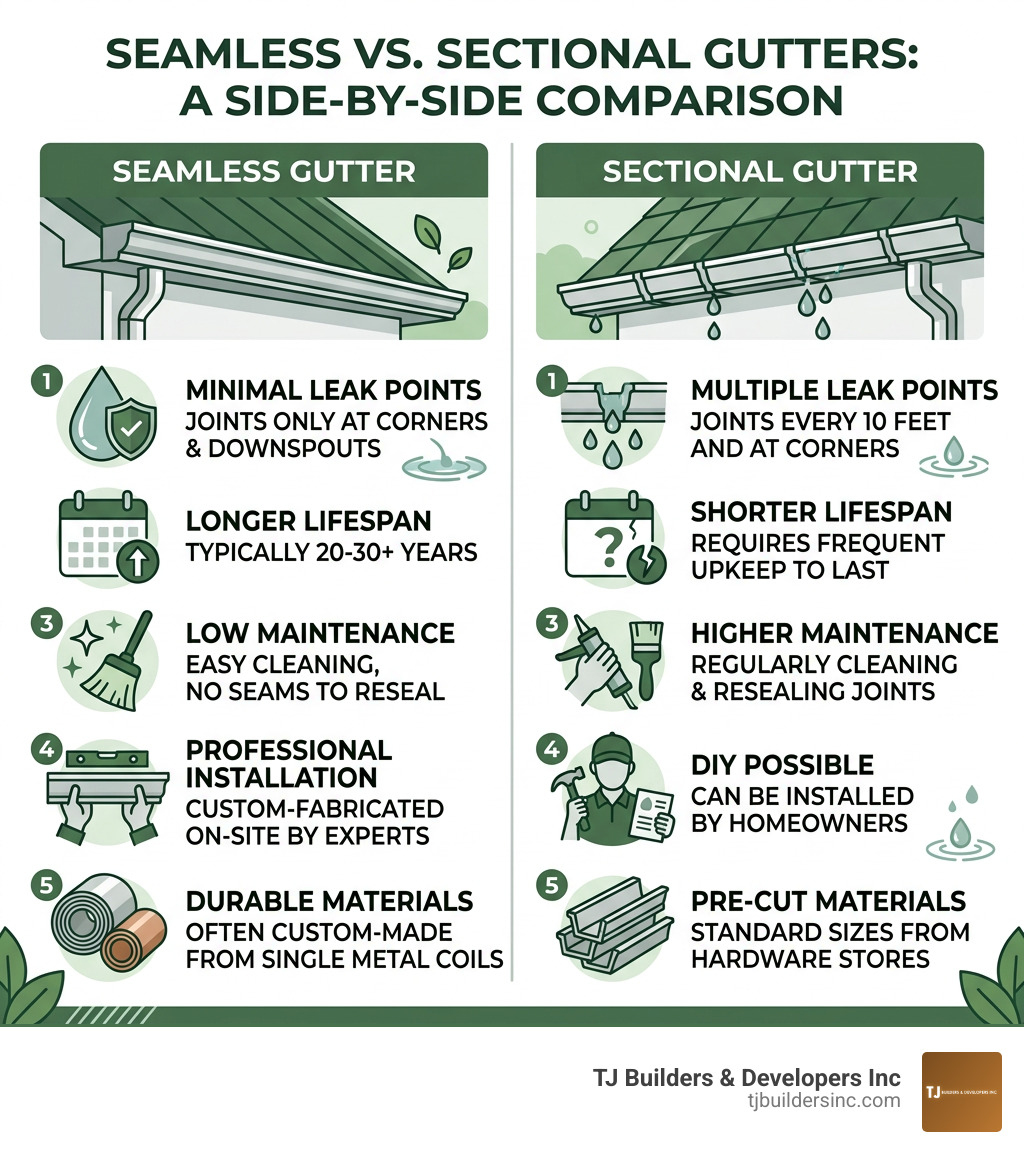
Basic seamless gutter vocab:
What is a Seamless Gutter and How Does It Work?
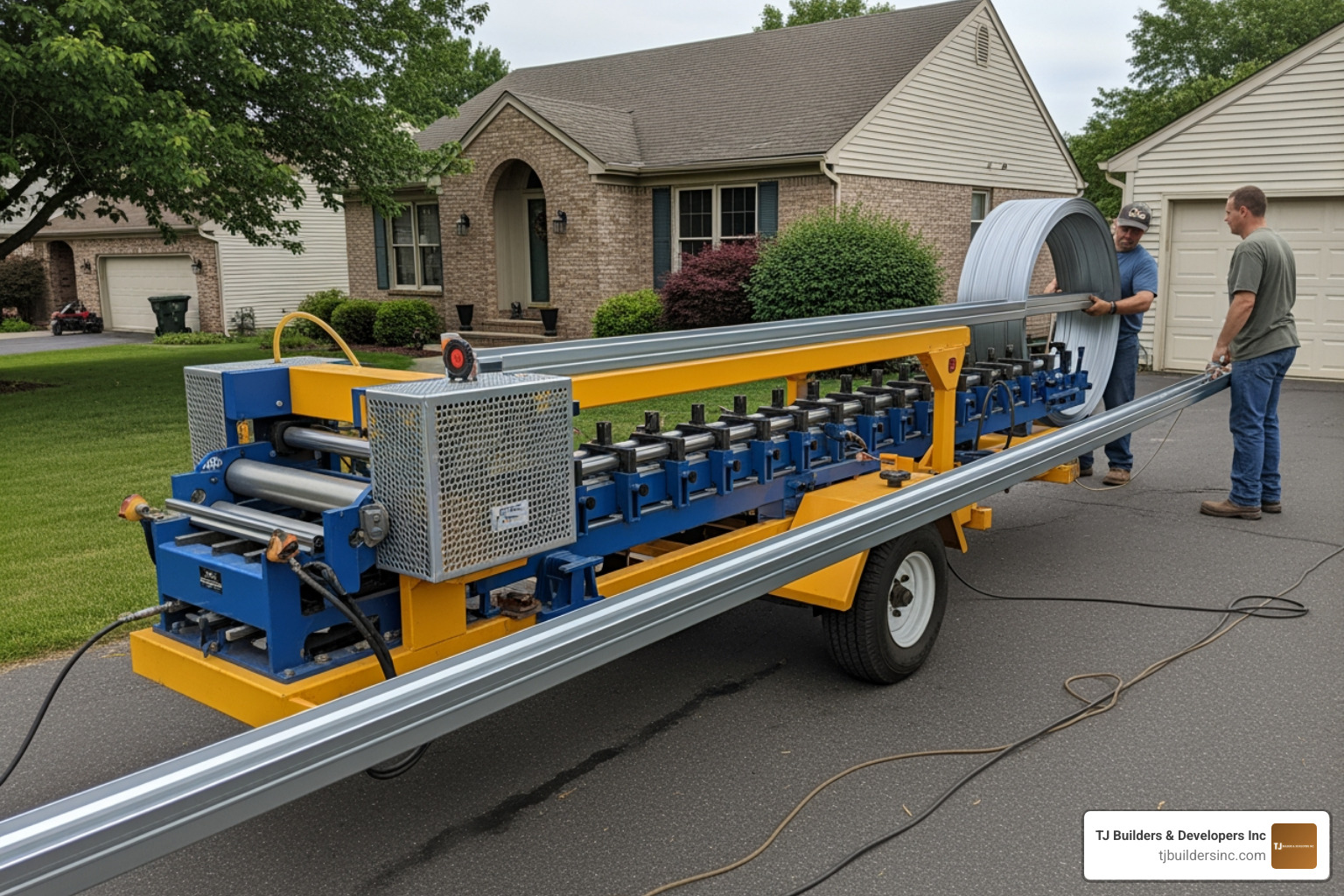
To understand why a seamless gutter is such a massive leap forward in home protection, we have to look at how it’s born. Most home improvement products are manufactured in a factory and shipped to your door. A seamless gutter, however, is actually manufactured right in your driveway.
We use a portable roll-forming machine—essentially a mobile factory on wheels. We feed a flat “coil stock” of metal (usually aluminum) into one end of the machine. As the metal passes through a series of rollers, it is shaped into the specific profile needed for your home, such as the popular K-style or half-round. The machine extrudes the gutter in one continuous run, meaning if your roofline is 60 feet long, your gutter is 60 feet long—no breaks, no joints, no middle seams.
The only places where seams exist are at the mitered corners and the downspout outlets. These are meticulously sealed with high-grade industrial sealants to ensure a watertight fit. This precision-fit approach is why seamless gutters are often called continuous gutters. Because they are custom-measured to the fraction of an inch, they offer a level of protection that “off-the-shelf” products simply can’t match. To see the precision required, you can view this tutorial on installing metal sheet guttering.
The Difference Between Seamless and Sectional Systems
Traditional sectional gutters are the “old school” alternative. These systems are sold in 10-foot or 20-foot lengths at big-box stores. To cover a 40-foot stretch of roof, you have to join four separate pieces together using plastic or metal connectors and a lot of caulk.
The problem? Every one of those joints is a ticking time bomb.
- Leak Points: Over time, the sealant in sectional joints dries out, cracks, and fails. This leads to “the drip”—that annoying leak that eventually rots your fascia board.
- Thermal Expansion: In Illinois, our temperatures swing from sub-zero winters to 90-degree summers. Metal expands and contracts. In a sectional system, this movement puts immense stress on the seams, eventually pulling them apart.
- Debris Traps: Sectional joints often have internal ridges or fasteners that catch leaves and twigs. These small obstructions act like tiny dams, leading to clogs and overflows.
A seamless gutter eliminates these failure points by removing the seams themselves. By having one continuous piece of material, the system can expand and contract as a single unit, significantly reducing the risk of structural failure.
Need Help With Your Home?
TJ Builders & Developers handles roofing, siding, gutters, windows, home additions, and fire damage restoration for homes and businesses in Lakewood, Crystal Lake, Schaumburg, and nearby McHenry County towns.
- Free, no-obligation estimates
- Licensed & insured
- 20+ years of local experience
The Advantages of Choosing a Seamless Gutter System
When we talk to homeowners in Lakewood or Crystal Lake, the conversation usually turns to value. Is a seamless gutter worth the investment? The data suggests a resounding yes.
| Comparison Factor | Sectional Gutters | Seamless Gutters |
|---|---|---|
| Maintenance | High (requires frequent cleaning and resealing) | Low (fewer clogs, no mid-run seams to seal) |
| Leak Potential | High (joints fail over time) | Extremely Low |
| Lifespan | 10–15 years | 20–30+ years |
| Structural Integrity | Moderate (sections can sag at joints) | High (continuous runs are stronger) |
The primary advantage is leak prevention. When water escapes a gutter, it doesn’t just fall to the ground; it often tracks back toward your home’s siding or foundation. This can lead to mold, basement flooding, and wood rot. By ensuring water stays inside the channel until it reaches the downspout, you are providing essential long-term property protection.
For more detailed information on how these systems are integrated into your home’s exterior, check out our guide on gutter installation and replacement.
Enhancing Curb Appeal with a Seamless Gutter
Beyond the functional benefits, a seamless gutter acts like the “crown molding” of your home’s exterior. Because they are custom-made, they sit perfectly flush against the roofline.
- Baked-on Enamel: Most seamless aluminum gutters come with a factory-applied, baked-on enamel finish. This resists chipping, peeling, and fading, which is vital for maintaining curb appeal in the harsh Illinois sun.
- Hidden Hangers: Unlike old-fashioned gutters held up by visible “spike and ferrule” fasteners (which look like big nails sticking out), we use hidden hangers. These brackets clip into the inside of the gutter and screw directly into the fascia, making the hardware invisible from the ground.
- Color Matching: With over 20 colors available, we can match your gutters to your trim or siding so perfectly that they practically disappear, or choose a contrasting color to make them a design accent.
Material Performance and Weather Protection
The material you choose for your seamless gutter dictates how well it will handle the heavy snow loads of a Schaumburg winter or the spring downpours in Elk Grove Village.
Aluminum: The Industry Standard
Roughly 80% of seamless gutters installed today are aluminum. It is the “Goldilocks” of materials—just right for most homes. We typically use .032-gauge aluminum, which is thick enough to withstand heavy ladders and ice buildup without sagging. It’s marine-grade, 100% recyclable, and naturally resists corrosion. Knowing how to choose the best aluminum gutters involves checking the thickness and the quality of the finish.
Copper: The Lifetime Choice
If you are looking for a “forever” gutter, copper is the answer. Seamless copper gutters can last 50 to 100 years. Over time, they develop a beautiful green patina that provides a natural protective layer. Copper also has antimicrobial properties, which can help prevent moss growth. You can learn more about how a copper guttering system ages to decide if the aesthetic fits your home.
Steel: For Extreme Strength
Galvanized or stainless steel is sometimes used in areas with extreme weather. While incredibly strong, galvanized steel can eventually rust if the coating is scratched. Stainless steel avoids the rust issue but comes at a significantly higher price point.
Sizing Your Seamless Gutter for Maximum Intake
Size matters when it comes to water management. A gutter that is too small will overflow during a heavy storm, rendering the whole system useless.
- 5-Inch Gutters: The standard for most residential homes.
- 6-Inch Gutters: Often recommended for homes with large, steep roofs or in areas with high-intensity rainfall. A 6-inch gutter can handle significantly more water volume than a 5-inch model.
- Downspout Capacity: We calculate downspout needs based on your roof’s square footage. A standard 2×3 inch downspout handles about 600 sq. ft. of roof, while a 3×4 inch downspout can handle 1,200 sq. ft.
Properly calculating rainwater harvesting and conveyance is a technical task that ensures your foundation stays dry even during the heaviest Midwestern “frog-stranglers.”
Professional Installation Standards and Longevity
Installing a seamless gutter is not a DIY project. Because it requires a specialized roll-forming machine and precise on-site fabrication, it must be handled by professionals.
Our process at TJ Builders & Developers Inc involves more than just hanging metal. We start with a full fascia inspection. If the wood behind your old gutters is rotted, installing new gutters on top of it is like building a house on sand—it won’t last. We ensure the wood is sound before we begin.
Next comes the “pitch.” A gutter that looks perfectly level to the eye is actually a failing gutter. Gutters must be slightly sloped toward the downspouts—typically 1/4 inch of fall for every 10 feet of run. If the pitch is wrong, water will pool, leading to mosquito breeding grounds and heavy ice dams in the winter.
For homeowners in the Chicago suburbs, we pay special attention to hanger spacing. While some contractors space hangers every 3 feet, we recommend spacing them every 2 feet (or even closer in high-snow areas) to provide the structural support needed to hold the weight of wet snow and ice. You can see more about our gutters installation & replacement standards here.
Common Mistakes to Avoid with a Seamless Gutter
Even the best materials will fail if the installation is sloppy. Here are the most common blunders we see:
- Incorrect Pitch: Water sitting in the gutter leads to rust and clogs.
- Too Few Downspouts: This causes the gutter to overflow during heavy rain because the water can’t exit fast enough.
- Poor Placement: Downspouts should discharge water at least 5 to 10 feet away from the foundation.
- Inadequate Sizing: Using 5-inch gutters on a massive roof that clearly requires 6-inch capacity.
Choosing a professional contractor with local experience in Northern Illinois ensures these technical details are handled correctly the first time.
Need Help With Your Home?
TJ Builders & Developers handles roofing, siding, gutters, windows, home additions, and fire damage restoration for homes and businesses in Lakewood, Crystal Lake, Schaumburg, and nearby McHenry County towns.
- Free, no-obligation estimates
- Licensed & insured
- 20+ years of local experience
Maintaining Your System for Decades of Service
While a seamless gutter is “low maintenance,” it isn’t “no maintenance.” To get the full 30-year lifespan out of your aluminum system, a little TLC goes a long way.
We recommend a bi-annual cleaning—once in the spring and once in the late fall after the leaves have dropped. Even without seams, debris can still blow into the top of the gutter. Flushing the system with a garden hose helps ensure the downspouts are clear and the water is flowing at the correct speed.
The Role of Gutter Guards
To truly minimize maintenance, many of our clients in Barrington and Palatine opt for gutter guards.
- Micromesh Screens: These are the gold standard. They allow water in while keeping even tiny debris (like pine needles) out.
- Debris Resistance: High-quality guards prevent clogs and reduce the risk of “gutter gardens” sprouting in your eaves.
- Ice Dam Prevention: While guards don’t stop ice dams entirely, they can prevent debris from freezing inside the gutter, which helps water drain more effectively during a thaw.
There is often a debate about gutter screens—fact or fiction—but in our experience, a high-quality micromesh system paired with a seamless gutter is the ultimate “set it and forget it” solution for home protection.
Frequently Asked Questions about Seamless Gutters
How long do seamless gutters typically last?
Seamless aluminum gutters typically last 20+ years in harsh, snowy climates like Northern Illinois and can last 30 years or more with proper maintenance. Copper systems can last 50 to 100 years.
Are seamless gutters more expensive than sectional gutters?
Initially, yes. The upfront cost for a seamless gutter is higher because it requires professional labor and specialized machinery. However, when you factor in the reduced maintenance costs and the fact that you won’t have to replace them nearly as often, they are significantly more cost-effective over the life of the home.
Why is professional installation required for seamless systems?
You simply cannot buy a seamless gutter at a retail store. They must be custom-extruded on-site using a roll-forming machine that costs thousands of dollars. Furthermore, calculating the correct pitch and ensuring secure attachment to the fascia requires professional expertise to prevent future home damage.
Conclusion
Upgrading to a seamless gutter system is one of the most effective ways to protect your home’s structural integrity. From preventing foundation erosion to boosting your curb appeal, the benefits far outweigh the initial investment.
At TJ Builders & Developers Inc, we take pride in providing the residents of Lakewood, Crystal Lake, Schaumburg, and the surrounding Chicago suburbs with reliable workmanship and durable exterior solutions. Whether you are dealing with leaky old sections or building a new home addition, our team is here to ensure your home stays dry and protected for decades to come.
Don’t wait for the next big storm to find out your gutters aren’t up to the task. Schedule your professional seamless gutter installation and replacement with us today and experience the peace of mind that comes with a truly seamless solution.