Why Homeowners Are Choosing to Build Up Instead of Out
A prefab 2nd story addition is a home expansion method where components are built off-site in a controlled factory environment, then transported and assembled on your existing home in as little as 1-3 days. This approach contrasts with traditional construction, which can take 6-12 months and requires living in an active construction zone.
Key Comparisons: Prefab vs. Traditional Second Story Additions
| Feature | Prefab Addition | Traditional Addition |
|---|---|---|
| On-Site Construction Time | 1-3 days | 6-12 months |
| Factory Build Time | 2-4 weeks | N/A |
| Disruption to Daily Life | Minimal | Significant |
| Average Cost | $175,000 | $175,000+ |
| Weather Delays | Rare | Common |
| Quality Control | Factory-controlled | Site-dependent |
Many homeowners face a common dilemma: their family is growing, they need a home office, or they simply need more space—but they don’t want to leave their neighborhood or sacrifice their yard. Moving comes with hefty transaction costs and the stress of uprooting your life. Building out isn’t always possible on smaller lots or when you want to preserve outdoor space.
That’s where building up becomes the smart solution. And among building-up options, prefab second story additions stand out for their speed and reduced disruption. As one industry source notes, “Add a second story and roof to your house in less than 24 hrs.” While the complete project takes longer when you factor in design and finishing work, the actual installation of the structure happens in days, not months.
The process is surprisingly straightforward. Your new second story is built in sections at a factory while your home is prepared for the addition. When the modules arrive, the old roof is removed and the new structure is craned into place—often in a single day. This means your home is only exposed to the elements for hours instead of weeks or months.
What is a Prefab Second Story Addition?
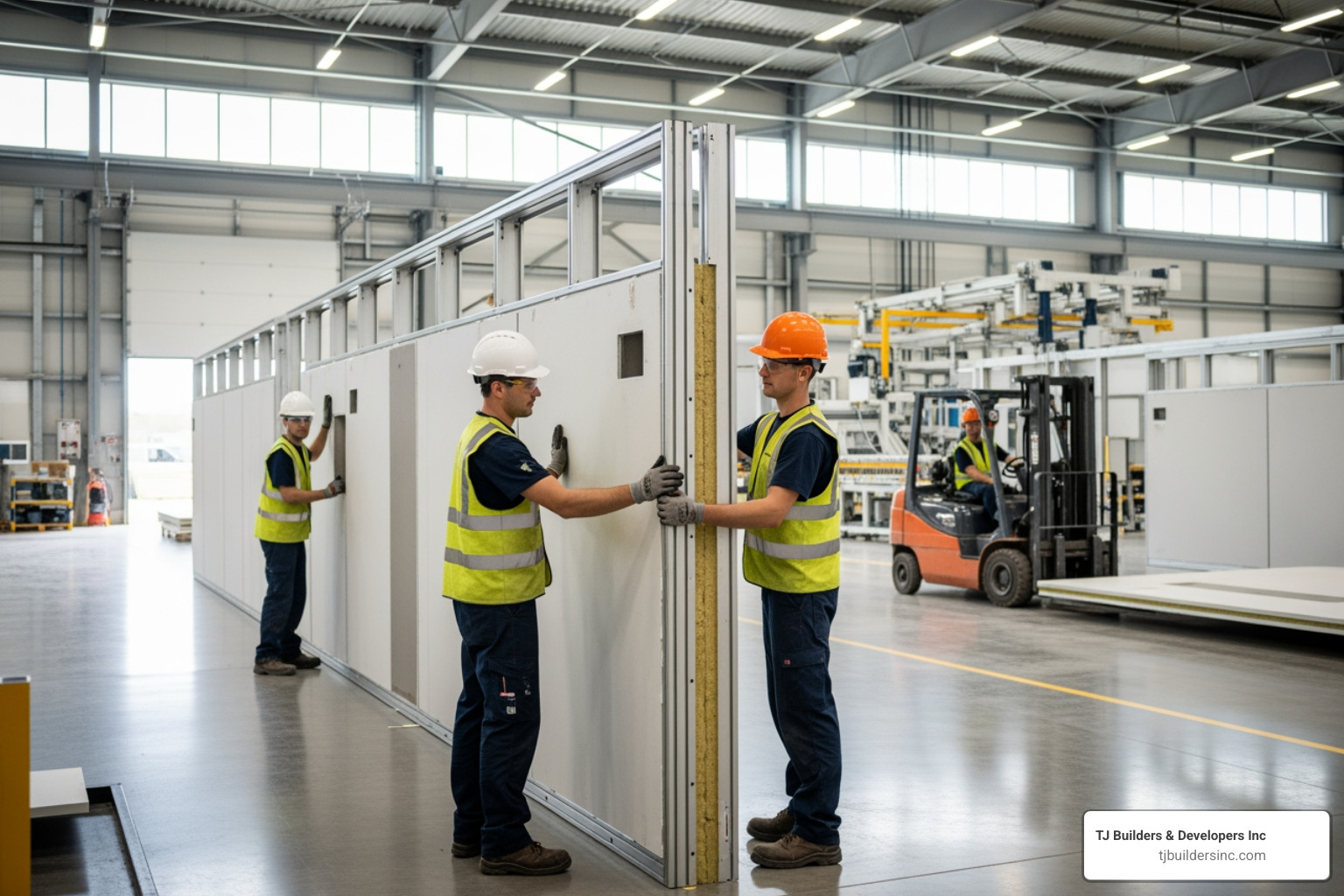
When we talk about a prefab 2nd story addition, we’re referring to a approach to home expansion that leverages off-site construction. Instead of building everything from scratch on your property in Lakewood, Crystal Lake, Schaumburg, or other Chicago suburbs, the main components of your new second floor are carefully crafted in a controlled factory environment. This method offers a distinct advantage over traditional stick-built construction, where every beam, wall, and roof section is assembled piece by painstaking piece on your home site.
The term “prefab” is a broad category. It encompasses various types of construction where parts of a structure are built elsewhere and then transported for assembly. Within prefab, you’ll often hear “modular” and “panelized” construction. Modular homes consist of multiple factory-built components—entire rooms or sections—that are then assembled on-site. Panelized construction, on the other hand, involves factory-built wall, floor, and roof panels that are then erected on your foundation. For a prefab 2nd story addition, both methods offer significant benefits. Our floors, walls, and roofing materials are all factory-built and ready to go, ensuring precision and quality from the start.
This factory setting allows for superior quality control. Unlike a traditional construction site exposed to the elements, a climate-controlled factory means materials are protected from weather damage, and consistent manufacturing processes lead to higher structural integrity. In fact, prefabricated structures are often built sturdier than many traditionally built homes because they must withstand the rigors of transportation to your job site in Illinois. This robust construction means a more durable and resilient addition for your home.
Another key difference is the significant reduction in material waste. Because components are cut and assembled with precision in a factory, there’s less scrap and fewer discarded materials, making it a more environmentally friendly option. This efficiency also translates to cost savings, as there are no wasted days, lost materials, or downtime due to inclement weather.
A prefab 2nd story addition means we can provide you with a high-quality, structurally sound new living space that is built faster, with less disruption, and often more cost-effectively than traditional methods. It’s about bringing the future of construction to your doorstep.
Need Help With Your Home?
TJ Builders & Developers handles roofing, siding, gutters, windows, home additions, and fire damage restoration for homes and businesses in Lakewood, Crystal Lake, Schaumburg, and nearby McHenry County towns.
- Free, no-obligation estimates
- Licensed & insured
- 20+ years of local experience
The Best Benefits of Building Up with Prefab
Choosing a prefab 2nd story addition for your home in the Chicago suburbs offers a compelling array of benefits that traditional construction simply can’t match. We often tell our clients that it’s about getting more space, faster, and with less hassle.
First and foremost is the incredible speed of construction. While traditional additions can drag on for months, a significant portion of a prefab addition is completed off-site. The fabrication of all components—including attaching rain screens, painting finishes, and installing windows—can take as little as two weeks after the drawings are finalized. Once the modules arrive on your property, the on-site installation is astonishingly quick. Imagine adding an entire second story and roof to your house in less than 24 hours! Some of our most popular finished spaces are installed in less than one week, with some projects wrapping up in just three days. This rapid turnaround minimizes the disruption to your daily life, a common pain point with home renovations.
Speaking of minimal disruption, this is a huge advantage. Because most of the work happens in a factory, your home isn’t a chaotic construction zone for an extended period. We can have your project finished in just a few days, meaning you won’t have to worry about living amidst constant noise, dust, and workers for weeks on end. For a prefab 2nd story addition, this is especially critical, as the family can often remain in the home during the off-site fabrication phase, only needing to make temporary arrangements for a very short period during the on-site installation.
Cost-effectiveness is another major draw. Prefab additions are often less expensive than building new from the ground up, and they can be more cost-effective than traditional on-site additions due to reduced labor costs and efficient material use. There’s less waste, less downtime, and a streamlined process that keeps budgets in check. While the average cost to add a second story can range from $80,000 to $600,000, with an average of $175,000, modular options can help manage these costs by saving on labor fees and avoiding wasted days.
Beyond the immediate benefits, a prefab 2nd story addition is a smart long-term investment. Adding significant square footage to your home almost invariably increases its property value. In competitive real estate markets like the Chicago suburbs, expanding your living space efficiently can provide an excellent return on investment. Many modern prefab designs also incorporate high-efficiency insulation and construction techniques, leading to improved energy efficiency and lower utility bills over time.
Finally, the eco-friendly building process of prefab construction appeals to many homeowners. With no waste materials being a key benefit, along with shorter construction times and optimized resource use, prefab is a greener way to build. And when it comes to customization options, don’t think factory-built means simple or boring! Modern prefab allows for extensive design flexibility. We can work with you to choose from millions of combinations of sizes, door and window placements, colors, and exterior finishes to ensure your new second story seamlessly blends with your existing home’s aesthetic. From attaching rain screens to painting Shakertown shingles with two coats of semi-transparent stain, the possibilities for a personalized, high-quality finish are endless.
Your Project Blueprint: The Prefab 2nd Story Addition Process
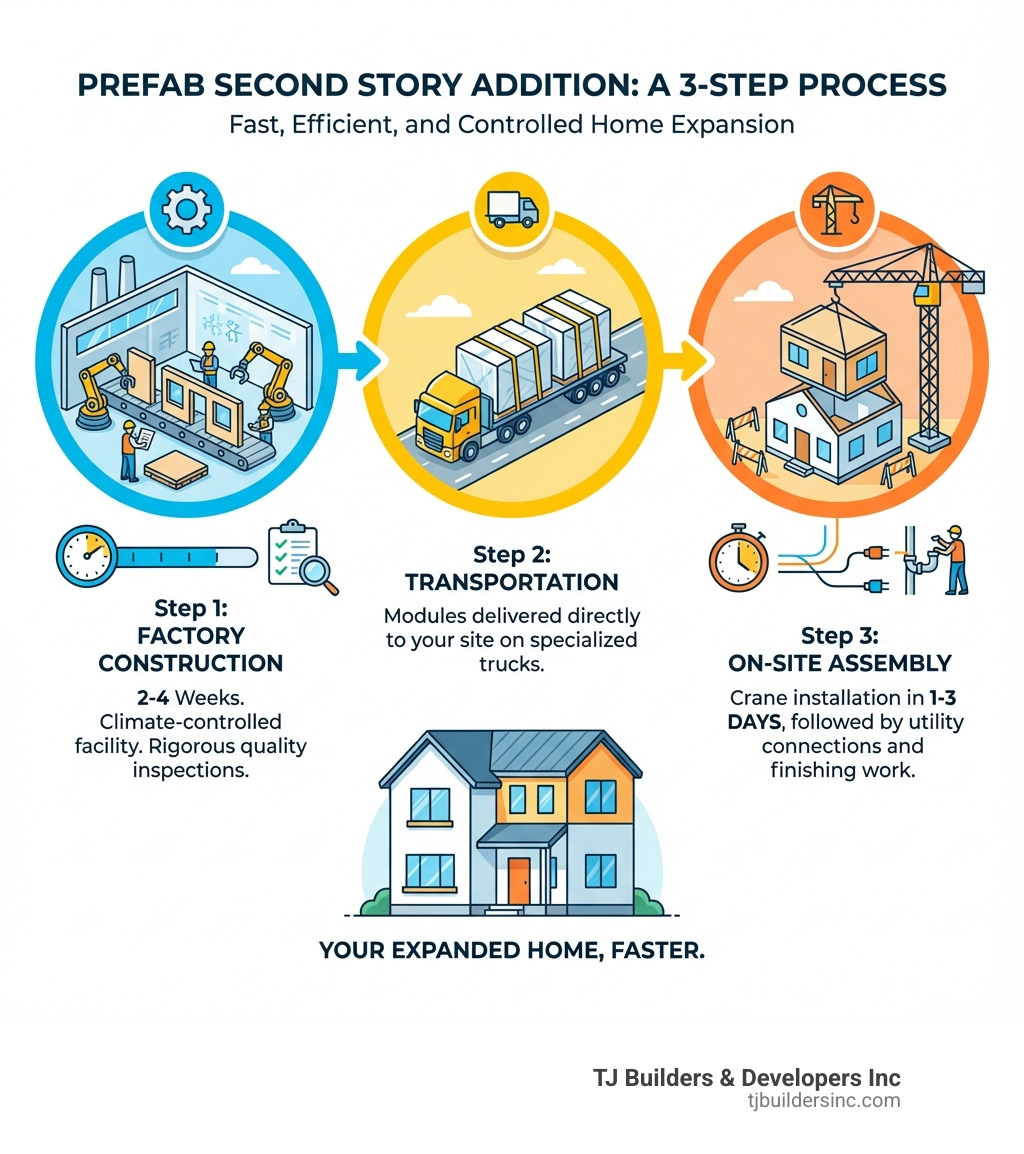
Starting on a prefab 2nd story addition project with us is a structured and efficient journey. We pride ourselves on a “No Mess, No Stress” methodology, ensuring a smooth experience for our clients in Lakewood, Crystal Lake, Schaumburg, and across the Chicago suburbs. Here’s a breakdown of the three key phases:
Phase 1: Planning for a Prefab 2nd Story Addition
The journey begins with meticulous planning, which is crucial for the success of any home addition. Our first step is a comprehensive structural engineer assessment of your existing home. Most single-story homes are not originally designed to support the weight of an entire second floor, so reinforcement is often necessary. The engineer will evaluate your foundation and framework, potentially conducting soil tests, to ensure your home can safely accommodate the additional load. We often find that building codes may require steel or plywood connections extending into the foundation for added support.
Next, we dive into the regulatory landscape. We’ll help you steer local zoning laws and building codes specific to your municipality in Illinois. These regulations, often based on models like the International Residential Code, dictate everything from height limitations and setbacks from property lines to the types of materials that can be used. Obtaining permits is a critical step; permits for building, electrical, plumbing, and sometimes even demolition will be required. This phase, including design and permitting, can take several weeks to months, so patience here pays off. We also recommend checking with your Homeowner’s Association, if applicable, regarding any restrictions on home extensions.
When considering suitable home types, ranches and bungalows are often excellent candidates for a prefab 2nd story addition, as they typically have simpler rooflines and foundations that can be more readily adapted. We’ll also assess site access for cranes—a crucial logistical detail for the on-site installation. We need to ensure there’s enough clear space for the crane to operate safely and efficiently, hoisting the modular sections into place.
Phase 2: Designing Your Prefab 2nd Story Addition
Once the structural and regulatory groundwork is laid, the fun begins: designing your dream second story! We believe that factory-built doesn’t mean simple or boring. We’ll work closely with you and our architects to create a space that is both functional and beautiful. This phase focuses on customization options and ensuring the new addition seamlessly integrates with your existing home.
You’ll explore various floor plan designs, deciding on the layout of new bedrooms, bathrooms, a home office, or perhaps a spacious family room. Our modular home additions offer a vast array of choices, with millions of combinations of sizes, door and window placements, and colors available. We’ll guide you through selecting exterior finishes that perfectly match your current home’s aesthetic. This might involve careful selection of siding, which we can expertly install or replace to ensure a cohesive look. Similarly, we’ll assist with windows installation and replacement, ensuring energy efficiency and architectural harmony. The goal is for the addition to look like it was always meant to be there, not like a box simply dropped on top. We leverage advanced design tools to help visualize your options and refine the design and pricing options for modular home additions before any fabrication begins.
Phase 3: Fabrication and Final Installation
This is where the magic of prefab really shines. While we’re finalizing plans and permits, the modules for your prefab 2nd story addition are already being built in the factory. The factory fabrication timeline can be as short as two weeks after drawings are completed, with all components, including siding, windows, and even rain screens, pre-attached and finished.
Once the modules are ready and transported to your property, the on-site preparation begins. This involves carefully removing your existing roof and prepping the top of your first story to receive the new addition. If you have an existing chimney or HVAC components in the attic, these will be temporarily modified or removed.
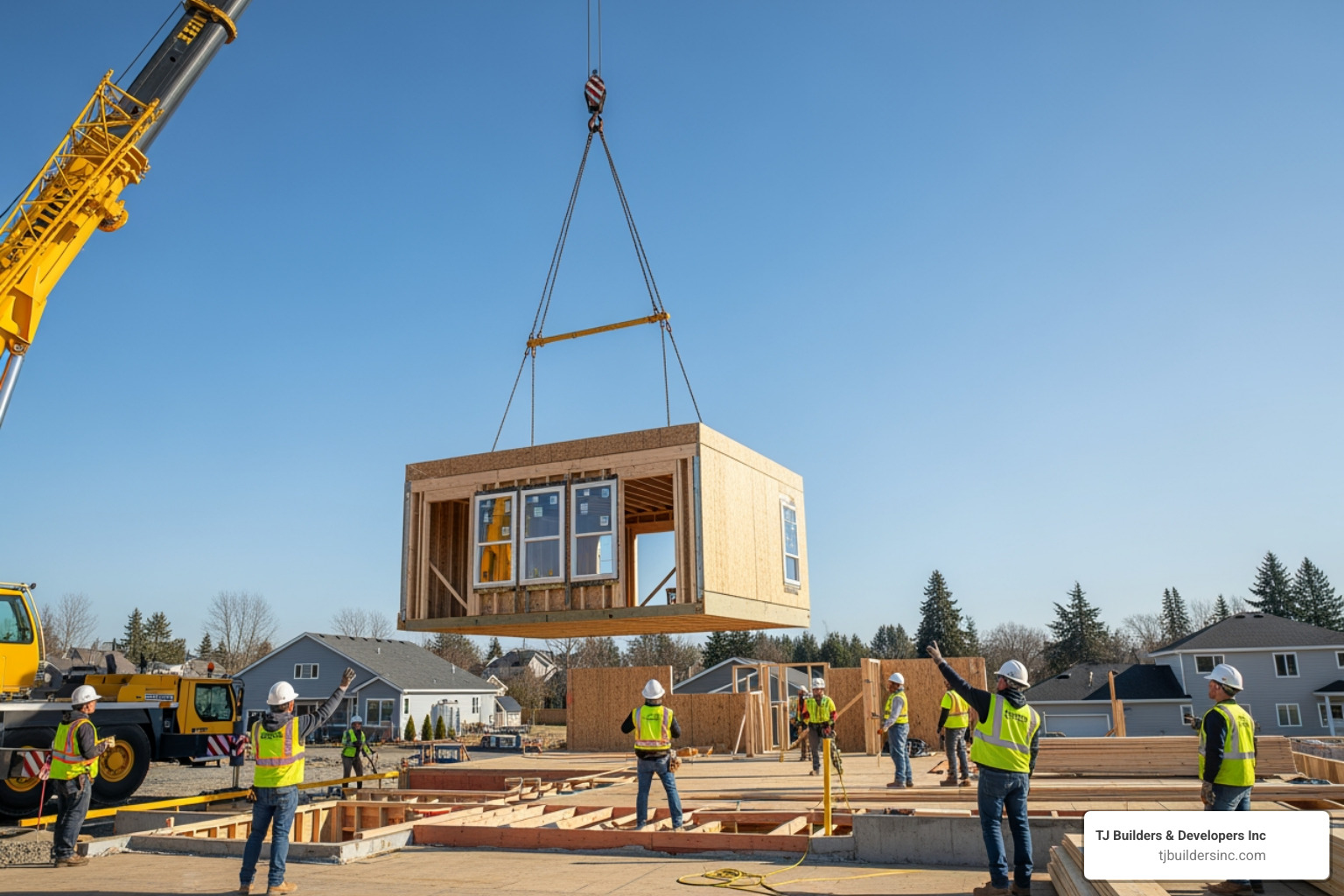
Then comes the dramatic moment: craning modules into place. Your new second story, often delivered in large sections, is hoisted by a crane and precisely set onto your prepared home. This is the part that happens incredibly fast—sometimes in less than 24 hours. The speed is a tremendous benefit, as your home is only exposed to the elements for a minimal amount of time, protecting it from sudden storms.
After the modules are secured, our team gets to work on connecting all the essential utility connections. This includes integrating new HVAC systems, plumbing, and electrical wiring with your existing home’s infrastructure. We ensure that your home’s electrical service, panel box, and even smoke detectors are seamlessly interconnected with the new addition. Any chimneys previously cut down will be extended, and new ductwork will be run. Finally, we move to interior finishing, completing drywall, flooring, trim, and paint to bring your new rooms to life, along with any exterior touch-ups and roof repair necessary to finalize the project.
Need Help With Your Home?
TJ Builders & Developers handles roofing, siding, gutters, windows, home additions, and fire damage restoration for homes and businesses in Lakewood, Crystal Lake, Schaumburg, and nearby McHenry County towns.
- Free, no-obligation estimates
- Licensed & insured
- 20+ years of local experience
Budgeting for Your Build: Costs and Considerations
Understanding the financial aspects of a prefab 2nd story addition is crucial. While the average cost to add a second story to a house is around $175,000, this can range significantly from $80,000 to $600,000, depending on various factors. For a 500-square-foot addition, you might expect to pay between $100,000 and $250,000, while a 1,000-square-foot addition could range from $200,000 to $350,000. These figures typically include materials, labor, permits, architectural plans, and structural changes.
One of the significant advantages of prefab methods is cost savings on labor and materials. Because components are built in a controlled factory setting, there’s less waste, optimized material use, and reduced on-site labor hours. This efficiency means that while the initial investment might seem substantial, it’s often more economical than a comparable traditional stick-built addition. Modular additions are also generally less expensive than building a brand-new home.
However, like any construction project, there are factors influencing the price. These include the size and complexity of the addition, the quality of finishes you choose, and the specific site conditions. It’s important to budget not only for the construction itself but also for architectural and planning fees, which can add up. We always recommend setting aside a contingency budget of 10-20% of the total project cost for unforeseen issues.
While prefab minimizes many common construction challenges, potential challenges or drawbacks can still arise. These might include site access limitations for the crane, which could increase logistical costs. Unforeseen structural issues finded during the initial assessment of your existing home could also require additional work and expense. Permitting delays, though often shorter for prefab due to standardized components, can still occur.
Regarding long-term maintenance needs, a well-built prefab 2nd story addition will have similar maintenance requirements to the rest of your home. The quality materials and controlled construction environment often contribute to a durable structure. Regular roof inspections, siding maintenance, and window care, services we proudly offer at TJ Builders & Developers Inc., will ensure your addition remains in excellent condition for years to come.
Frequently Asked Questions about Prefab Additions
We understand you likely have many questions about starting on a prefab 2nd story addition. Here are some of the most common inquiries we receive from homeowners in Illinois:
Can I live in my house during the installation?
For most of the process, yes! This is one of the biggest benefits of a prefab 2nd story addition. Since the majority of the construction happens off-site in a factory, your daily life experiences minimal disruption. You won’t have a constant stream of workers, noise, and dust for months on end. The primary disruption occurs during the few days of on-site preparation and installation, which is significantly shorter than traditional methods. During this brief period, typically when the old roof is removed and the new modules are craned into place, we’ll advise on temporary arrangements. Some homeowners choose to stay with family or friends for a few days, but for many, the impact is surprisingly manageable. We work to ensure most of the work can be done without significantly affecting the lives of the residents.
Will a prefab addition look like a box on top of my house?
Absolutely not! This is a common misconception, and we’re here to debunk it with a smile. Modern prefab 2nd story additions offer extensive customization options that allow your new level to seamlessly blend with your existing home’s architecture. Factory-built doesn’t mean simple or boring. We work with skilled architects and designers to ensure your addition complements your home’s style, rather than clashing with it. You’ll have choices for:
- Exterior Finishes: From brick and stone to various siding options, including those we expertly install and replace, we can match or improve your home’s current look.
- Roofing Styles: The new roof will be integrated to match your home’s existing roofline and materials, with options for new roof installation or repair as needed.
- Window and Door Placements: With hundreds of window and door configurations available, we can create a design that feels custom and looks natural.
- Architectural Details: We can incorporate features like dormers, gables, and overhangs to add character and ensure a harmonious aesthetic.
The goal is always to create a cohesive and attractive exterior that looks like it was always part of the original design, enhancing your home’s curb appeal in the Chicago suburbs.
How long does the entire process take from start to finish?
While the on-site installation of the physical structure is incredibly fast—often just a few days, with some projects completed in as little as 1-3 days—the entire process from initial design to final finishing does take longer. However, it’s still significantly faster than a traditional build.
Here’s a typical breakdown:
- Design and Planning (Weeks to Months): This phase involves initial consultations, architectural drawings, structural assessments, and the crucial step of obtaining all necessary permits and approvals from your local municipality in Illinois. This can take several weeks to a few months.
- Factory Fabrication (2-4 Weeks): Once plans are approved, your prefab 2nd story addition components are built in the factory. This can take as little as two weeks after drawings are completed, with all elements pre-assembled and finished.
- On-Site Installation (1-3 Days): This is the rapid phase where your old roof is removed, and the new modules are craned into place and secured.
- Finishing and Utility Connections (Several Weeks): After the structure is set, our team completes interior finishes (drywall, flooring, paint) and connects all utilities (HVAC, plumbing, electrical) to your existing systems.
All told, while a traditional second-story addition can easily take 6-12 months, a prefab 2nd story addition can often reduce that timeline by months, offering a much quicker path to your expanded living space.
Conclusion
Expanding your home with a prefab 2nd story addition is a smart, efficient, and increasingly popular choice for homeowners in Lakewood, Crystal Lake, Schaumburg, and across the Chicago suburbs. We’ve seen how this innovative construction method delivers exceptional speed, quality, and value, allowing you to gain the space you need without the extensive disruption or lengthy timelines of traditional builds. From the precision of factory-built components to the rapid on-site installation, prefab offers a compelling solution to meet your evolving family needs.
At TJ Builders & Developers Inc., we believe that expert guidance is crucial for success in any home addition project. With our commitment to reliable workmanship, competitive pricing, and eco-friendly solutions, we’re dedicated to ensuring your complete satisfaction. Whether you’re considering a new roof, siding, windows, or a complete home addition, our team is here to guide you through every step of the process.
Ready to explore how a prefab 2nd story addition can transform your home and improve your lifestyle?