
What Is a Power Attic Fan — and Do You Actually Need One?
A power attic fan is an electrically or solar-powered ventilation device installed on your roof or gable wall to actively pull hot, humid air out of your attic. Here’s a quick overview of the main types:
| Type | How It Works | Best For |
|---|---|---|
| Roof-Mount (Electric) | Fan motor exhausts air through a dome on the roof | Most attic sizes and shapes |
| Gable-Mount (Electric) | Installed in the gable wall, pushes air out sideways | Attics with accessible gable ends |
| Solar-Powered | Same as above but runs on a built-in solar panel | Homeowners wanting zero operating costs |
Attics in places like Crystal Lake and Schaumburg, IL can get brutally hot in summer — some reaching over 150°F. That trapped heat and moisture doesn’t just stay in the attic. It works its way into your living space, stresses your HVAC system, and slowly degrades your roof from the inside out.
But here’s the thing: not everyone agrees that a powered fan is the right fix. Building science experts and everyday homeowners alike have debated whether these fans actually help — or quietly make things worse.
I’m Thomas Pruszynski, and over more than 20 years leading TJ Builders & Developers, I’ve helped Northern Illinois homeowners diagnose and solve exactly these kinds of attic ventilation problems — including deciding when a power attic fan is the right call and when it isn’t. This guide walks you through everything you need to know to make a smart decision.
Understanding the Power Attic Fan: Types and Mechanics
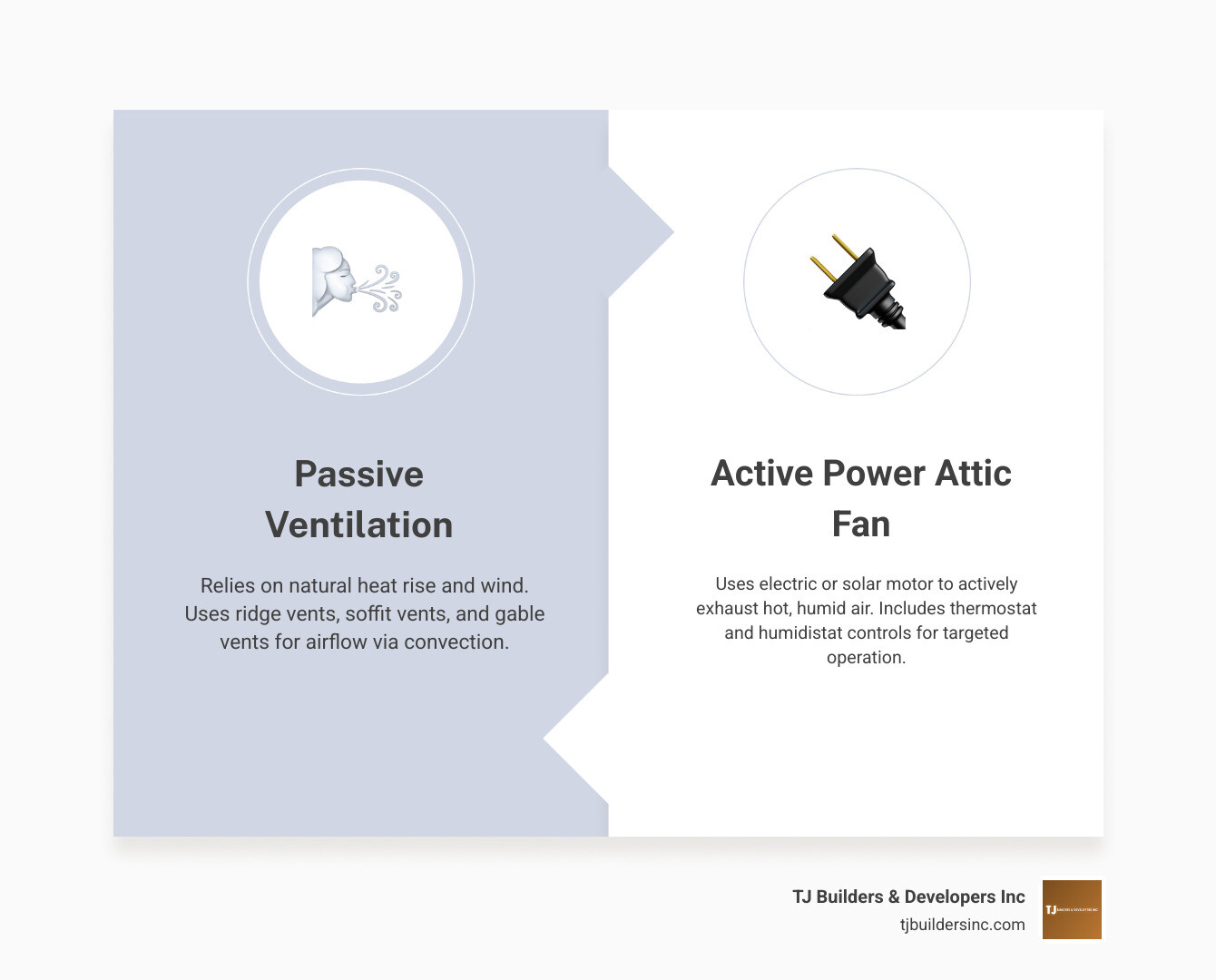
When we talk about active ventilation, we are referring to systems that use mechanical force to move air. Unlike passive vents that rely on the natural principle of “heat rises,” a power attic fan uses a motor to create an exhaust path. This is particularly useful in the Chicago suburbs, where stagnant, humid air can sit in an attic like a heavy blanket.
Most modern units utilize a Permanent Split Capacitor (PSC) motor. These are designed for high efficiency and long-term operation. Many of these fans are “smart” in their own way; they come equipped with adjustable thermostats and sometimes humidistats. This means the fan only kicks on when the attic hits a certain temperature (often set around 85°F to 105°F) or when humidity levels threaten to cause mold or wood rot.
Roof-Mount vs. Gable-Mount Power Attic Fan
The two primary mechanical designs we install are roof-mount and gable-mount units.
- Roof-Mount Fans: These are installed directly onto the roof deck. They require a hole to be cut through the shingles and decking, usually near the ridge. High-quality models, like those from the GAF Master Flow series, feature heavy-duty galvanized steel or aluminum domes. These domes are designed to be weatherproof and often pass rigorous wind-driven rain tests.
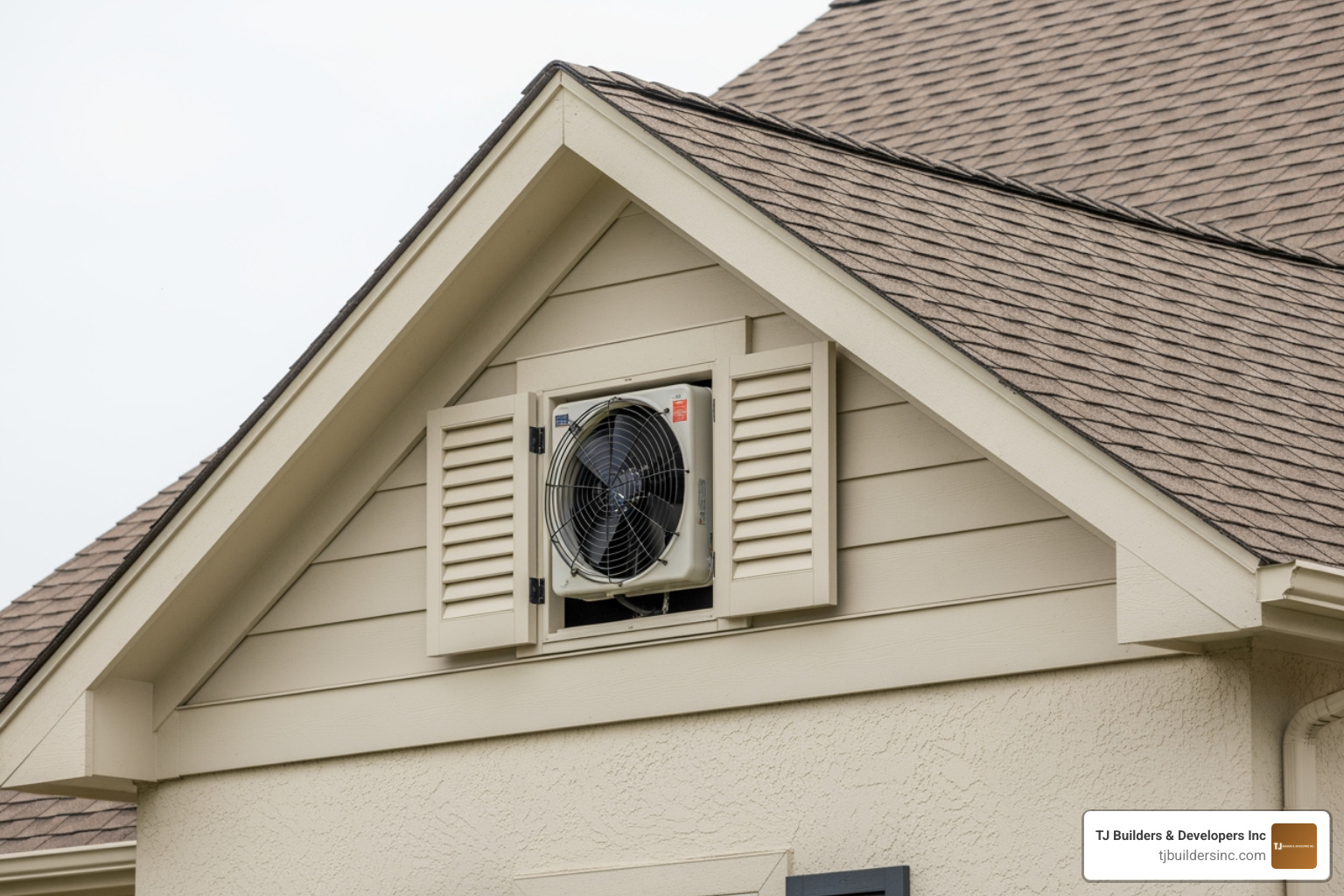
- Gable-Mount Fans: If your home has a vertical side wall (a gable), these fans are installed behind a shutter or louver. They are often easier to install because they don’t require a roof penetration, which reduces the risk of future leaks. Brands like Broan offer gable-mount models that can move over 1,000 CFM (Cubic Feet per Minute), making them powerful enough for large garages or expansive attics.
The Rise of the Solar Power Attic Fan
In recent years, we’ve seen a massive shift toward solar-powered options in the Lakewood and Barrington areas. A solar power attic fan uses a photovoltaic panel to run a brushless DC motor.
The main draw here is the zero-operating cost. Since it runs on the sun, you aren’t adding to your monthly ComEd bill. Advanced models now feature “ClimaSense” technology or similar smart controllers that allow the fan to run for several hours after sunset using stored energy or to monitor both heat and moisture levels. Some even offer Wi-Fi connectivity, allowing you to check your attic temperature from your phone via apps like SolaCom.
Performance Specs and Manufacturer Claims
When you start shopping for a power attic fan, you’ll be hit with a lot of numbers. Understanding what these mean for your specific home in Elk Grove Village or Palatine is crucial for long-term roof health.
CFM Ratings and Coverage Areas
The most important spec is the CFM (Cubic Feet per Minute) rating. This tells you how much air the fan can move. Manufacturer data, such as specs from Maxx Air, typically breaks down like this:
- 1,000 to 1,100 CFM: Good for attics up to 1,600 sq. ft.
- 1,200 to 1,400 CFM: Ideal for attics up to 2,000 sq. ft.
- 1,600 CFM and up: Necessary for large homes or attics up to 2,400 sq. ft. or more.
It is a common mistake to think “bigger is better.” If a fan is too powerful for the amount of intake ventilation (like your soffit vents) available, it will start looking for air elsewhere—often pulling cooled air right out of your bedrooms.
Smart Controls and Weather Resistance
Living in Northern Illinois means our roofs take a beating from snow, ice, and high winds. When selecting a power attic fan, we look for units that meet strict building codes. For example, GAF Master Flow ERV models are tested to pass 110 mph wind-driven rain tests (TAS 100(A)1). This ensures that while the fan is pulling air out, it isn’t letting a summer thunderstorm in.
Many units now include a thermal switch that activates at 85°F and deactivates at 65°F. This prevents the fan from running in the middle of a winter night when you actually want to keep some of that heat in the structure to prevent ice dams.
The Building Science Debate: Is a Powered Fan Right for You?
This is where things get interesting. If you browse forums like Reddit’s r/buildingscience, you’ll find many experts who call powered fans a “solution to the wrong problem.” At TJ Builders & Developers, we believe in looking at the whole “house as a system.”
Risks of Depressurization and Air Leakage
The biggest concern with a power attic fan is depressurization. Imagine your attic is a giant straw. If the fan is sucking air out at 1,500 CFM, but your soffit vents only allow 800 CFM of fresh air in, the fan will create a vacuum.
Where does it get the rest of the air? It pulls it through recessed lights, attic hatches, and plumbing stacks. This means you are literally paying to air condition your home, only for the attic fan to suck that expensive cool air into the attic and blow it outside. Even worse, in homes with gas water heaters or furnaces in the attic, this vacuum can cause “backdrafting,” where dangerous combustion gases are pulled back into the home instead of going up the flue.
Passive Ventilation vs. Powered Systems
In a perfect world, a roof would use passive ventilation. This includes:
- Soffit Vents: Located under the eaves to pull cool air in.
- Ridge Vents: Located at the very peak to let hot air out.
Passive systems are reliable because they have no moving parts and cost nothing to run. However, many older homes in Crystal Lake or Mount Prospect have “cut-up” rooflines or limited eave space where passive airflow just isn’t enough. In these specific cases, a power attic fan can be a helpful tool, provided the home is properly air-sealed first.
| Feature | Passive Ventilation | Powered Attic Fan |
|---|---|---|
| Energy Cost | $0 | $5-$15/month (Electric) / $0 (Solar) |
| Noise | Silent | Humming/Vibration |
| Control | None (Natural) | Thermostat/Humidistat |
| Risk | Low | Depressurization if not balanced |
Calculating Your Attic Ventilation Needs
Before we install anything, we have to do the math. The general rule of thumb is the “1/300 rule”—you need 1 square foot of net free ventilation area for every 300 square feet of attic floor space.
Proper Sizing for Longevity
Using tools like the GAF Vent Calculator helps us ensure your intake and exhaust are balanced. If you have 1,200 square feet of attic, you need roughly 4 square feet of total vent area. We aim for a 50/50 split between intake (soffit) and exhaust (roof).
If we determine a power attic fan is needed, we make sure it doesn’t conflict with existing passive vents. For instance, you should never install a power fan right next to a ridge vent. The fan will simply pull air from the ridge vent (the path of least resistance) and short-circuit the airflow, leaving the rest of the attic hot and stagnant.
Properly balanced ventilation is also a requirement for many manufacturer warranties. For example, GAF’s WindProven Limited Warranty and enhanced coverages often require specific ventilation standards to be met to protect the shingles from “baking” from the underside.
Frequently Asked Questions about Attic Fans
Can a power attic fan void my roof warranty?
Generally, no, as long as it is installed correctly. However, improper ventilation that leads to shingle damage can affect warranty claims. We always ensure our installations comply with Florida Building Codes and local Illinois standards to keep your coverage intact. Using certified contractors who understand systems like the GAF Master Flow is the safest bet.
Do solar attic fans work at night?
Standard solar fans do not work at night because they lack batteries. However, some premium models now feature “run-at-night” technology or ClimaSense controls that can utilize stored energy or household power to continue venting moisture after the sun goes down.
How do I know if my attic is depressurizing?
A simple “smoke test” near your attic hatch or recessed lights can tell you. If the fan is running and you see smoke being sucked up into the ceiling, your fan is pulling air from your house. This is a sign you need more intake vents (soffits) or a less powerful fan.
Conclusion
At TJ Builders & Developers Inc, we know that a power attic fan isn’t a “one-size-fits-all” miracle. In many Lakewood and Crystal Lake homes, the real solution is a combination of better air sealing, increased insulation, and improved passive intake. However, when a roof design limits natural airflow, a high-quality, thermostatically controlled fan can be the difference between a sweltering house and a comfortable one.
Whether you are restoring a home after fire damage or simply looking to protect your investment with a new roofing system, we are here to help you navigate the science of airflow. We pride ourselves on reliable workmanship and eco-friendly solutions that keep your home safe and efficient for decades.
If you’re worried about your attic temperature or noticing signs of moisture, don’t sweat it. Contact us for a professional assessment of your roofing and ventilation needs. We serve the entire Chicago suburban area, from Schaumburg to Barrington, ensuring your roof protects you from the top down.