
Why Installing Gutters Is Critical for Your Home’s Protection
Installing gutters is one of the most important projects you can tackle to protect your home from water damage. Without a properly functioning gutter system, rainwater cascades off your roof and pounds the ground around your foundation, leading to erosion, basement leaks, rotted fascia boards, and damaged siding.
Quick Answer: Here’s What Installing Gutters Involves
- Plan and measure your roofline, determining gutter runs and downspout locations
- Mark the slope (⅛ to ¼ inch per 10 feet) and attach fascia brackets every 18-24 inches
- Cut and prepare gutter sections, outlets, and end caps
- Hang the gutters by securing them to brackets and sealing all connections
- Install downspouts with elbows and straps, directing water away from your foundation
- Expected time: 4-8 hours for most single-story homes
- DIY cost: $200-$500 in materials vs. $8-$15 per linear foot for professional installation
Many homeowners put off gutter projects because, as one expert noted, “they just don’t see the reward of new gutters outweighing the effort required to replace them.” But the reality is stark: water damage restoration averages over $3,600, far more than the cost of a proper gutter system.
The good news? Installing gutters yourself is manageable if you’re comfortable working on a ladder and have basic DIY skills. This guide walks you through every step, from choosing materials to hanging your final section.
Whether you’re replacing damaged gutters or adding a system to a home that never had one, understanding the process helps you either complete the project successfully or know exactly what to expect when hiring a professional.
Preparation: Planning Your Gutter Installation
Before climbing a ladder, a little planning goes a long way. Think of it as the blueprint for your home’s rain protection system. This section walks us through choosing the right materials, gathering our tools, and planning the layout to ensure a successful gutter installation.

Essential Tools and Materials for Installing Gutters
For a successful DIY gutter installation, having the right tools and materials on hand is crucial. This job requires more than a hammer and nails; we need precision and safety equipment. Here’s what we’ll need to gather:
Tools:
- Extension ladder: Essential for reaching your roofline. Make sure it’s sturdy and rated for your weight plus tools. For improved stability and comfort, consider using ladder brackets or a scaffold plank. Always place the ladder on stable ground and keep a safe distance from power lines.
- Cordless drill/driver: Our best friend for pre-drilling holes and driving screws. We’ll need a socket set with hex bits, twist drill bits, and a 4-inch hole saw bit for downspout outlets.
- Cutting tools: A hacksaw or miter saw for gutter sections and aviation snips for finer cuts on metal. A cold chisel and hammer might also be useful for cutting downspout holes.
- Measuring and marking tools: A chalk line for marking our slope, a tape measure for accurate lengths, a level to check our pitch, and a pencil and nail for marking.
- Pop rivet gun: For securely joining gutter sections and attaching end caps.
- Needle nose pliers: Handy for crimping downspout elbows.
Materials:
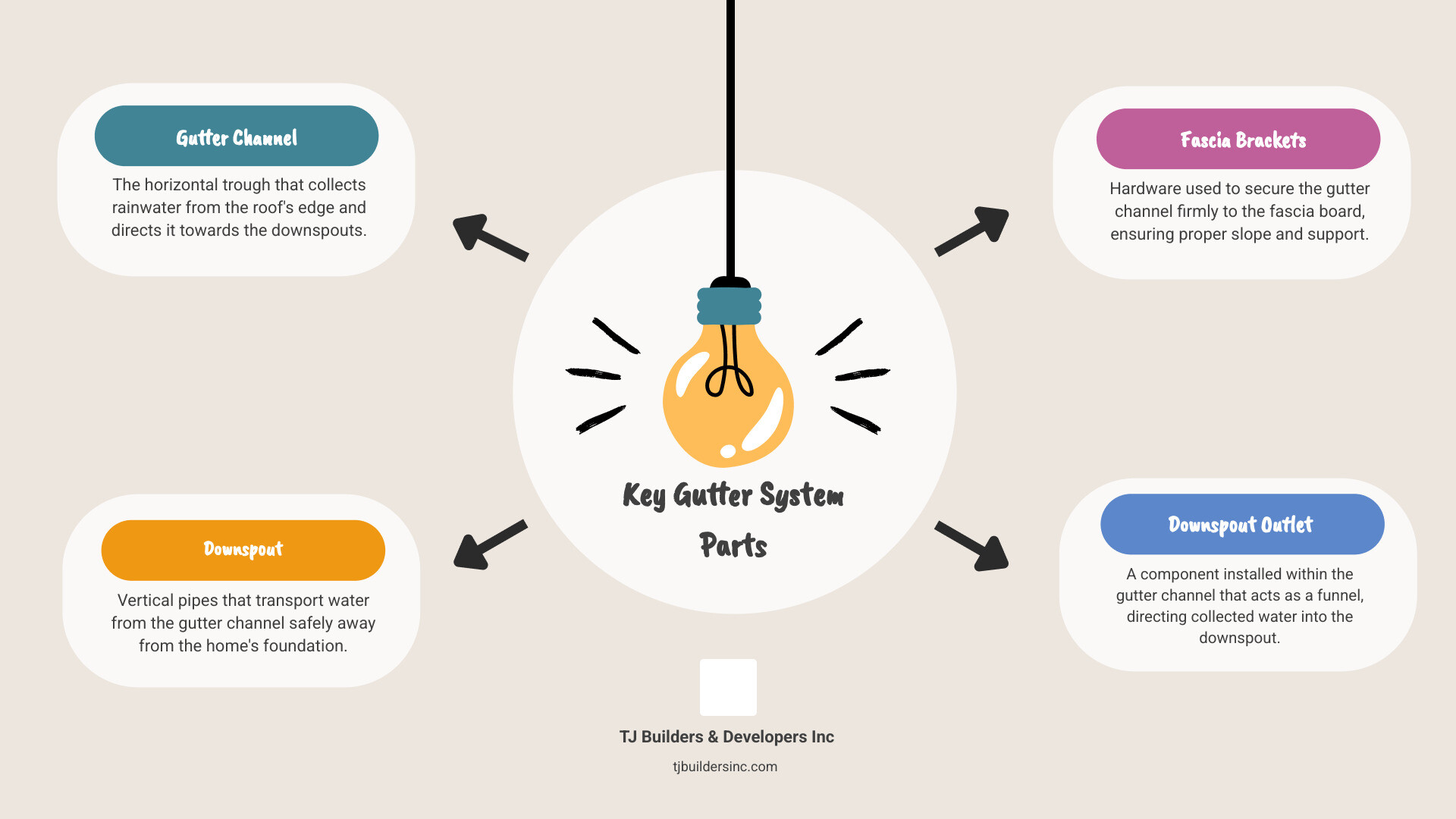
- Gutter sections: These come in various materials and lengths, typically 10 feet. We’ll choose these based on our home’s needs and aesthetic preferences.
- Downspouts: To channel water from the gutters to the ground.
- Fascia brackets/hangers: These support the gutters. Hidden fasteners are generally preferred over older spikes and ferrules.
- Gutter sealant: A high-quality siliconized caulk is essential for making all our connections watertight.
- Fasteners: Self-tapping, stainless steel screws (3/8-inch for joining sections, 1-inch #8-32 for securing to brackets), and pop rivets. Stainless steel is key for rust resistance.
- End caps: To close off the ends of our gutter runs.
- Connectors/Miters: For joining gutter sections or handling corners (inside or outside miters, or strip miters).
- Downspout outlets: To connect the gutter to the downspout.
- Downspout elbows: To direct the downspout around corners and away from the house.
- Downspout brackets/straps: To secure the downspout to the side of the house.
- Safety gear: Always wear safety glasses, work gloves, and heavy shoes with good traction. It’s always safer and easier with a partner.
Choosing Your Gutter Type and Material
Selecting the right type and material for your gutters is more than just an aesthetic choice; it impacts cost, durability, and even the ease of gutter installation. Here’s a quick rundown to help us decide:
| Material | Cost (per linear foot) | Durability | Installation Difficulty | Pros | Cons |
|---|---|---|---|---|---|
| Vinyl | $3-$7 | Moderate (prone to cracking in extreme temperatures) | Easy | Affordable, lightweight, DIY-friendly, pre-finished. | Less durable, fades over time, can sag or crack in harsh weather. |
| Aluminum | $3-$7 | Good | Moderate | Lightweight, rust-proof, wide range of colors, can be seamless (professionally installed), good value. | Can dent easily, may require more frequent cleaning than steel or copper. |
| Steel | $9-$20 | Excellent | Difficult | Very strong, durable, resistant to dents and high winds. | Heavy, can rust if coating is compromised, more expensive, more difficult to install DIY. |
| Copper | $15-$30 | Excellent | Difficult (specialized) | Extremely durable, beautiful patina develops over time, rust-proof, high-end aesthetic. | Very expensive, specialized installation often required, can be stolen for scrap value. |
Note: Costs are approximate and can vary based on supplier and market conditions.
Most homes in the Chicago suburbs, including Lakewood, Crystal Lake, and Schaumburg, use aluminum K-style gutters for their balance of cost, durability, and maintenance. K-style gutters mimic crown molding for a traditional look, while half-round gutters are popular for historical homes.
Gutter Sizing: Standard residential gutters are 5-inch or 6-inch widths. For most homes, a 5-inch gutter is sufficient. However, if your roof has a large surface area or you live in an area with heavy rainfall, a 6-inch gutter might be necessary to handle the increased water volume and prevent overflow.
How to Measure and Plan Your Gutter Layout
Accurate measurement and a well-thought-out plan are the cornerstones of successful gutter installation. Let’s get to work!
- Measuring Roof Fascia: We’ll need to measure the linear feet of every roof edge where we plan to install gutters. This gives us the total length of gutter sections needed. It’s a good idea to purchase extra material to account for miscuts or future repairs.
- Downspout Placement Strategy: Downspouts are critical for directing water away from our foundation. A good rule of thumb is to place a downspout at each corner. For longer rooflines, we’ll need additional downspouts—typically one for every 30 to 40 feet of gutter run to prevent overflows. If a roofline is longer than 40 feet, it’s best to pitch the gutter down from the middle to a downspout at each end, or from each end toward a central downspout. We’ll also consider where the water will drain, aiming for areas away from the house.
- Calculating Gutter Slope: This is a critical step for proper drainage. Gutters should never be installed perfectly level. We need a minimum slope of ⅛ inch per foot towards the downspout. A general recommendation is about ¼ to ½ inch for every 10 feet of gutter run. This tilt ensures water flows efficiently. Be careful not to create too much slope, as this can cause water to flow too rapidly and splash out during heavy rain.
- Planning for Corners: If our roofline has inside or outside corners, we’ll need special miter pieces (either pre-formed or we can create strip miters). We’ll account for these in our material list.
- Fascia Board Inspection: Before we install anything, inspect the fascia boards (the long boards along the edge of your roof). If they’re soft, spongy, or show signs of rot, they must be repaired or replaced. Small damaged areas can be patched with wood filler, but larger sections may require replacing with treated lumber for durability. Neglecting this step can compromise the entire gutter system. If you find significant rot, it might be time to review your overall roof repair needs.
Your Step-by-Step Guide to Installing Gutters
Alright, our planning is done, our tools are ready, and our materials are neatly stacked. It’s time to get down to the exciting part: the physical gutter installation! Safety first, and a helper makes this job significantly easier and safer.
Step 1: Mark the Slope and Attach Fascia Brackets
This step sets the foundation for our entire gutter system, ensuring proper water flow.
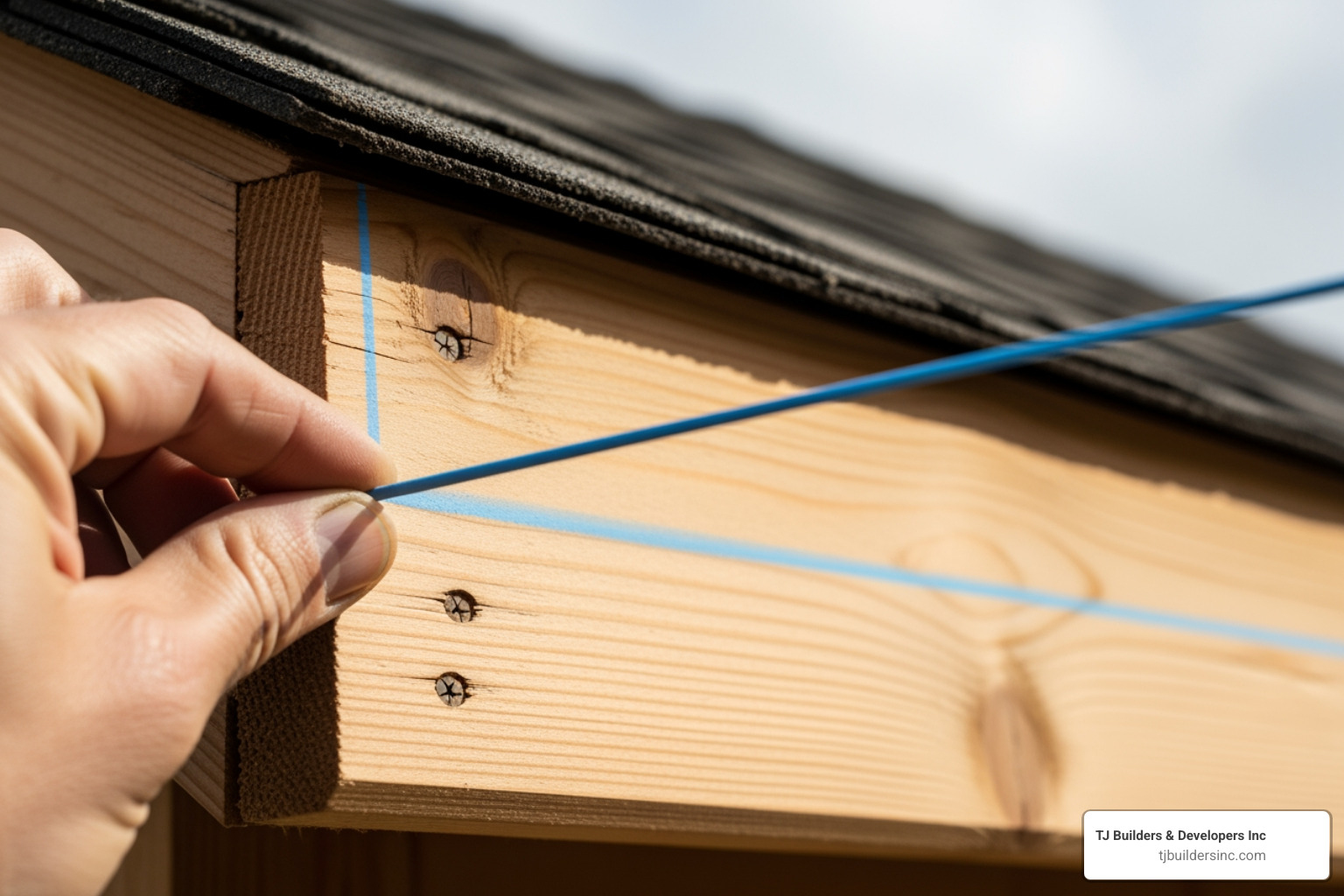
- Determine Your High Point: Starting at the end of a gutter run furthest from your chosen downspout location, mark a point on the fascia board. This will be our “high point.” This point should be just below the roof’s drip edge (if present) so that water flows directly into the gutter.
- Mark Your Low Point: Measure the length of your gutter run to the downspout. For every 10 feet, measure down ¼ to ½ inch from your high point mark. For example, if your run is 20 feet, measure down ½ to 1 inch. Mark this as your “low point” near the downspout location.
- Snap a Chalk Line: Drive a small nail into your high point mark. Attach one end of your chalk line to this nail. Extend the chalk line to your low point mark, pull it taut, and snap it against the fascia board. This line is our guide for the top edge of the gutter, ensuring the correct slope.
- Find Rafter Tails: Fascia brackets need to be securely fastened into the rafter tails behind the fascia board, not just the fascia itself. Rafter tails are typically spaced 16 inches on center and are often visible by the nail heads in the fascia. Use a stud finder or gently tap along the fascia to locate these solid points.
- Attach Fascia Brackets: We’ll space our fascia brackets every 18-24 inches, or ideally, every 2 feet. If rafter tails are 16 inches apart, we can attach brackets to every other rafter tail, making them roughly 32 inches apart. This provides excellent support, especially important in areas like the Chicago suburbs that experience snow and ice. Pre-drill a ⅛-inch pilot hole into the rafter tail through your chalk line. Then, fasten the brackets using 1/4-inch stainless steel lag screws, ensuring they penetrate the rafter by at least 2 inches. A little soap on the screw threads can make driving them easier—it’s like magic!
Step 2: Cut Gutters, Outlets, and Attach End Caps
Now that our brackets are in place, it’s time to prepare the gutter sections themselves.
- Measure and Cut Gutter Sections: Using our tape measure, we’ll determine the exact length needed for each gutter section. Remember to account for any overlaps if we’re joining sections, or for miter cuts at corners. Use a hacksaw or tin snips for vinyl and aluminum. For cleaner cuts, especially on aluminum, a miter saw with a fine-tooth blade can be used, though it’s optional.
- Cut Downspout Outlets: On the gutter section where a downspout will be located, we need to cut a hole for the downspout outlet. Place the downspout outlet on the inside bottom of the gutter section at the desired location (our low point). Trace around the opening with a marker. Then, use a 4-inch hole saw bit on our drill/driver to cut the circular opening. Alternatively, a hammer and cold chisel can be used, but the hole saw provides a much cleaner cut. Ensure the outlet is positioned correctly for water flow.
- Attach End Caps: For the ends of our gutter runs, we’ll attach end caps. It’s easiest to do this on the ground. Apply a generous bead of gutter sealant along the inside edge of the end cap and fit it onto the gutter end. Drill a few ⅛-inch pilot holes and secure the end cap with pop rivets. Wipe away any excess sealant for a clean finish.
Step 3: Hang Gutter Sections and Handle Corners
This is where our gutter system starts to take shape!
- Working with a Partner: Long gutter sections can be unwieldy and dangerous to manage alone. We highly recommend recruiting a friend or family member to help us. Two people can safely lift and position the gutter sections.
- Mount Gutters to Brackets: Carefully lift the first gutter section into place, resting it on the fascia brackets. Ensure the top edge of the gutter aligns with our chalk line. Lay the gutter into the brackets, slipping the rear edge into the hooks at the top of each bracket. Once positioned, drill ⅛-inch pilot holes through the gutter and into the bracket’s mounting holes. Secure the gutter to the brackets using 1-inch long #8-32 stainless steel machine screws and flanged nuts.
- Connect Gutter Sections: If our gutter run is longer than a single section, we’ll need to join them. Overlap the sections by about 8 inches, ensuring the top edge of the overlapping section points in the direction of water flow (downhill). Apply a bead of gutter sealant between the overlapping sections. Drill two rows of four ⅛-inch pilot holes and secure with 3/8-inch-long, self-tapping stainless steel screws or pop rivets along the sides of the overlap (never through the bottom, as this can create weak points for leaks). Seal the rivet heads and seams with more gutter sealant.
- Install Miter Joints for Corners: For corners, we’ll use either pre-formed miter sections or create strip miters. A strip miter is a 3-inch wide aluminum strip that covers the joint. Apply sealant to both gutter ends, fit the miter in place, and secure it with pop rivets (typically eight rivets for a strip miter). Generously apply gutter sealant to all internal seams for a watertight connection.
Step 4: Assemble and Install the Downspouts
The final touch for directing that rainwater away from our home.
- Connect Elbows: We’ll typically need three elbows to create the “S-bend” that connects the downspout outlet in the gutter to the main downspout section running down the wall. The first elbow attaches to the downspout outlet, pointing out from the house. The second elbow connects to the first, turning downwards. The third elbow connects to the second, turning back towards the wall. We might need to slightly crimp the ends of the elbows with needle-nose pliers to get them to fit snugly.
- Assemble Downspout Sections: Measure the distance from the third elbow to about one foot above the ground. Cut our downspout sections to fit this length. Connect the sections, ensuring they overlap in the direction of water flow. Secure each connection with a few self-tapping stainless steel screws or pop rivets.
- Secure Downspouts to the Wall: Hold the assembled downspout against the wall, making sure it’s plumb (straight up and down). Attach downspout brackets or straps to the wall, securing the downspout. We typically use two brackets for a one-story house and three for a two-story house, spaced roughly every 5 feet.
- Direct Water Away from Foundation: The downspout pipe should end about a foot above the ground. To ensure water is carried even further away from our foundation, we’ll attach a downspout extension or place a splash block directly underneath. This prevents erosion and protects our home’s structural integrity.
DIY vs. Professional Installation: When to Call for Help
We’ve just walked through the entire process of installing gutters ourselves, and it’s certainly a rewarding project for many DIY enthusiasts. However, there are times when calling in the pros is not just advisable, but essential.
Key Considerations Before Installing Gutters
Before we commit to tackling this project ourselves, let’s consider a few critical factors:
- Project Complexity: While installing gutters is rated as an intermediate DIY skill, it does require precision and attention to detail. If you’re comfortable with basic home repairs and working with tools, you might find it manageable.
- Working at Heights: This is perhaps the biggest safety consideration. We’ll be spending a lot of time on a ladder. If you’re not comfortable with heights, or if your home is particularly tall, this could be a significant risk.
- Two-Story Homes: For installations on a two-story home or higher, the risks associated with ladder work increase significantly. We strongly recommend going with a professional for these taller installations.
- Time Commitment: A DIY gutter installation can take anywhere from 4 to 8 hours, depending on your roof size and project complexity. Do you have a full day (or more) to dedicate to this?
- Required Tools: While we’ve outlined the necessary tools, purchasing them all can be a significant investment if you don’t already own them.
- Potential for Incorrect Installation: An improperly installed gutter system can lead to serious problems down the line, including leaks, overflowing, and costly water damage.
- Water Damage Risks: As we mentioned earlier, water damage restoration can be very expensive. A small mistake during installation could lead to much larger problems.
Cost and Expertise: DIY vs. Pro
Let’s talk numbers and know-how.
- DIY Material Costs: For a typical DIY gutter installation, we can expect to spend around $200-$500 on materials. This includes the gutter sections, downspouts, brackets, sealants, and fasteners.
- Professional Installation Cost: Professional gutter installation typically costs between $8-$15 per linear foot. While this might seem higher upfront, it includes labor, specialized equipment, and often, a warranty on the work.
- Seamless Gutters: If you’re considering seamless gutters, professional installation is virtually mandatory. Seamless gutters are fabricated on-site using specialized machinery that creates continuous lengths, minimizing leaks and providing a cleaner aesthetic. This is not a DIY project.
- Expertise and Efficiency: Professionals have the experience, specialized tools, and often a crew, allowing them to complete the job much faster and more efficiently than a DIYer. They also understand the nuances of proper slope, drainage, and local building codes. Sometimes, the overall value and peace of mind from professional installation can outweigh the perceived savings of DIY.
While DIY gutter installation can be a rewarding project, especially for single-story homes, we often find that the precision, efficiency, and safety offered by experienced professionals are invaluable. If you’re in Lakewood, Crystal Lake, Schaumburg, or anywhere in the Chicago suburbs, and you’re unsure about tackling this project, don’t hesitate to reach out. You can learn more about professional standards and find resources through organizations like the Rain Gutter Association. For a comprehensive solution, explore our services at TJ Builders & Developers Inc.
Frequently Asked Questions about Gutter Installation
We get a lot of questions about installing gutters, and for good reason! It’s a critical home improvement project. Here are some of the most common inquiries we hear:
How much slope do gutters need?
Gutters absolutely need a slope to function correctly. They should not be installed perfectly level. We recommend a minimum slope of ⅛ inch per foot, or about ¼ to ½ inch for every 10 feet of run, towards the downspout. This slight decline ensures that rainwater flows efficiently and doesn’t sit stagnant in the gutters.
For very long gutter runs, say longer than 40 feet, it’s often best to pitch the gutter down from the middle to a downspout at each end, or from each end towards a single downspout in the middle. This helps manage the volume of water over a greater distance. Be careful not to create too much slope, as this can cause water to rush too quickly and potentially overshoot the gutter during heavy rainfall, leading to splashing and ineffective drainage.
What happens if gutters are not installed correctly?
If gutters are not installed correctly, it can lead to a cascade of problems for your home. The primary issue is overflowing water. When gutters don’t drain properly, water can:
- Erode your foundation: Constant water runoff near the base of your home can wash away soil, leading to structural instability and costly foundation repairs.
- Cause basement or crawlspace flooding: Water that pools around your foundation can seep into your basement or crawlspace, causing water damage, mold growth, and expensive remediation.
- Rot fascia boards and damage siding: Water overflowing from the gutters can constantly drench your fascia boards and siding, leading to wood rot, paint damage, and a compromised exterior envelope.
- Wash out landscaping: Your beautiful flowerbeds and shrubs can be damaged or washed away by uncontrolled torrents of rainwater.
- Create muddy messes: Splattering dirt on your siding and around your home is not only unsightly but can also contribute to exterior deterioration.
- Lead to ice dams: In colder climates like Illinois, improperly draining gutters can trap water that freezes and expands, leading to ice dams that force meltwater under your roof shingles, causing leaks and structural damage.
The average cost of water damage restoration is over $3,600, making proper gutter installation a crucial preventative measure.
Should I install gutter guards?
We highly recommend considering gutter guards, especially if your property in Lakewood, Crystal Lake, or Schaumburg has a lot of trees. Gutter guards are designed to prevent leaves, twigs, and other debris from entering and clogging your gutters.
Here’s why they’re a great idea:
- Reduced Maintenance: The most obvious benefit is less frequent gutter cleaning. While not entirely maintenance-free, guards significantly cut down on the amount of debris that accumulates, saving you time and effort. Some homeowners report only needing to clean their gutters every five years with guards in place!
- Ensured Proper Water Flow: By preventing clogs, gutter guards ensure that water always flows freely to the downspouts and away from your home, protecting against all the water damage issues mentioned above.
- Prevention of Water Damage and Ice Dams: Unclogged gutters mean less standing water, which reduces the risk of water overflowing and damaging your fascia, siding, and foundation. In winter, they help prevent the formation of ice dams by allowing water to drain away before it can freeze and back up under your roof.
While they add to the initial cost of gutter installation, the long-term benefits in terms of reduced maintenance and home protection often make gutter guards a worthwhile investment.
Protect Your Home with a Perfect Gutter System
Installing gutters might seem like a daunting task, but as we’ve explored, with careful planning, the right tools, and a methodical approach, it’s a project many homeowners can tackle. Whether you’re upgrading old, leaky gutters or adding a system to a new build, proper gutter installation is a crucial investment in protecting your home’s foundation, roof, and siding from the relentless forces of water.
We hope this guide empowers you to approach your gutter installation with confidence. Remember the importance of correct slope, secure fastening, and watertight seals for a system that truly lasts.
For complex jobs, multi-story homes, or if you simply prefer the peace of mind that comes with guaranteed professional results, don’t hesitate to reach out to the experts. At TJ Builders & Developers Inc, we specialize in roofing and exterior home services, including gutter installation and replacement. We’re proud to serve homeowners in Lakewood, Crystal Lake, Schaumburg, and throughout the Chicago suburbs of Illinois, offering reliable workmanship and competitive pricing.
Learn more about our Gutter Installation & Replacement services and let us help you achieve a drip-free, protected home.